ELD vs Paper Logs: What Changed After the Mandate
The ELD mandate did not change the single-hour service rule. Every limit that existed on December 15, 2019, still exists today unchanged. The 11-hour driving limit, the 14-hour window, the 30-minute break, and the 70-hour weekly cap are identical to what was required under paper logs.
What changed was enforcement precision, falsification difficulty, the form that violations take, and the time a roadside inspection consumes. For drivers who always ran their paper logs honestly, the practical change was smaller than most accounts suggest. For drivers who had routinely managed their paper records beyond legal limits, the change was significant.
What the Mandate Changed and What It Did Not

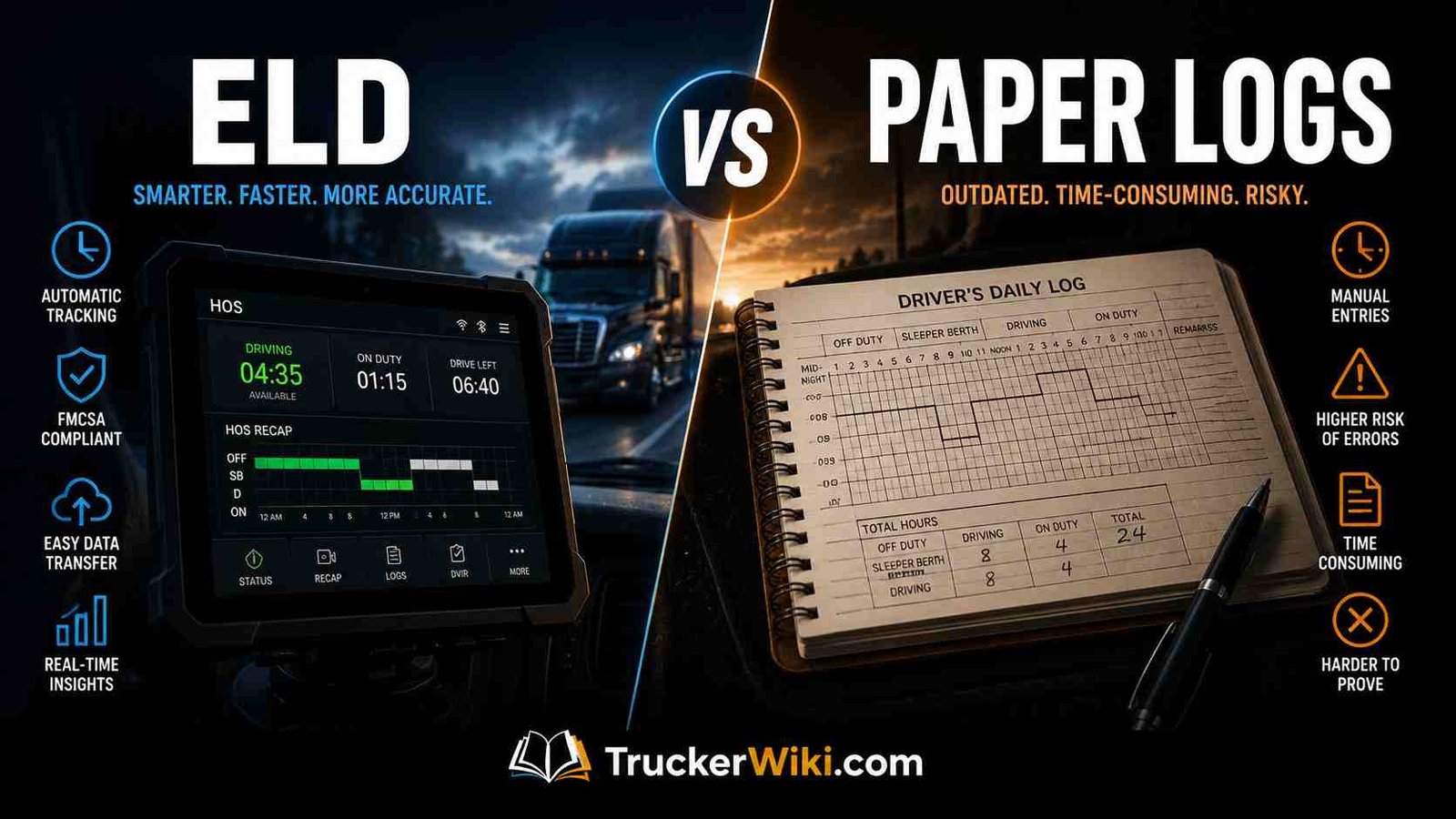
The ELD mandate changed the recording mechanism. Paper logs required a driver to manually draw status lines across a grid, write in mileage and location, sign the log, and carry it for 8 days. Every one of those entries depended on the driver’s memory, honesty, and manual accuracy.
The ELD connects to the vehicle’s engine control module and captures driving time, vehicle motion, engine hours, and location automatically. The driver still inputs non-driving status changes (off-duty, on-duty not driving, sleeper berth), but the driving record is generated by the vehicle, not by the driver’s pencil.
The direct consequence of automatic recording is a substantial reduction in unintentional error. FMCSA studies conducted before the mandate found that paper logs had an estimated error rate exceeding 30%. Not all of those errors were deliberate falsifications. Many were honest mistakes: rounding drive times to the nearest quarter hour, misremembering when a break started, forgetting to log a fuel stop.
Even drivers running compliant schedules produced records that could trigger form-and-manner violations at inspection simply because of imprecise manual entry. The ELD eliminates most of those errors because the vehicle records driving time to the minute, not to the driver’s nearest recollection.
The FMCSA’s Regulatory Impact Analysis for the ELD final rule projected 26 lives saved per year and 562 fewer injuries per year as a direct result of more accurate HOS compliance. Those projections were based on the assumption that a meaningful share of paper-log-era driving time above HOS limits was undetected. ELD automatic recording, by making every minute of driving visible and timestamped, was designed to close that detection gap.
The mandate also changed inspection speed. A paper log inspection required the officer to manually review grid lines, cross-reference trip documents, and calculate elapsed time with a pencil and ruler. That process typically took 15 to 30 minutes per driver. An ELD data transfer takes 2 to 5 minutes, with the officer’s inspection software automatically flagging limit violations rather than requiring manual calculation.
For drivers with clean records, this means shorter stops and faster release. For a driver with a 14-hour violation from 3 days ago, who hoped the paper volume would make it difficult to find, it means faster detection.
The net effect on total inspection time across the industry is substantial. According to the FMCSA’s pre-mandate analysis, the ELD mandate was projected to save approximately 53 minutes per inspection by reducing the time officers spent manually reviewing paper records. Multiplied across millions of annual roadside inspections, that administrative time savings has a measurable impact on both enforcement capacity and driver productivity.
What the mandate did not change: every underlying HOS limit, the 34-hour restart mechanics, the exemption structure, and the definition of on-duty time. Drivers who expected ELDs to simplify the rules themselves were disappointed. The rules are equally complex. The recording is just automated.
What Drivers Lost When Paper Logs Were Replaced
Honest drivers who ran compliant paper logs lost something real when the mandate took effect, even if compliance itself was straightforward: they lost the operational flexibility that came from manual entry’s inherent looseness.
Under paper logs, a driver who ran 11 hours and 10 minutes of driving could write “11:00” on the log without creating a flagged violation, because the manual system had no mechanism to verify the exact minute. A driver who experienced an unexpected shipper delay could absorb that delay into the log in ways that preserved the appearance of compliance even when the actual timing was tight. Not falsification in the deliberate sense, but an informal tolerance margin that the manual system made possible.
ELDs eliminate that margin. Every minute of vehicle movement above 5 mph is recorded as driving. A driver who logged 11 hours and 10 minutes of driving on an ELD has exactly that in the record, and the system flags it. There is no rounding. There is no retroactive adjustment.
The inflexibility affects legitimate unexpected delays as much as it affects deliberate excess. A driver who is stuck at a shipper for 3 hours due to a dock backup that was not the driver’s fault has those 3 hours in the 14-hour window the same as any other on-duty time. The only legal relief available is the adverse driving conditions exemption, which covers weather and road conditions, not shipper delays.
This inflexibility created real operational pressure on carriers who had built their freight schedules around paper log flexibility. Lanes with high shipper-side dwell time became harder to run profitably under strict ELD enforcement because the time buffer that informal paper log management had provided disappeared.
Some carriers responded by renegotiating detention pay terms with shippers. Others restructured their driver schedules to build mandatory buffer time into every delivery window. Both responses added costs that had not existed under the paper log era.
Dual logbooks, which were common in the pre-mandate era and constituted deliberate falsification, also disappeared. A driver who kept a “show log” for inspections and a “real log” for actual hours no longer has that option. The ELD’s connection to the engine data produces a single record that cannot be overridden without generating a visible data trail. Drivers who had been using dual logs effectively lost operating capacity that was never legally available to them, but that they had been routinely using.
How Violations Changed Form After the Mandate

The ELD mandate did not reduce the total volume of HOS violations found at inspection. In some categories, it increased detection by making violations easier to find. What it changed was which violations dominate.
Under paper logs, form-and-manner violations were among the most common citations. These included missing log entries, illegible handwriting, incorrect grid placement, missing signatures, absent shipment numbers, and improperly calculated totals. Officers reviewing paper logs found procedural errors routinely, even on records with no actual HOS limit violations. The compliance burden was partly about the rules and partly about paperwork execution.
After the mandate, form-and-manner violations shifted in character. The old paper concerns (handwriting, line placement, grid accuracy) have disappeared. New digital completeness concerns took their place.
Common ELD-era form-and-manner citations include: ELD records missing the required mileage figures, missing location data at duty status changes (which the ELD should capture automatically but occasionally fails to log if the GPS signal is lost), and missing annotations.
The annotation requirement is the most frequently underestimated source of ELD form violations. A driver who invokes the adverse driving conditions exemption must annotate the ELD with the specific condition encountered. A driver who uses personal conveyance should annotate why the movement qualifies. A driver who makes an edit to a logged status must add a reason. Missing annotations are the new handwriting violations: a record that is substantively correct but formally incomplete.
This shift requires carriers to update how they review driver logs. A paper log review looked for legibility, grid accuracy, and missing entries. An ELD log review looks for annotation completeness, unassigned driving time, unanswered edit suggestions, and the presence of supporting documents that corroborate the ELD data. Carriers who adapted their internal review processes to match ELD-era compliance patterns see fewer violations. Carriers who applied their paper log review checklist to ELD records without updating it missed the new failure modes entirely.
Unassigned driving time is an ELD-era violation category that did not exist under paper logs. When a vehicle moves without a logged driver, the ELD records the miles as unassigned. Carriers must assign those miles within 13 days. Unassigned driving appearing in a transferred record at a roadside inspection looks identical to a falsification attempt to an officer who does not know the context.
A driver who moved the truck briefly in a yard without logging in, or who drove a segment under the wrong driver account, generates unassigned miles that require carrier review and assignment. Under paper logs, short yard moves simply were not logged at all.
False RODS violations evolved rather than disappeared. Under paper logs, falsification meant drawing false lines on a grid or keeping two logs. Under ELDs, falsification means misusing personal conveyance status to travel to a shipper without logging on-duty time, logging yard moves that were not actually yard moves to avoid driving time, or using the edit function to retroactively change status with inaccurate annotations. The underlying behavior is the same; the mechanism changed.
ELD edit histories are visible to inspectors, which means poorly rationalized edits are more detectable than paper falsification in some respects. A paper log showing a 10-hour off-duty block near a shipper with no corroborating documents was hard to disprove. An ELD edit changing an “on-duty not driving” entry to “off-duty” at a shipper address, made at 11:00 p.m. the night before an inspection, has a timestamp and is marked “edited by driver.”
How Roadside Inspections Changed
The inspection experience changed for both officers and drivers after the mandate, with significant differences depending on which side of the inspection you are on.
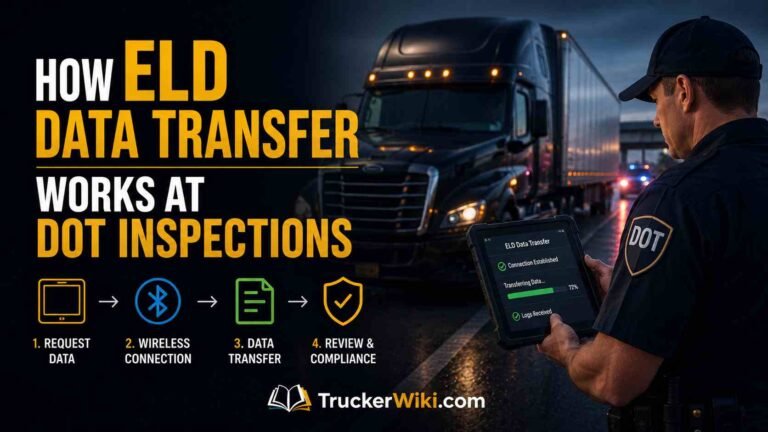
For officers, ELD data transfers made violations faster to detect and document. The officer’s inspection software receives the standardized output file from the ELD, parses the duty status entries automatically, and flags any period where driving time exceeded limits, where the on-duty window expired before driving stopped, or where insufficient off-duty time preceded a driving period.
The officer does not need to count grid lines. The software produces a violation list at the same time it takes the file to transfer. A driver with clean records is cleared faster. A driver with a 14-hour violation from 3 days ago cannot hide it because it is already flagged before the officer finishes reviewing the transfer confirmation.
For drivers, the most meaningful change is 7-day record availability. Under paper logs, a driver was required to carry their log for the current day and the previous 7 days. An officer could request those records at any stop. Under ELDs, the same 7-day record is available electronically from the device, accessible in the same transfer that handles the current-day record. A driver does not need to dig through a paper log stack. The records are always current, always available, and always in the same format the officer expects.
For carriers, the inspection change brought a new category of risk: the carrier’s back-office ELD records are accessible during compliance reviews in ways that paper log archives never were. Under paper logs, a compliance review investigator reviewing months of records had to physically sort through stacked log books.
Under ELDs, an investigator can query an electronic database covering years of records and run automated pattern analysis across an entire driver fleet in the time it previously took to review a single month of paper logs. Systematic violations that paper management had obscured in volume became visible in data analysis.
Carriers with patterns of drivers routinely hitting 11:55 in driving time but never exceeding 12:00, or with recurrent late-night status changes suggesting backdated edits, became detectable through database queries rather than manual inspection alone.
What the Research Shows: Real Effects on Safety and Operations
Academic analysis of the ELD mandate’s actual effects has produced findings that are more nuanced than either the mandate’s proponents or opponents predicted before full enforcement began.
Research published by Balthrop and colleagues, cited in HDT and Trucking Info (March 2022), analyzed FMCSA data across three periods: pre-mandate, light enforcement, and full enforcement.
The compliance finding was clear: HOS compliance improved significantly after the mandate, especially for small carriers and independent owner-operators. The drivers who improved most were those at the smallest companies, where informal log management had been most widespread. Large carriers with established compliance departments showed smaller improvement, because their paper log compliance rates were already higher.
The unintended consequence finding was equally clear. Some carriers whose operations had implicitly depended on flexible log management to serve routes with unpredictable dwell times found those routes economically unworkable under strict enforcement.
This was not a framing for falsification; it was documentation that some operational models were economically viable only because the paper log system’s enforcement limitations allowed them to be. When those limitations disappeared, so did the economic model. Rates on lanes with high shipper-side delay exposure increased after full mandate enforcement, reflecting the real cost of the operational flexibility that paper logs had obscured.
The safety outcome data is less settled. The FMCSA’s pre-mandate projections (26 lives saved annually, 562 fewer injuries) were modeled on compliance improvement assumptions. Whether crashes involving HOS-fatigued drivers declined at the projected rate after December 2019 is complicated by the COVID-19 period (2020-2021), during which traffic volumes and commercial vehicle crash patterns were significantly abnormal.
Research into the post-mandate, post-COVID safety record is ongoing as of 2026. What the data shows clearly is the compliance improvement; what it does not yet cleanly show is whether that compliance improvement translated to the projected safety improvement at the national level.
For a driver considering the practical reality of operating under ELDs in 2026, the central conclusion from six years of mandate enforcement is straightforward. Drivers who were always running legally lost administrative burden and gained inspection speed. Drivers who had been managing their paper records informally lost effective capacity.
The mandate enforces the rules as written, not as they were practically applied under paper. Understanding what the HOS rules actually require, using the legitimate exemptions correctly, operating an ELD that transfers cleanly at inspection, and maintaining complete annotations is the full compliance obligation. The rules themselves have not changed since before the mandate took effect. The clarity with which they are enforced has changed substantially.
By TruckerWiki Editorial Team | Sources: FMCSA ELD Final Rule (December 2015), FMCSA ELD Mandate page, HDT / Trucking Info coverage of Balthrop et al. research (March 2022), ATBS HOS violations analysis (July 2025), O Trucking ELD vs paper logs (February 2026). The HOS rules cited throughout this article are covered in detail in their dedicated TruckerWiki articles linked in the opening paragraph.