Who Needs an ELD? Full Exemptions List 2026
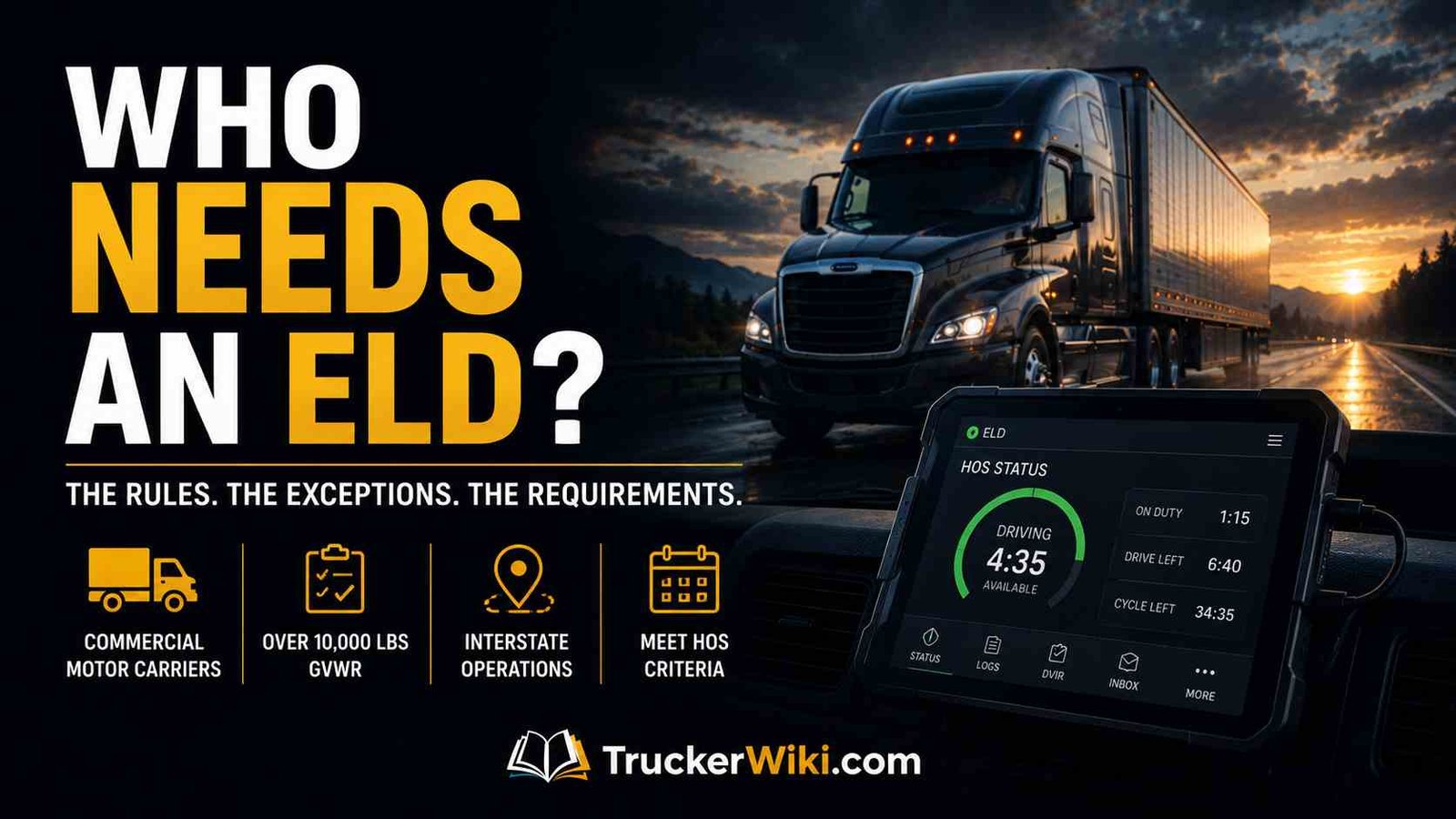
The ELD mandate under 49 CFR 395.8(a)(1) applies to most CMV drivers required to maintain Records of Duty Status in interstate commerce, but the regulation contains four specific vehicle and operation categories where a motor carrier may allow a driver to record duty status on paper logs instead of an ELD.
A fifth category, the short-haul exemption under 49 CFR 395.1(e), removes the RODS requirement entirely on qualifying days, which eliminates the ELD requirement by extension. If there is no RODS obligation, there is no ELD obligation.
This article covers every current ELD exemption with the exact qualifying conditions under each, the common misapplications that generate violations, and what documentation inspectors expect when a driver claims an exemption at the roadside.
The Four Exemptions Written Into 49 CFR 395.8
The four ELD exemptions for paper log use are codified directly in 49 CFR 395.8(a)(1)(A). The regulation states that a motor carrier may allow paper logs instead of an ELD when the driver is operating a CMV under any of these four conditions.
Exemption 1: RODS required on 8 or fewer days in any 30-day period. A driver who is required to complete a record of duty status on no more than 8 days within any 30-day period is not required to use an ELD. On the days when RODS is required, the driver must use paper logs. The exemption applies only to those specific days; it does not exempt the driver from maintaining records.
The 30-day period is rolling, not calendar-month-based. Per FMCSA FAQ on ELD Exceptions and Exemptions, the 30-day period applies to any 30 consecutive days. June 15 through July 14 is a qualifying 30-day window; it does not reset on July 1. A driver who reaches 9 required RODS days within any rolling 30-day window must begin using an ELD immediately for the exceeding days. Carriers that track this count using calendar-month logic rather than rolling logic will undercount and create compliance gaps.
This exemption is commonly misunderstood to mean the driver can use paper logs 8 days per calendar month. That reading is incorrect and will generate violations for carriers operating on or near the 8-day threshold. The count looks backward from today’s date across the previous 30 days, not from the 1st of the current month.
Exemption 2: Driveaway-towaway (vehicle as commodity). A driver in a driveaway-towaway operation where the vehicle being driven is itself part of the shipment being delivered is exempt from the ELD requirement. The clearest example is a driver transporting a new commercial truck from a manufacturer or dealer to the buyer or a terminal, where the driven vehicle is the product being delivered. The vehicle changes with each delivery, making permanent ELD installation impractical, and the ECM connection required by the mandate may not be available in a vehicle not set up for fleet operation.
This exemption does not apply if the vehicle being transported is carrying cargo. If a driveaway driver loads freight into the vehicle being transported and delivers both the vehicle and cargo, the vehicle is no longer operating purely as the shipment commodity, and the exemption is lost.
Exemption 3: Driveaway-towaway (motorhome or RV trailer). A separate but related provision in 395.8(a)(1)(A)(3) covers driveaway operations where the vehicle being transported is a motor home or a recreation vehicle trailer with one or more sets of wheels on the road surface. This applies to drivers who tow or transport RVs from manufacturers or dealers to buyers. The qualifying condition is that the transported vehicle must be a motor home or RV trailer specifically; other vehicle types towed for non-commodity reasons do not qualify under this sub-category.
Most compliance articles treat Exemptions 2 and 3 as a single driveaway exemption. They are listed as separate conditions in the regulatory text, and the distinction matters because Exemption 3 extends coverage to saddle-mount and tow-bar configurations specifically involving motor homes and RV trailers, which may not meet the “vehicle as commodity” definition of Exemption 2 in all factual situations.
Exemption 4: Vehicle manufactured before model year 2000. A CMV manufactured before model year 2000, as reflected in the vehicle identification number shown on the vehicle’s registration, is exempt from the ELD mandate. Vehicles with engines predating model year 2000 are also accepted, even if the VIN-based registration indicates a later model year, per FMCSA FAQ guidance. This covers scenarios where an older engine was installed in a newer chassis, such as a glider kit build.
Two nuances from the FMCSA FAQ apply here. First, if a carrier claims the engine-based pre-2000 exemption (rather than the VIN-based registration exemption), 49 CFR Part 379 Appendix A requires the carrier to maintain all documentation of motor and engine changes at the principal place of business.
Drivers are not required to carry that documentation in the cab, but the carrier must be able to produce it during a compliance review. Second, a model year 2000 or newer vehicle without an ECM is still subject to the ELD mandate under 395.8(a)(1)(iii). If the engine cannot support ECM connectivity, the carrier must deploy an ELD that does not rely on ECM data but that nonetheless meets the accuracy requirements in Appendix A Sections 4.2 and 4.3.1 of Part 395 Subpart B.
The Short-Haul Exemption: No RODS, No ELD
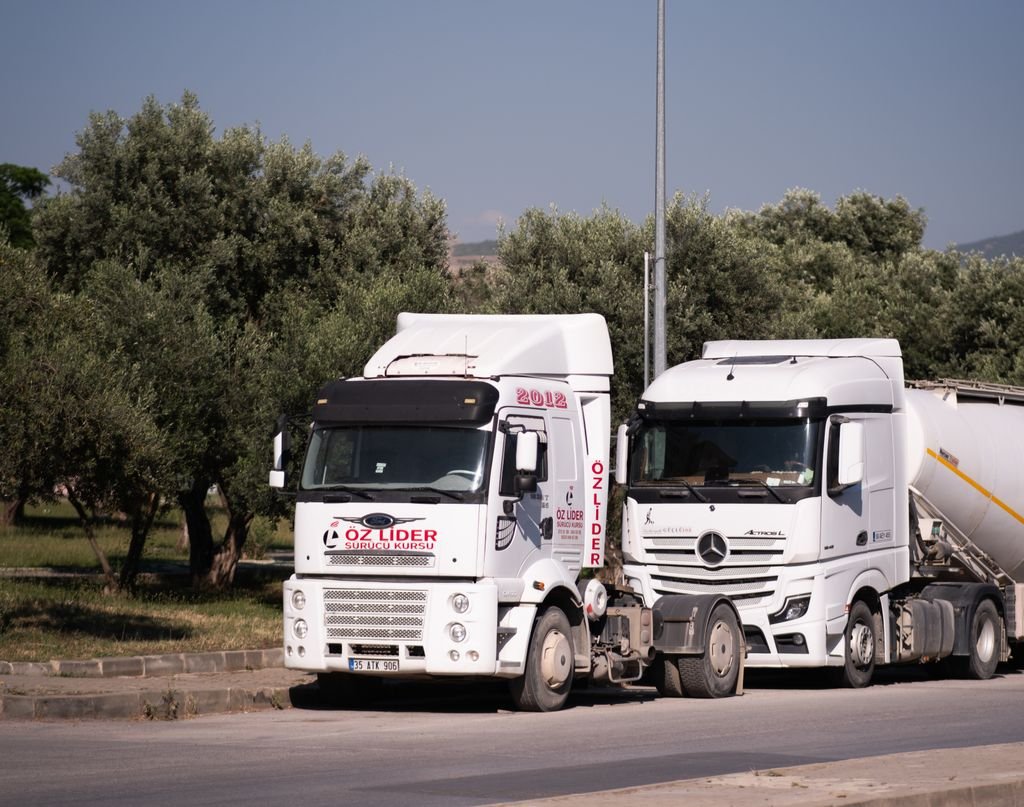
The short-haul exemption under 49 CFR 395.1(e) works differently from the four 395.8 exemptions. It does not allow paper logs instead of an ELD. It eliminates the RODS obligation entirely on qualifying days. Because the ELD mandate only applies to drivers who must keep RODS, a driver who does not need RODS does not need an ELD on those same days.
Under 395.1(e)(1), a driver who operates within 150 air miles of their normal work reporting location, returns to that location, and is released from duty within 14 consecutive hours of coming on duty does not need to maintain RODS and therefore does not need an ELD. The carrier must instead maintain time records showing start time, end time, and total on-duty hours, retained for 6 months. Full qualifying conditions are covered in the Short-Haul Exemption article.
When a short-haul driver exceeds the qualifying conditions on a given day, that day requires full RODS. If those exceeding days add up to 9 or more within any rolling 30-day period, the 8-in-30 exemption no longer applies, and the driver must use an ELD on the exceeding days. The 8-in-30 rule in 395.8(a)(1)(A)(1) acts as a bridge for short-haul operations that occasionally breach short-haul conditions: it allows paper logs for those days rather than requiring ELD deployment the moment the first exception day occurs.
The sequence matters. First, check whether the driver qualifies for short-haul on a given day. If yes, no RODS and no ELD. If no, check whether the total RODS days in the rolling 30-day window are 8 or fewer. If yes, paper logs suffice. If the driver is on RODS for 9 or more hours within the 30-day window, an ELD is required from that point.
The practical management challenge is tracking the rolling count accurately at the carrier level. A driver who occasionally exceeds short-haul conditions may not be aware of their own 30-day RODS tally if the carrier is not actively monitoring it.
Dispatch systems that are unaware of the rolling window treat each day independently, missing the cumulative picture. Carriers operating short-haul fleets should build a mechanism to track exceeding days per driver against the rolling 30-day window, not just flag individual days when short-haul conditions are broken.
The first 8 exceeding days in 30 days require paper logs and are manageable. Day 9 requires an ELD, and if the vehicle is not ELD-equipped, the carrier is in violation.
Agricultural Operations: Full HOS Exemption
Drivers transporting agricultural commodities during state-designated planting and harvesting seasons, while operating within 150 air miles of the source of those commodities, qualify for a full exemption from all HOS requirements under 49 CFR 395.1(k).
Because the entire HOS framework is suspended during the exempt operation, the ELD mandate is also suspended. There is no RODS obligation, no daily driving limit, no weekly cap, and no ELD requirement while the driver is within the 150-air-mile radius and operating during the applicable state season.
The agricultural exemption is broader than it is commonly understood to be. It covers:
- Transport of agricultural commodities (livestock, bees, horses, fish used as food, and other defined agricultural commodities) from the production location.
- Delivery of farm supplies to agricultural operations from a wholesale or retail distribution point, during planting and harvesting periods
- Livestock haulers operating between a point within 150 air miles of a sales barn and a delivery destination under the 2021 extension in 395.1(k)(4)
The exemption ends the moment the driver moves outside the 150-air-mile radius from the commodity source. At that point, full HOS rules, including the ELD mandate, apply for the remainder of the trip. Carriers that operate drivers in mixed exempt/non-exempt segments on the same day must ensure their ELD or paper log system correctly captures the point at which the exemption ended and full HOS compliance resumed.
The agricultural commodity exemption is not the same as the CDL agricultural exemption under 49 CFR 383.3(d)(1), which exempts certain agricultural equipment operators from CDL requirements. These are separate provisions with different qualifying conditions. A driver can qualify for one without qualifying for the other.
What Personal Conveyance and Yard Moves Are Not
Two operating modes that drivers and carriers frequently misidentify as ELD exemptions are personal conveyance and yard moves. Neither eliminates the ELD requirement.
Owner-operators are not automatically exempt. An owner-operator who drives a CMV with a GVWR over 10,001 pounds in interstate commerce and is required to keep RODS must use a registered ELD, exactly as a company driver would. The owner-operator status has no bearing on ELD compliance. Owner-operators who believe self-employment creates an exemption are operating on an incorrect assumption. The mandate applies to the operation, not the employment arrangement.
Intrastate operations are not automatically ELD-exempt. Federal ELD requirements apply to interstate commerce. However, several states have adopted their own intrastate ELD requirements that mirror the federal mandate, including California. A driver operating entirely within a single state should verify their state’s intrastate HOS and ELD requirements before assuming federal exemptions cover their operation. California’s intrastate ELD requirement, for example, applies to most intrastate CMV operations using the same exemption structure as the federal rule.
Personal conveyance (PC) is a duty status, not an exemption from the ELD mandate. When a driver uses the vehicle for travel that serves no motor carrier operational purpose, they may log that time as off-duty using the personal conveyance designation on the ELD.
The ELD remains required and records all vehicle movement, including PC movement, automatically. Logging personal conveyance means the time does not count toward HOS limits, but the device must still be in the vehicle and operational. A driver who removes the ELD to claim personal conveyance time is not exempt from the mandate; they are operating without a required ELD.
Yard moves are similarly a duty status option on a compliant ELD, not an exemption from using one. A driver moving a CMV within a yard or facility at walking speeds may log that movement as on-duty, not driving, using the yard move status. The ELD records the movement. The yard move status affects how that time is categorized for HOS calculation purposes, not whether the device is required.
Both personal conveyance and yard moves require an operational ELD to use correctly. A driver who is otherwise ELD-required and attempts to use either status to circumvent the mandate will find that the absence of ELD records for those periods, when compared against any GPS, fuel, or toll records, creates a stronger falsification exposure than a straightforward HOS violation.
What Proof Inspectors Expect When You Claim an Exemption
Every ELD exemption shifts the burden of proof to the driver and carrier. When an officer encounters a driver without an ELD during a roadside inspection, the officer’s first question is what exemption applies.
The driver must be prepared to articulate the specific exemption and provide documentation supporting it. An unsubstantiated claim that the driver is “short-haul” or “pre-2000” without supporting material places the driver at the officer’s discretion on whether to issue a citation.
The documentation standard differs by exemption:
| Exemption | What the Driver Should Have in the Cab | What the Carrier Must Maintain |
|---|---|---|
| 8-in-30 paper log days | Paper logs for the current day and prior 7 days | Rolling 30-day RODS day count; 6-month log retention |
| Driveaway-towaway (vehicle as commodity) | Bill of lading or delivery order showing vehicle as the shipment | Trip records identifying commodity type |
| Driveaway-towaway (RV/motorhome) | Documentation showing the vehicle being transported is a motor home or RV trailer | Same |
| Pre-2000 (VIN-based) | Vehicle registration showing pre-2000 model year | Maintenance records |
| Pre-2000 (engine-based) | No requirement to carry; paper logs for applicable days | Engine change documentation at principal place of business per 49 CFR Part 379 Appendix A |
| Short-haul 395.1(e) | Time card for the current day and prior days | 6-month time card retention, total on-duty hours for prior 7 days |
| Agricultural 395.1(k) | Documentation of agricultural commodity, state season schedule | Carrier records of commodity source and operating radius |
An officer who finds a driver without an ELD and without documentation supporting an exemption has grounds to issue a citation under 49 CFR 395.8(a)(1) for failure to maintain RODS using an ELD. The resulting violation is treated as “no record of duty status,” which is an OOS-eligible offense, not merely a paperwork issue.
The enforcement consequences are the same whether the driver actually qualifies for an exemption but cannot prove it, or does not qualify at all. In both cases, the officer sees a driver without an ELD and without compliant records.
Documentation is not optional for exemption claims; it is the mechanism by which the exemption becomes defensible. A driver who genuinely operates a pre-2000 vehicle, driveaway-towaway runs, or short-haul routes should build a habit of carrying the relevant proof before any inspection arises, not after a citation is issued.
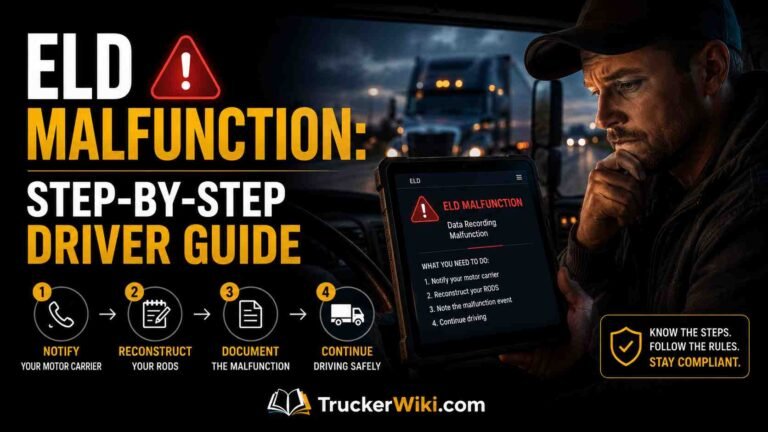
For drivers and carriers who need help selecting a compliant ELD device once they confirm they are not exempt, see the Best ELD Devices for Owner-Operators in 2026 article. For a full walkthrough of what happens when an ELD malfunctions and the device becomes temporarily unavailable, see the ELD Malfunction: Step-by-Step Driver Guide article.
By TruckerWiki Editorial Team | Regulatory sources: 49 CFR 395.8(a)(1) via Cornell LII, 49 CFR 395.1(e) and (k) via eCFR, FMCSA ELD FAQ on Exceptions and Exemptions, FMCSA Registered ELD List. As of May 2026, no changes to the enumerated ELD exemptions in 49 CFR 395.8 are in effect.