ELD Malfunction: Step-by-Step Driver Guide
When an ELD malfunctions, HOS obligations do not pause. Under 49 CFR 395.34, an ELD malfunction triggers a specific compliance protocol with defined steps and deadlines for both the driver and the motor carrier. Not following the protocol precisely converts a hardware problem into a regulatory violation, with exposure ranging from OOS orders to civil penalties for missing records.
This guide covers the full protocol in order: what qualifies as a malfunction, what the driver must do immediately and continuously until the device is repaired, what to carry in the cab before any malfunction occurs, how to handle a roadside inspection during a malfunction, and what obligations fall on the carrier.
For context on the broader ELD mandate framework and what constitutes a compliant device, see the ELD mandate pillar article. For the complete list of who must use an ELD, see Who Needs an ELD? Full Exemptions List 2026.
What Counts as a Malfunction and What Does Not

Not every ELD error, warning, or alert requires the full 395.34 protocol. The key distinction is whether the condition prevents the ELD from accurately recording the driver’s hours of service.
Per FMCSA ELD Malfunction FAQ, if the malfunction or data diagnostic event does not hinder the ELD’s accurate recording of hours of service and the ELD has cleared the event itself, the documentation requirements of 395.34 do not apply.
A driver who triggers the full paper log protocol every time the ELD shows a minor diagnostic warning is doing unnecessary work. A driver who ignores a genuine malfunction because it “looks minor” is creating an unrecorded compliance failure.
FMCSA’s technical specifications in Appendix A to Subpart B define six categories of compliance malfunction that do require the protocol:
- Power compliance malfunction: ELD fails to comply with engine power requirements.
- Engine synchronization compliance malfunction: ELD fails to establish or maintain a connection to the engine control module.
- Timing compliance malfunction: ELD cannot synchronize with Coordinated Universal Time (UTC); the allowable deviation is 10 minutes.
- Positioning compliance malfunction: ELD fails to acquire a valid position measurement within 5 miles of a moving CMV for 60 consecutive minutes.
- Data recording compliance malfunction: ELD fails to record the required data.
- Data transfer compliance malfunction: ELD cannot perform an electronic data transfer at roadside inspection
In each of these cases, the malfunction directly affects the ELD’s ability to produce an accurate, transferable HOS record. The full 395.34 protocol applies from the moment the driver identifies or the ELD displays the malfunction indicator.
Data diagnostic events are a separate category. Diagnostic events flag data inconsistencies that may not rise to a compliance malfunction. When a data diagnostic event appears, the driver should follow the motor carrier’s and ELD provider’s recommendations for resolving the inconsistency. If the ELD self-clears the event and it did not affect the HOS recording, no further action under 395.34 is required. If the diagnostic event cannot be resolved and it is affecting accurate HOS recording, it escalates to a malfunction requiring the full protocol.
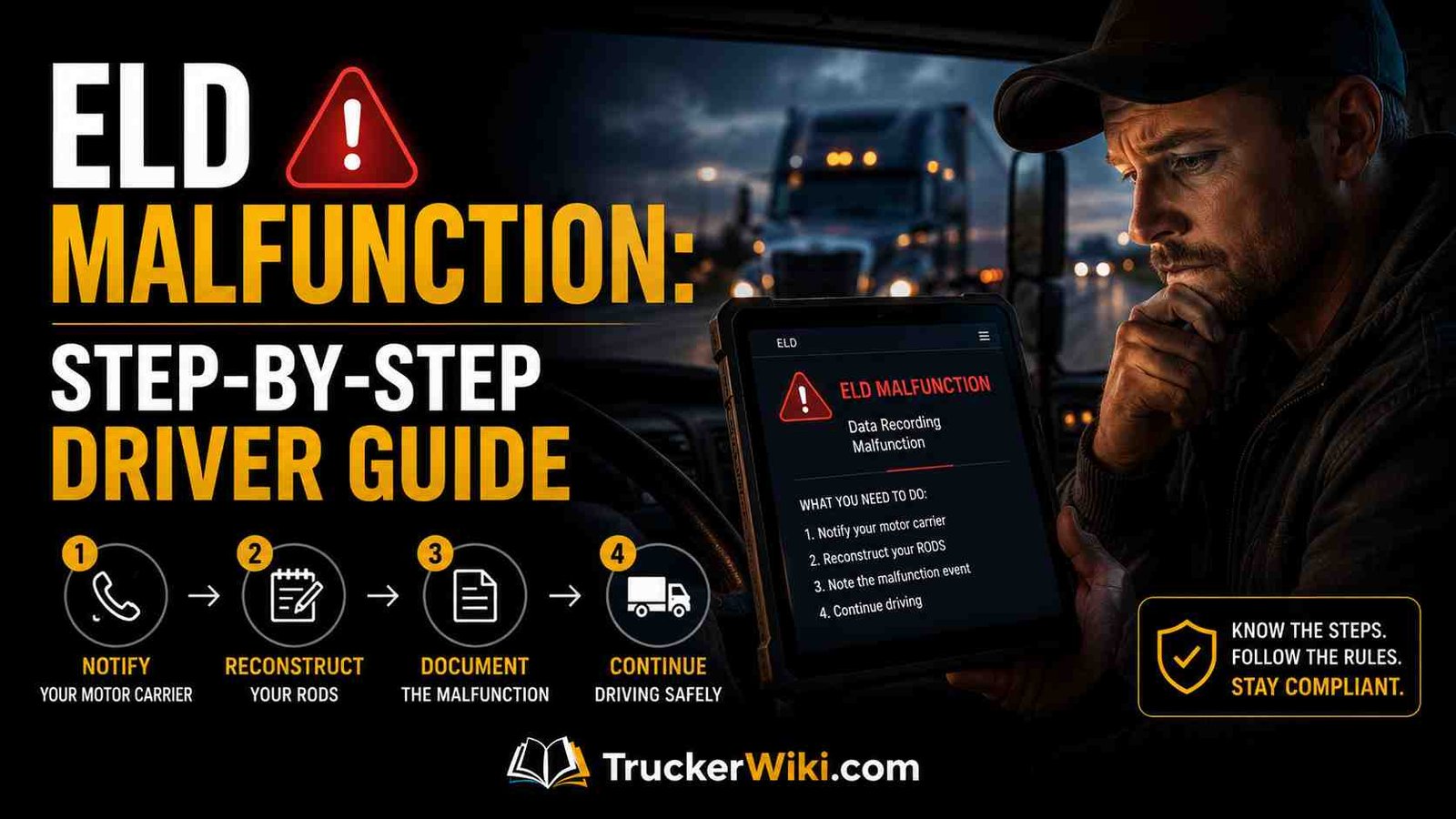
The Driver’s Three-Step Protocol Under 49 CFR 395.34(a)
The regulatory text of 49 CFR 395.34(a) specifies three driver obligations in sequence. Each has a distinct timing requirement.
Step 1: Note the malfunction. When a driver identifies or is notified of an ELD malfunction, the driver must note it. This note should include the malfunction type, the date and time it was identified, and the driver’s current location. Most ELDs that display a malfunction indicator also generate a system log entry.
The driver should confirm that the entry exists, but should also make a written notation on the paper log to document when the driver became aware of the condition. An undocumented malfunction with no written record leaves the driver unable to prove the timeline if the timing is later disputed.
Step 2: Provide written notice to the motor carrier within 24 hours. The driver must notify the carrier in writing within 24 hours of identifying the malfunction. This is not an informal verbal notification over the phone. Written notice means a text message, email, fax, or other documented communication that establishes a timestamp.
The 24-hour window runs from when the driver identified the malfunction, not from the end of the shift or the next check-in. Carriers that do not have a clear procedure for receiving malfunction notifications risk missing the notice entirely and then face the 8-day repair clock starting from the wrong date.
The written notification should include: the driver’s name and CDL number, the vehicle unit number and VIN, the specific malfunction code or indicator displayed by the ELD, the date and time of malfunction identification, and the driver’s current location or route when the malfunction was identified.
A carrier that has this information can initiate device replacement logistics, schedule service, or contact the ELD provider’s support line immediately. A notification that says only “my ELD isn’t working” creates delays on the carrier side that eat into the 8-day repair window.
Step 3: Reconstruct RODS for the current 24-hour period and the previous 7 consecutive days. This is the most frequently misunderstood requirement. The driver must reconstruct paper records not just going forward, but backward. The reconstruction covers the current 24-hour period and the previous 7 consecutive days on graph-grid paper logs that comply with 49 CFR 395.8.
There are two exceptions: if the driver already possesses those records in compliant paper form, or if the records are retrievable from the ELD in a printable or displayable format, reconstruction is not required for those days.
In practice, a driver whose ELD has failed but whose device can still display (just not electronically transfer) the prior 7 days has those records available to print or show at inspection. The reconstruction obligation applies when neither of those alternatives exists.
A driver who has been running for 6 days with a fully functional ELD that fails on day 7 must reconstruct 7 days of records from memory, fuel receipts, trip sheets, and any other available sources. This is why carriers should ensure drivers understand what data points go into a compliant 395.8 log long before any malfunction occurs, not after one happens in the field.
Continuing obligation: Manual RODS until the ELD is back in service. The driver must continue to manually prepare a full record of duty status in compliance with 395.8 for every duty period until the ELD is repaired and returned to compliant operation.
These paper logs must meet the complete 395.8 standards: graph grid, all required data fields, supporting document reference numbers, and signatures. A notebook of rough notes does not satisfy the requirement. Blank graph-grid paper logs are required to be in the vehicle before any malfunction occurs, specifically to support this obligation.
What Must Be in the Cab Before Any Malfunction Happens
The vehicle information packet required by 49 CFR 395.22(h) is the driver’s primary resource during a malfunction. Carriers are required to ensure each CMV carries this packet at all times. The packet must contain four items:
- A user’s manual for the driver describing how to operate the specific ELD model installed
- An instruction sheet describing the data transfer mechanisms supported by the device, with step-by-step transfer instructions for producing records at a roadside inspection
- An instruction sheet describing ELD malfunction reporting requirements and the recordkeeping procedures to follow during a malfunction
- A supply of blank driver’s RODS graph grids sufficient to record duty status for a minimum of 8 days
The 8-day paper supply is the most frequently missing element at inspections. Trucksafe’s compliance data cited 23,412 violations related to missing or incomplete ELD information packet items out of approximately 1.1 million driver inspections reviewed. A carrier whose vehicles carry the complete information packet at all times is protected against this violation category entirely.
The malfunction instruction sheet is the most operationally important item in the packet during a malfunction. It gives the driver the specific carrier-authorized steps for notification, the contact information to use, and the paper log procedure for the specific ELD model. A driver who reaches for that sheet during a malfunction spends 30 seconds reading instructions.
A driver who does not have it has to recall regulatory requirements under pressure, call dispatch for guidance, and risk errors in the notification timeline. Carriers should review and update the instruction sheet any time the device model changes, the carrier’s safety contact changes, or the ELD provider’s malfunction procedures change.
At a Roadside Inspection During a Malfunction

A driver operating under the ELD malfunction paper log protocol must present the manually kept RODS to the officer at any roadside inspection. Under 49 CFR 395.34(b), the driver provides the paper records maintained under the protocol rather than an ELD data transfer.
The paper logs must meet the full standards of 49 CFR 395.8. This means: graph-grid format with all required data fields completed, all duty status changes recorded with times and locations, shipping document numbers or references included, total mileage recorded, signature by the driver, and co-driver information if applicable.
An FMCSA FAQ confirms that during a malfunction, the safety official can decide what alternative methods of record retrieval are acceptable, including records by fax. But the driver should not rely on the officer’s discretion as a compliance strategy. The officer is not obligated to accept alternatives.
A driver who arrives at an inspection with compliant paper logs covering the current day and the reconstructed prior 7 days is in a defensible position. A driver who has partial notes or no paper records because they believe the verbal carrier notification was sufficient faces a potential OOS order.
Officers can also issue the driver OOS under the North American Standard Out-of-Service Criteria if the driver cannot produce paper logs meeting 395.8 standards, cannot account for the prior 7 days of RODS, or if the carrier has not documented the malfunction notification timeline. All three conditions are independently checkable. The absence of any one creates OOS exposure.
The driver should also be prepared to describe the malfunction when asked. An officer reviewing paper logs from a driver who claims an ELD malfunction will ask what the malfunction is, when it was identified, when the carrier was notified, and when the ELD is expected to be repaired or replaced.
A driver who can answer those questions with specifics and produce the written notification record demonstrates that the protocol was followed correctly. A driver who cannot describe when or how they notified the carrier suggests the protocol was not followed, which shifts the inspection toward a potential false log investigation rather than a straightforward malfunction accommodation.
The 30-minute break rule and all other HOS obligations continue to apply in full during the malfunction period. The paper logs must reflect compliance with the 11-hour driving limit, the 14-hour on-duty window, and the weekly accumulation limits exactly as they would on an ELD. The malfunction protocol substitutes the recording method; it does not modify the underlying HOS rules being recorded.
The Carrier’s 8-Day Window and the Extension Process
Once the carrier receives the driver’s malfunction notification, the 8-day repair clock starts. Under 49 CFR 395.34(d)(1), the motor carrier must correct, repair, replace, or service the malfunctioning ELD within 8 days of the carrier discovering the condition or receiving the driver’s notification, whichever comes first. The carrier cannot extend this window by delaying acknowledgment of the notification.
If the carrier cannot meet the 8-day deadline, it may request an extension from FMCSA. The extension request must be submitted within 5 days of the driver’s notification to the carrier, not within 8 days.
This is a commonly misread deadline. A carrier that waits until day 7 to request an extension is already past the 5-day filing window and will not receive one. The request must be submitted to the FMCSA Division Administrator for the state of the carrier’s principal place of business. It must be signed by the motor carrier and must include:
- The carrier’s legal name, principal place of business address, and USDOT number
- The name, address, and telephone number of the carrier representative filing the request
- A concise statement of the good-faith actions taken to repair, replace, or service the ELD, and why additional time beyond 8 days is needed
FMCSA will notify the carrier in writing of its determination. If FMCSA approves the extension, the carrier is deemed compliant with the RODS requirements for that period, provided the driver continues maintaining paper logs and both parties continue complying with all other applicable requirements.
Carriers should build ELD malfunction response into their compliance management system rather than treating each malfunction as an ad hoc event. A carrier that has a malfunction response checklist, a designated person for receiving and documenting driver notifications, a stock of replacement devices or an ELD provider replacement agreement, and a trained understanding of the 5-day extension window will manage malfunction events without enforcement exposure. A carrier that responds reactively after the 8-day window has already passed faces civil penalties and a compliance review finding with no procedural defense available.
From the driver’s perspective, the single most important preparation for an ELD malfunction is knowing how to complete a compliant paper log before the malfunction occurs. A driver who has never filled out a paper log since the ELD mandate took full effect in December 2019 will struggle to produce one under inspection pressure.
Fleet safety managers should include paper log completion in annual refresher training precisely because it is the skill drivers practice least and need most urgently when an ELD fails on the road. The reconstruction requirement under 395.34(a)(2) covers 8 days of RODS. A driver who cannot produce 8 days of compliant paper records at inspection does not have a malfunction defense; they have an HOS recordkeeping violation on top of the device failure.
Related articles: For how data transfer works at a standard ELD inspection when the device is functioning, see How ELD Data Transfer Works at DOT Inspections. For HOS violations and their CSA consequences, see HOS Violations: Fines, Penalties and CSA Impact.
Revoked devices are handled differently. A device that FMCSA has removed from the registered list is not treated as a malfunctioning ELD. The carrier has a 60-day transition window to replace the device before enforcement begins. During that window, the carrier should switch drivers to paper logs and source a replacement device from the FMCSA registered ELD list at eld.fmcsa.dot.gov/List. Once the transition deadline passes, using a revoked device is treated as operating without an ELD under 49 CFR 395.8(a)(1), not as an ELD malfunction with the accommodations of 395.34.
By TruckerWiki Editorial Team | Regulatory sources: 49 CFR 395.34 via Cornell LII, 49 CFR 395.22(h) via eCFR, FMCSA ELD Malfunction and Data Diagnostic Events FAQ, FMCSA ELD Malfunctions FAQ page. As of May 2026, the 395.34 malfunction protocol and the 8-day repair window remain unchanged.