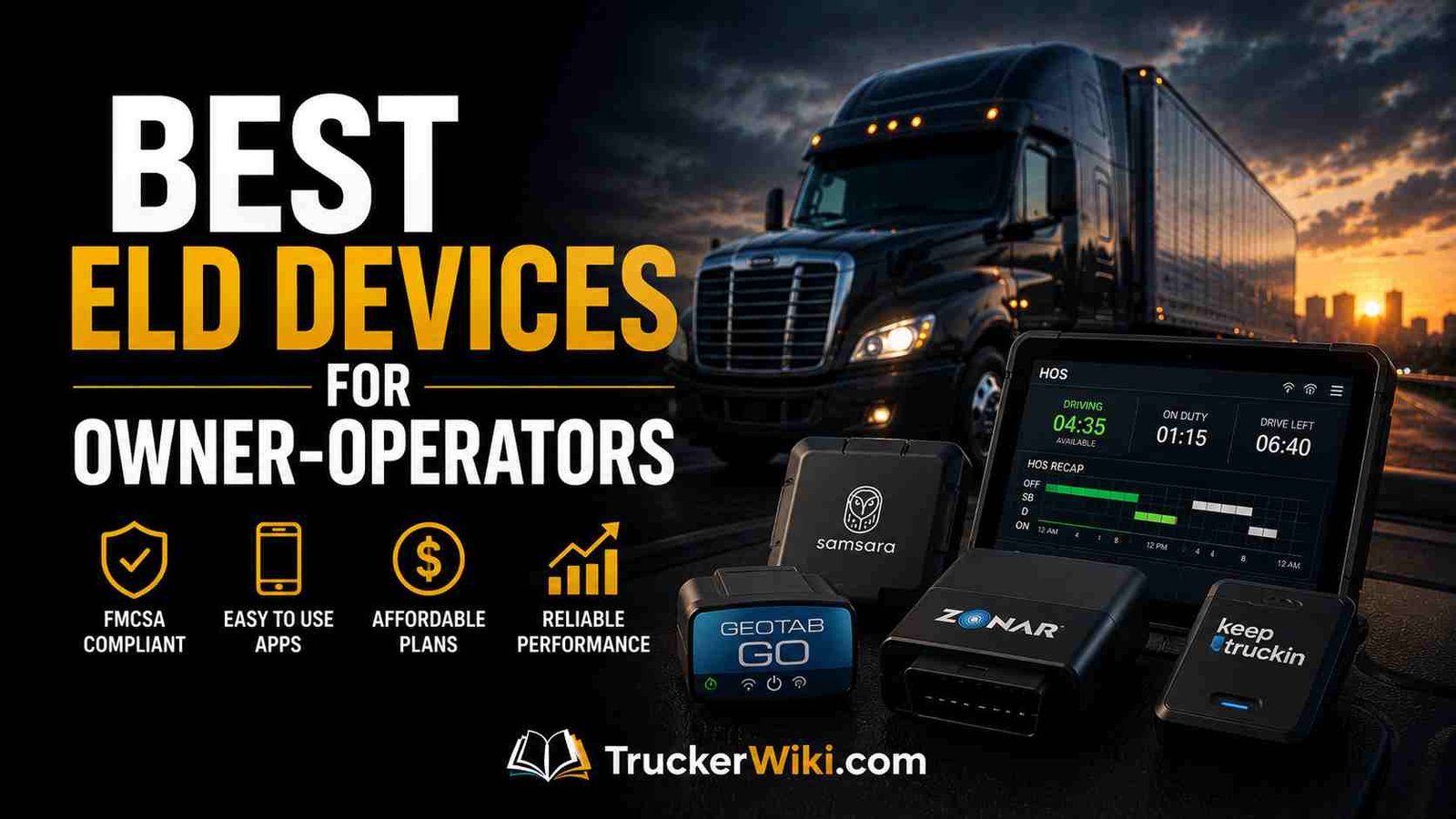
Best ELD Devices for Owner-Operators in 2026
Not all ELDs are built for the same operator. A device that works well for a 50-truck fleet with a dedicated safety department may be the wrong fit for an owner-operator running solo on a tight margin.
The difference comes down to four variables: total cost over two years, contract length, whether the device requires dedicated hardware or runs on your phone, and how easy it is to use under inspection pressure. This article covers each major option for 2026 with straight-line comparisons on the numbers that matter.
One critical note before any purchase: verify the device appears on the FMCSA registered ELD list at eld.fmcsa.dot.gov/List before buying. FMCSA has removed 79 devices from the registered list since January 2025, including 14 in a single batch in March 2026.
A device that was registered when you saw a review may have been revoked since. Running an unregistered device is treated as operating with no ELD at all under 49 CFR 395.8(a)(1), which is an OOS-eligible offense.
The full context of what constitutes a compliant device is covered in the ELD Mandate Explained article. If you are unsure whether you are required to use an ELD at all, see Who Needs an ELD? Full Exemptions List 2026.
What Owner-Operators Should Actually Compare

The advertised monthly price is the least useful number when evaluating an ELD. Subscription-based ELDs quote monthly rates that understate total cost of ownership. No-subscription devices quote one-time hardware costs that seem expensive upfront. The right comparison is the 2-year total cost including hardware, subscription, and any contract exit fees.
| Pricing model | 2-year total (typical) | Flexibility | Risk |
|---|---|---|---|
| Free hardware + monthly subscription (no contract) | $600-$1,080 | High | None |
| Free hardware + monthly subscription (1-year contract) | $600-$1,080 | Medium | Early termination fee |
| Free hardware + monthly subscription (3-year contract) | $600-$1,080 | Low | $500+ exit fee if things change |
| One-time hardware purchase, no subscription | $150-$350 | Maximum | None |
For an owner-operator, contract length is the single most consequential factor after price. A 3-year contract makes sense for a fleet that is growing and can absorb the volume commitment. For a solo owner-operator, a 3-year commitment creates real financial exposure if you lease a truck back, change carriers, take a company driving position, or have a medical event. Month-to-month or 1-year terms cost roughly the same over 24 months and protect your flexibility.
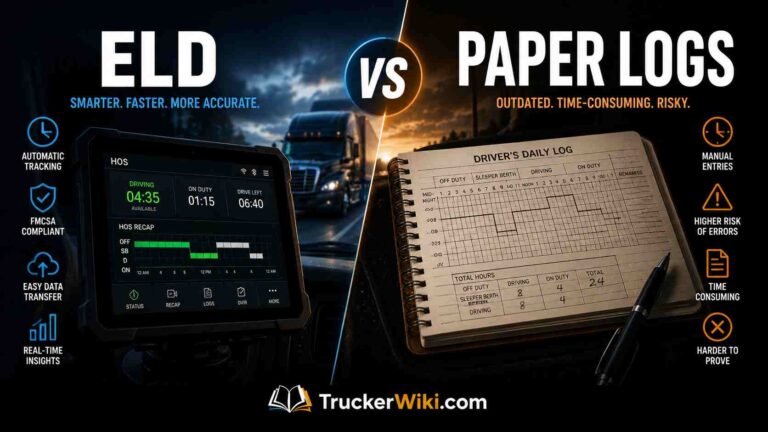
The second factor is phone-based versus dedicated hardware. Phone-based ELDs (Motive being the most prominent example) require a smartphone or tablet running the app, connected to a small Bluetooth or cable-connected hardware module that plugs into the truck’s diagnostic port.
Dedicated hardware ELDs (Samsara’s most common configuration) have a standalone device with a built-in screen that operates independently of your phone. Phone-based systems are cheaper and more flexible. Dedicated hardware systems are more reliable because they do not depend on your phone staying charged, updated, and paired.
For most owner-operators, the phone-based approach is sufficient. For drivers in remote areas with poor cell service or who prefer not to depend on their phone for compliance, dedicated hardware is worth the premium.
Data transfer speed at a DOT inspection is a real differentiator. The major platforms (Motive, Samsara) have fast, practiced transfer processes that officers are familiar with. Budget devices sometimes require more steps and produce slower transfers.
Verify the specific device supports both telematics and local transfer per the requirements in Appendix A to Subpart B of Part 395 before purchasing. For a step-by-step explanation of how the transfer actually works at an inspection, see How ELD Data Transfer Works at DOT Inspections.
A final note specific to owner-operators: you own both the driver record and the carrier record. A CSA violation from an ELD issue hits your HOS Compliance BASIC score as the carrier, not just your driving record as the driver.
That dual exposure is the reason proper device selection, registration verification, and malfunction protocol knowledge matter more for an owner-operator than for a company driver, where the carrier absorbs the fleet-side consequence.
Choosing a reputable, actively maintained device from a provider with strong support is not a premium feature decision; it is a compliance risk management decision. The $20-per-month savings from a cheap, poorly supported device evaporate after a single OOS order or a failed transfer at a roadside inspection.
Motive ELD: Best Overall for Owner-Operators
Motive (formerly KeepTruckin) is the most widely used ELD in trucking and the strongest overall recommendation for owner-operators in 2026. The platform has the largest active user community, the most comprehensive public support documentation, and the most driver-friendly inspection interface in the market.
Pricing: Hardware is free with a subscription. Subscription pricing runs approximately $20-$45 per month, depending on the plan tier. The entry-level plan covers FMCSA compliance, HOS, and basic GPS. Higher tiers add IFTA reporting, vehicle diagnostics, and AI dashcam integration. Motive offers month-to-month billing and 1-year contract terms. Unlike Samsara, a 3-year commitment is not required. Early termination fees apply to annual contracts; verify the specific fee structure before signing.
How it works: Motive uses a small hardware device that plugs into the truck’s OBD-II or 9-pin diagnostic port. The driver runs the Motive app on their smartphone or tablet. The hardware captures engine data; the app handles the HOS interface, log display, and data transfer. Installation typically takes under 15 minutes.
What is strong about Motive: The inspection workflow is practiced and fast. Officers at roadside inspections are familiar with it. The app interface is clear enough that most drivers learn it in a single shift. IFTA reporting is included on mid-tier plans, which saves owner-operators the manual calculation burden at quarter-end. Customer support is available 24/7, and the volume of user-created guides, YouTube tutorials, and community forum answers for Motive-specific issues is larger than any other ELD platform.
What to watch: Motive is phone-dependent. If your phone battery dies, your ELD is inaccessible. If your phone screen cracks mid-trip, data transfer at an inspection becomes problematic. Owner-operators who use Motive should carry a backup power bank and have a clear plan for device failure. Early termination fees on annual contracts have been reported as high as $500 by drivers who switched devices mid-contract; confirm this figure with Motive directly before signing.
Best for: Solo owner-operators and small fleets of 1-5 trucks who want the most widely used and supported ELD platform in the market, are comfortable using a smartphone as the primary interface, and want flexible contract terms.
Pricing note: Motive frequently runs promotions for new signups, particularly for owner-operators switching from a competitor. Before signing, ask specifically about the monthly rate for a 1-truck account on a month-to-month plan, the rate on a 12-month contract, the exact early termination fee if applicable, and whether any hardware fees apply. Get these in writing, not from a sales call only.
Samsara: Best Dedicated Hardware Option
Samsara is the dominant fleet telematics platform in the United States and the best choice for owner-operators who want a dedicated, self-contained hardware device that does not depend on a separate smartphone.
Pricing: Subscription runs approximately $30-$50 per month. Hardware is typically provided free or at low cost with a service agreement. The significant caveat: Samsara’s standard contract term is 3 years. For a fleet, this is standard. For an owner-operator, it requires careful consideration. Over 36 months at $40/month, the total commitment is $1,440 plus any early exit fee. That is a binding financial obligation if your operation changes.
How it works: Samsara’s ELD is a dedicated in-cab device with its own cellular connectivity, GPS, and touchscreen. It connects to the truck’s diagnostic port for engine data and operates as a standalone unit. The Samsara Driver App on your phone serves as an additional interface but is not required for basic compliance; the device itself handles transfers.
What is strong about Samsara: Dedicated hardware means zero dependency on phone battery, phone connectivity, or phone updates. The device operates in low-connectivity areas better than phone-based systems because it has built-in cellular with its own data connection. Samsara’s data transfer speed at inspections is among the fastest in the market. The platform also integrates IFTA, dashcam, engine diagnostics, and GPS in a single system, which reduces the number of separate tools an owner-operator needs to manage.
What to watch: The 3-year contract is the primary concern for solo operators. If you are an owner-operator who plans to run consistently for 3+ years without major operational changes, Samsara is an excellent choice. If you have any uncertainty about your business trajectory over 3 years, a shorter contract term from Motive or a no-subscription device is less risky. Some owner-operators report that Samsara’s pricing and support structure is oriented toward fleet accounts and that solo operators receive less responsive attention than large-volume customers.
Best for: Owner-operators who want dedicated hardware, plan to run long-term without operational changes, and value a fully integrated telematics system over the flexibility of a month-to-month subscription.
A note on negotiating Samsara contracts: Samsara is willing to negotiate contract terms for accounts they want to close. An owner-operator who approaches Samsara with a specific ask (24-month instead of 36-month, or a capped early termination fee) may find the sales team accommodating, particularly if the owner-operator is adding other Samsara services like AI dashcam or asset tracking. Do not assume the standard 36-month contract is fixed. Ask for the 24-month option explicitly and get the early termination calculation in writing before signing.
Blue Ink Tech BIT ELD: Best No-Subscription Option

Blue Ink Technology (BIT) offers the strongest value proposition for owner-operators who want to eliminate monthly fees entirely. The BIT ELD is a one-time hardware purchase at approximately $295 with no ongoing subscription requirement.
Pricing: $295 one-time hardware purchase. No monthly fees. No contract. The device connects to the truck’s diagnostic port and pairs with the BIT ELD app on a smartphone. Updates and support are included with the device purchase, not gated behind a subscription tier.
What is strong about BIT: The no-subscription model is genuinely different. Over 24 months, a BIT ELD costs $295 total versus $600-$1,080 for a subscription-based competitor. For an owner-operator running on a tight margin, eliminating a $30-$40 monthly ELD line item has real operational impact.
The device covers FMCSA HOS compliance, DVIR (Driver Vehicle Inspection Reports), IFTA reporting, GPS tracking, and vehicle maintenance monitoring. It connects to most commercial trucks including medium-duty vehicles used in hotshot operations. The BIT ELD appears on the FMCSA-registered list (verify at eld.fmcsa.dot.gov/List before purchase, as with any device).
What to watch: BIT is a smaller company than Motive or Samsara. Support response times may be slower than the enterprise platforms. The user community is smaller, meaning fewer publicly available troubleshooting resources. Inspection officers are less uniformly familiar with the BIT transfer interface than they are with Motive or Samsara, which can occasionally slow the inspection process. These are manageable tradeoffs for the pricing difference, but worth knowing upfront.
Best for: Cost-conscious owner-operators who want to eliminate monthly fees, run a straightforward solo or small-fleet operation, and do not need the enterprise fleet management features of Motive or Samsara.
Who should not choose BIT: Owner-operators who need to share real-time ELD data with a broker’s or carrier’s transportation management system (TMS) integration should verify compatibility before purchasing. Motive and Samsara have native API integrations with most major broker and load-board platforms. BIT ELD’s integration ecosystem is smaller, which can matter for owner-operators whose loads are dispatched through a carrier that requires specific ELD platform connectivity.
Budget Options, a Summary Table, and What to Verify Before Buying
For owner-operators who need nothing beyond basic FMCSA HOS compliance with minimal setup and no monthly costs, two legacy devices remain relevant in 2026.
Garmin eLog sells for approximately $149 as a one-time hardware purchase with no subscription. It is the most straightforward plug-and-play ELD available: connect the adapter to the diagnostic port, pair with the Garmin eLog app on your smartphone, and the device records driving and on-duty time automatically.
It does not include built-in GPS (it uses phone GPS), IFTA reporting, or fleet management features. At a roadside inspection, the transfer process is standard and familiar to most enforcement officers. For an owner-operator whose only goal is passing a DOT inspection without a monthly bill, the Garmin eLog does that job.
Rand McNally ELD 50 sells in the $150-$200 range as a one-time purchase. It pairs with the Rand McNally ELD app and includes basic GPS tracking alongside HOS compliance. Rand McNally has been in the commercial trucking space for decades and has broad driver familiarity, though the platform has not evolved as quickly as cloud-based competitors.
Both Garmin and Rand McNally are appropriate for owner-operators whose only requirement is FMCSA compliance and who have no need for IFTA automation, dashcam integration, fleet visibility, or carrier-facing reporting portals.
Drivers who need to share ELD data with brokers or shippers for real-time visibility will find that these basic devices fall short. Verify both devices remain on the FMCSA-registered list before purchasing, as several comparable legacy devices were revoked in the 2025-2026 cycles.
| Device | 2-Year Cost (approx.) | Contract | Hardware | Best For |
|---|---|---|---|---|
| Motive | $480-$1,080 | Monthly or 1-year | App-based (phone required) | Most owner-operators; best overall support |
| Samsara | $720-$1,200 | 3-year standard | Dedicated standalone device | Stable long-term operations; no phone dependency |
| Blue Ink Tech BIT | $295 total | None | App-based (phone required) | Minimum-cost compliance; no monthly fees |
| Garmin eLog | $149 total | None | App-based (phone required) | Basic compliance only; no IFTA or GPS |
| Rand McNally ELD 50 | $150-$200 total | None | App-based (phone required) | Basic compliance with basic GPS |
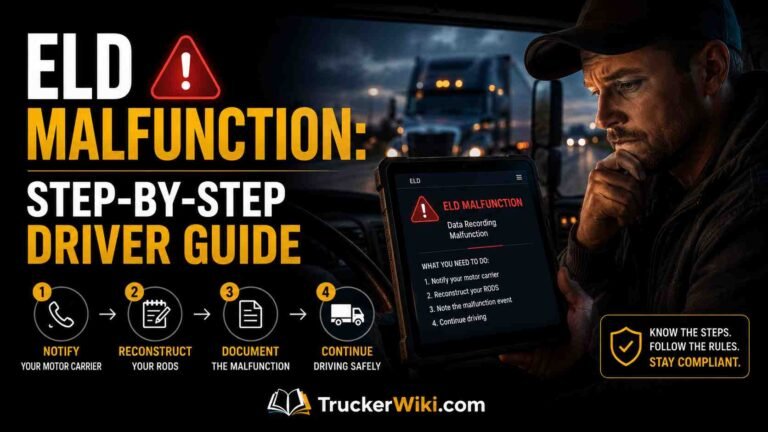
All prices are approximate based on March 2026 market data. Verify current pricing directly with each provider. For any device, confirm registration status at eld.fmcsa.dot.gov/List before purchase. If you purchase an ELD and it later malfunctions, the driver and carrier obligations under 49 CFR 395.34 apply regardless of which device you chose. The full protocol is covered in the ELD Malfunction: Step-by-Step Driver Guide article.
By TruckerWiki Editorial Team | Pricing and feature data sourced from manufacturer pricing pages and FreightWaves Checkpoint (February 2026), American Truckers LLC (March 2026), and FleetRabbit (March 2026). All device prices are approximate and subject to change. Verify current pricing directly with each provider. Confirm FMCSA registration status at eld.fmcsa.dot.gov/List before any purchase. TruckerWiki has no financial relationship with any ELD provider listed in this article.