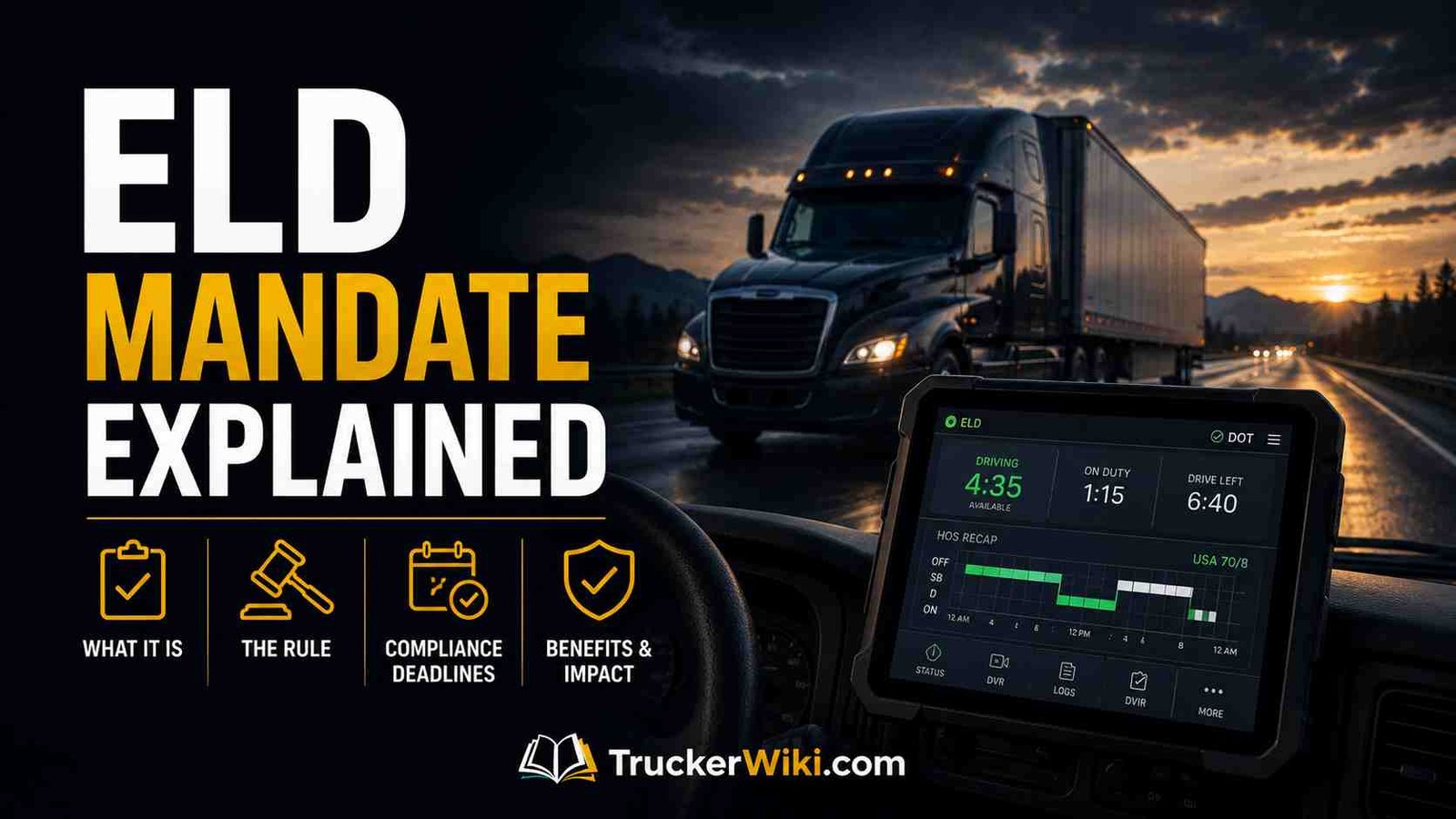
ELD Mandate Explained: Rules Every Driver Must Know
An Electronic Logging Device (ELD) is a hardware device that connects to a commercial motor vehicle’s engine control module and automatically records a driver’s hours of service, replacing manual paper logs. Under 49 CFR Part 395 Subpart B, most CMV drivers required to maintain Records of Duty Status must use a registered ELD. The mandate has been in full effect since December 16, 2019, and is enforced at every Level I and Level II roadside inspection across the United States, Canada, and Mexico.
The ELD does not change what the HOS rules require. The 11-hour driving limit, the 14-hour on-duty window, the 30-minute break, and the 70-hour weekly limit all remain unchanged.
What the ELD changes is how those limits are recorded and verified. A paper log requires an officer to manually compare the driver’s written record against odometer readings and trip documents. An ELD connects directly to the vehicle’s data systems, producing an automatic record that is significantly harder to manipulate and far faster to audit.
Where the ELD Mandate Comes From
The ELD mandate traces to the Moving Ahead for Progress in the 21st Century Act (MAP-21), which Congress passed in 2012. Section 32301(b) of MAP-21 directed the U.S. Department of Transportation to develop regulations requiring ELD use in commercial motor vehicles involved in interstate commerce. FMCSA published the final ELD rule in December 2015, with phased compliance dates.
Phase 1 compliance required ELD or Automatic On-Board Recording Device (AOBRD) use by December 18, 2017. Phase 2 required the replacement of all AOBRDs with fully compliant ELDs by December 16, 2019. As of December 2019, the mandate has been fully in effect with no transitional accommodations. Every enforcement inspection since that date treats a missing or non-compliant ELD as an immediate out-of-service offense under the CVSA criteria.
The mandate is codified in 49 CFR Part 395 Subpart B, which covers Sections 395.20 through 395.36 plus Appendix A (technical specifications). Section 395.8(a)(1) establishes the baseline requirement: a driver required to keep RODS must use a registered ELD for that purpose. Every subsequent section in Subpart B defines how the device must perform, what data it must record, and what the driver and carrier must do to comply.
One critical aspect of the ELD registration framework that most articles skip: FMCSA does not independently test ELD devices before placing them on the registered list. ELD manufacturers self-certify their products, declaring that the device meets the technical specifications in Appendix A to Subpart B. FMCSA then lists the device.
This means a device can appear on the registered list even if it fails to meet the actual technical requirements. When FMCSA discovers deficiencies through field reports, compliance testing, or industry complaints, it revokes the device. Since January 2025, FMCSA has removed 79 ELD devices from the registered list for failure to meet the minimum requirements of Appendix A. The most recent batch of 12 devices was removed in May 2026, with a 60-day transition deadline of July 20, 2026. Carriers operating those devices as of July 20, 2026, will be treated as operating without an ELD.
Who Must Use an ELD
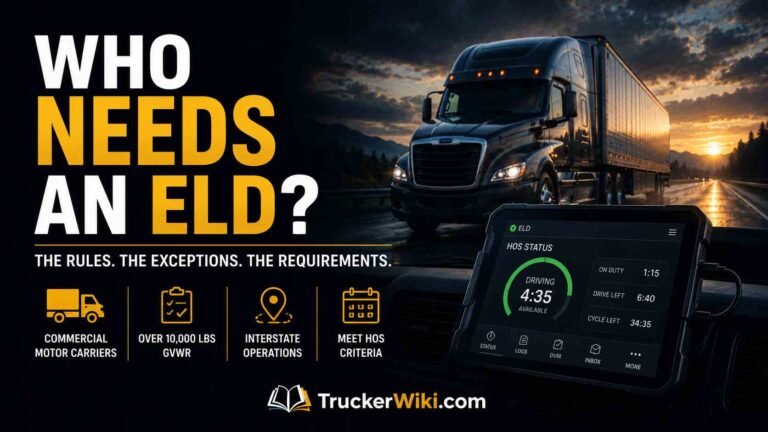
The ELD mandate applies to the same population that was previously required to keep paper Records of Duty Status. Under 49 CFR 395.8(a), any driver of a CMV in interstate commerce who is required to keep RODS must use a registered ELD for that purpose. The ELD mandate covers commercial buses as well as trucks, and it applies to Canada-domiciled and Mexico-domiciled drivers operating in the United States under the same requirements that apply to U.S.-domiciled drivers.
The mandate does not apply if the driver is not required to keep RODS in the first place. Five categories of drivers are exempt from the ELD mandate because they either do not need to keep RODS on the applicable days, or because the nature of their operation makes ELD use impractical:
1. Short-haul drivers under 49 CFR 395.1(e): Drivers who qualify for the 150-air-mile short-haul exception are not required to keep RODS on qualifying days and, therefore, are not required to use an ELD on those days. If the driver exceeds the short-haul conditions on more than 8 days in any 30 days, they are required to use an ELD on exceeding days. The full short-haul exemption mechanics are covered in the Short-Haul Exemption: Do You Qualify? article.
2. Vehicles manufactured before model year 2000: CMVs with engines manufactured before model year 2000 typically lack the standardized OBD-II or J1939/J1708 diagnostic ports that ELDs need to connect to the engine control module. Because a hardware connection to the ECM is a mandatory technical requirement of a compliant ELD, older vehicles that lack compatible ports are exempt.
Drivers of pre-2000 vehicles may use paper logs. Carriers claiming this exemption should retain documentation (engine build records, VIN records, or manufacturer documentation) that supports the model year claim, because an inspector may request proof during a roadside review.
3. Driveaway-towaway operations: In a driveaway-towaway operation, the vehicle being driven is itself the commodity being delivered. A driver delivering a newly manufactured semi-truck from a factory to a dealership, or transporting an RV from a manufacturer to a buyer, is exempt from the ELD mandate for that specific trip.
The exemption exists because the driven vehicle changes with each delivery and may not have an installed ELD, and permanent device installation in a vehicle being delivered to a new owner is not practicable. Documentation of the driveaway nature of the trip, such as a bill of lading or delivery order showing the vehicle as the commodity, is the proof of exemption at inspection.
4. Drivers using paper RODS 8 or fewer days in any 30 days: Drivers who are required to keep RODS on 8 or fewer days within a rolling 30-day period are not required to use an ELD. These drivers may use paper logs for the days when RODS is required. This exemption is designed for drivers who occasionally make long-haul runs outside their normal short-haul operational profile. Carriers with drivers who edge close to the 9-day threshold in a 30-day window need to track the count carefully, because exceeding 8 days triggers the ELD requirement for the exceeding days.
5. Agricultural operations during exemption periods: Drivers transporting agricultural commodities during state-designated planting and harvesting seasons within 150 air miles of the commodity’s source are fully exempt from HOS requirements, including the ELD mandate, for the duration of the exempt operation. The full agricultural exemption mechanics are covered in the HOS exemptions article.
Owner-operators are not automatically exempt from the ELD mandate. An owner-operator who operates a CMV over 10,001 pounds GVWR in interstate commerce and is required to keep RODS must use a registered ELD unless they qualify for one of the above exemptions. The owner-operator status itself provides no ELD relief. A detailed breakdown of every ELD exemption with qualifying conditions is covered in the Who Needs an ELD? Full Exemptions List 2026 cluster article.
What a Compliant ELD Must Do
Not every electronic device that records HOS data qualifies as an ELD under 49 CFR Part 395 Subpart B. The technical specifications in Appendix A to Subpart B of Part 395 define minimum requirements that a device must meet and self-certify to before being listed on the FMCSA-registered devices list.
Engine connection is mandatory. A compliant ELD must connect to the vehicle’s engine control module to automatically capture engine power status, vehicle motion status, miles driven, and engine hours from the vehicle’s data bus.
An ELD that records HOS data entered manually by the driver without a hardware connection to the ECM does not meet the specification. A smartphone app alone, without an ECM-connected hardware component, is not a compliant ELD regardless of whether the app is well-designed or FMCSA-registered.
The hardware component that physically connects to the vehicle diagnostic port is what triggers FMCSA registration and compliance. Carriers using app-based ELD systems must verify that the system includes a registered hardware piece physically connected to the vehicle’s J1939 or J1708 port.
Automatic recording required. A compliant ELD automatically records driving time the moment the vehicle begins moving above the threshold speed (currently 5 mph for automatic driving detection). The driver does not need to manually log “driving” status; the device initiates it. Off-duty, on-duty, not-driving, and sleeper berth statuses require driver input. Any discrepancy between the automatic movement record and the logged status is a potential false RODS flag during an inspection.
Location data must be recorded. The ELD records the vehicle’s location at every duty status change and at specified intervals during driving. Location data is used by inspectors to cross-reference logged duty statuses against physical position. A driver whose ELD shows “off-duty” while the location data shows the vehicle moving at highway speed has a documented falsification problem regardless of what the paper record says.
Annotation capability is required. Per 49 CFR Appendix A to Subpart B Section 4.5.1.3, a compliant ELD must allow drivers to add annotations in text format to recorded, entered, or edited ELD events. Annotations must be at least 4 characters long (including embedded spaces when prompted).
This requirement exists to support the adverse driving conditions and emergency exemption annotation obligations covered in the adverse driving conditions and other HOS exemption articles. A driver who invokes an HOS exemption must be able to annotate that invocation on the ELD; a device that does not support annotations does not meet the technical specification.
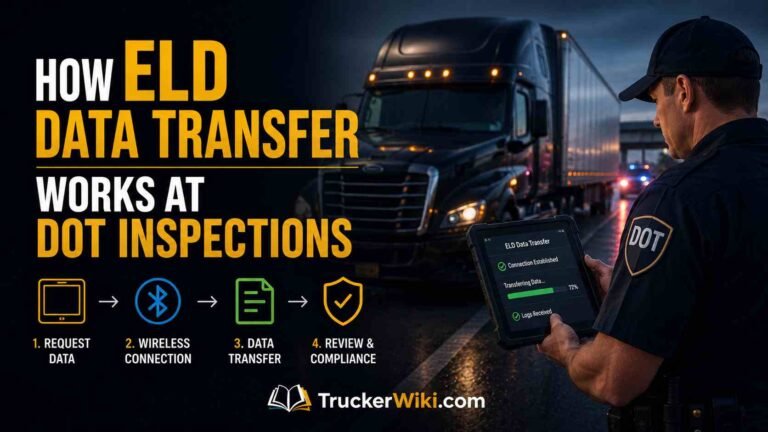
Data transfer methods. 49 CFR 395.22(d) requires a compliant ELD to support at least two of the following data transfer methods: Bluetooth, USB 2.0, email, or web service. When an inspector requests a data transfer at a roadside inspection, the driver must be able to produce the transfer using one of those methods.
Inspectors may request either a remote transfer (via Bluetooth or web service to FMCSA’s system) or a local transfer (via USB or email to the officer’s device). Drivers must know how to initiate both methods before any inspection. A driver who cannot produce the transfer is effectively unable to provide their RODS, which is an OOS offense.
Fixed mounting during operation. Per 49 CFR 395.22(g), a portable ELD, smartphone, or wireless device used as an ELD must be mounted in a fixed position during vehicle operation and must be visible to the driver from a normal seated position. An unmounted device bouncing around the cab does not satisfy this requirement.
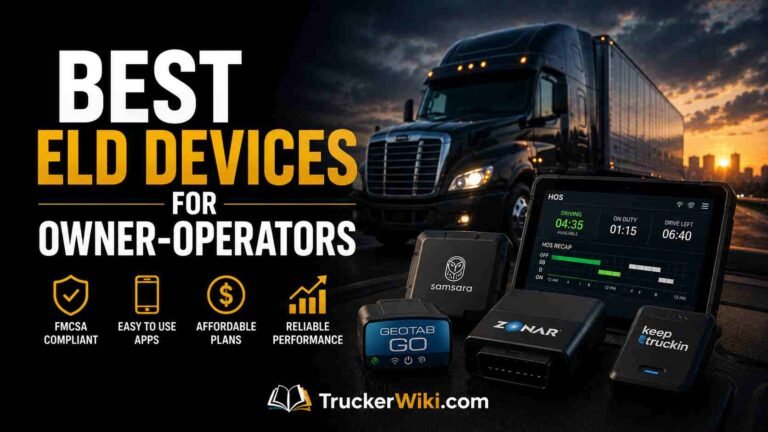
The FMCSA registered devices list. Carriers must verify their device appears on FMCSA’s registered ELD list at fmcsa.dot.gov/devices before deploying it. As noted above, FMCSA revokes devices when deficiencies are found.
A carrier whose device is revoked has 60 days to transition to a registered device before the revoked ELD is treated as no ELD at all. With 79 revocations since January 2025, the revocation risk is not hypothetical. Carriers should check the registered devices list at a minimum quarterly and sign up for FMCSA’s email alerts to receive revocation notifications when issued.
ELD Malfunction Rules: What Drivers and Carriers Must Do
An ELD malfunction does not suspend the driver’s HOS compliance obligations. Under 49 CFR 395.34, when a driver identifies an ELD malfunction, a specific procedure applies that covers both the driver’s immediate obligations and the carrier’s repair timeline.
Driver actions at malfunction. The driver must note the ELD malfunction in their records. The driver must immediately reconstruct the record of duty status on graph-grid paper for the current day and for any previous days not stored in the malfunctioning device.
This is the reason 49 CFR 395.22 requires the carrier to maintain a supply of blank driver’s RODS graph grids sufficient to cover at least 8 days in the vehicle information packet at all times. If those paper grids are not in the vehicle when the ELD fails, the driver is immediately without a recordkeeping backup.
Carrier notification. The driver must notify the motor carrier of the ELD malfunction within 24 hours of identification.
Carrier repair timeline. Under 49 CFR 395.34(b), the motor carrier must ensure the ELD is repaired, replaced, or serviced within 8 days of the malfunction notification. During the 8-day repair period, the driver must continue maintaining manual paper RODS. If the carrier cannot repair or replace the device within 8 days, it may submit a request for extension to FMCSA explaining the good-faith efforts taken and why additional time is needed. FMCSA may grant an extension period with conditions.
Revoked devices are treated as malfunctioning. A carrier whose device has been revoked by FMCSA must follow the same transition process as a malfunction: switch to paper logs and replace them with a registered device within the 60-day transition window. After the transition deadline, enforcement officers will cite the carrier under 395.8(a)(1) and place affected drivers out of service. The July 20, 2026, deadline for the most recently revoked batch of 12 devices means any carrier still running those devices after that date is operating without an ELD for enforcement purposes.
A full step-by-step driver guide to ELD malfunctions is covered in the ELD Malfunction: Step-by-Step Driver Guide cluster article.
Carrier Responsibilities Under the ELD Mandate

The ELD mandate places obligations on carriers that go beyond simply purchasing and deploying devices. 49 CFR 395.22 establishes carrier responsibilities in seven main areas.
Registered device only. A motor carrier required to use ELDs must use only devices that appear on FMCSA’s registered list. Using a non-registered device or continuing to use a revoked device after the transition deadline is an independent violation separate from any underlying HOS violation.
Information packet requirement. Each vehicle must carry an ELD information packet containing: a driver user manual for the specific ELD model; an instruction sheet explaining data transfer methods and step-by-step instructions for transferring records to an inspector; an instruction sheet describing malfunction reporting requirements and recordkeeping procedures during a malfunction; and a supply of blank driver’s RODS graph grids sufficient for at least 8 days. This packet is a required supporting document. An inspector who asks for it and finds it missing will cite the carrier for a recordkeeping violation.
Back-up record retention. Under 49 CFR 395.22(k)(1), the motor carrier must retain for 6 months a backup copy of the ELD records on a device separate from the one on which the original data is stored. This protects against data loss from device failure and ensures that compliance review investigators can access historical records even if the primary ELD is no longer operational.
Edit access and the anti-harassment prohibition. Motor carriers may authorize support personnel to access ELD records and make or suggest authorized edits. Every edit made by a carrier representative is logged with a timestamp and the editor’s identity. Under 49 CFR 395.28, carriers are explicitly prohibited from harassing drivers using ELD data or connected technology such as fleet management systems.
A carrier that monitors real-time ELD data and pressures drivers to continue driving when their hours are exhausted is engaging in conduct that the regulation was designed to prohibit. Drivers who believe they are being harassed based on ELD data have formal recourse under 49 CFR 395.28(b).
In practice, the most common carrier-side ELD compliance failures found during FMCSA compliance reviews are not related to the device itself but to the supporting documentation and process obligations.
Missing information packets, absent backup copies of ELD records, and failure to track the 8-day malfunction repair timeline account for a significant share of ELD-related audit findings. A carrier whose device performs flawlessly but whose drivers cannot produce the required information packet when asked by an officer at the roadside will receive a recordkeeping violation regardless of whether the ELD data is clean.
The self-certification and registration system also creates a responsibility for carriers to monitor FMCSA’s revocation announcements. A device that was compliant and registered when the carrier deployed it may subsequently be revoked.
FMCSA issues industry-wide email notifications when devices are revoked and gives carriers 60 days to transition. Carriers that miss these notifications and continue using revoked devices after the transition deadline face OOS consequences for their drivers at every subsequent inspection. Subscribing to FMCSA’s email alert list at eld.fmcsa.dot.gov is the simplest way to stay current on the revocation status of deployed devices.
At the Roadside: How ELD Inspections Work
At a Level I or Level II DOT roadside inspection, the officer will request the driver’s ELD records as part of the driver review. The driver must be able to display the current-day and previous 7 days’ worth of records on the ELD screen, and must be able to transfer those records to the officer electronically.
The officer may request either a remote transfer (via Bluetooth or web service directly to FMCSA’s system) or a local transfer (via USB cable or email to the officer’s device). Most state enforcement agencies use the remote transfer method in the field, which queries the ELD directly via Bluetooth from the officer’s inspection device. Drivers should know how to initiate both methods before any inspection occurs. Relying on the inspector to walk them through it creates delays and signals unfamiliarity with the device.
Supporting documents. ELD compliance does not eliminate supporting document obligations. Under 49 CFR 395.11, a driver must retain and be able to produce supporting documents that confirm the accuracy of their ELD records.
Supporting documents include bills of lading, dispatch records, trip receipts, expense account records, and any other documents that identify the shipper, commodity, origin, and destination of a shipment.
Officers reviewing ELD data during a roadside inspection may cross-reference the driver’s electronic records against supporting documents in their possession. A driver whose ELD shows a period of off-duty time that a fuel receipt, toll record, or bill of lading contradicts is facing a potential falsification issue even if the ELD data itself appears clean.
Carriers must retain driver supporting documents for 6 months. The obligation falls on both the driver and the carrier: the driver must retain documents in their possession during the trip and surrender them to the carrier at the trip’s end; the carrier must retain those documents for the required period.
Supporting documents do not override ELD data; they supplement it. The combination of ELD records and supporting documents is what gives inspectors and auditors a complete picture of a driver’s actual movements and activity.
Personal conveyance and yard moves. Two special ELD operating modes require driver understanding before any inspection. Personal conveyance (PC) allows a driver to log off-duty driving for personal travel, meaning travel that serves no carrier operational purpose. Time logged as PC does not count toward HOS limits.
A driver using PC incorrectly, for example, driving to a shipper in PC status to avoid logging on-duty time, creates a falsification record when the bill of lading and PC log are compared. Yard moves allow a driver to record movement of a CMV within a yard or facility at walking speeds, as on-duty, not-driving, rather than driving. Both statuses are legitimate, but are scrutinized during audits for potential misuse.
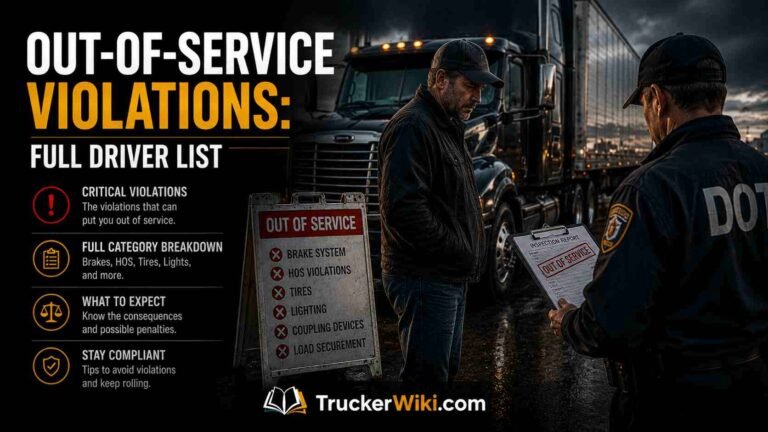
If the ELD data transfer fails during the inspection, the driver must provide the officer access to the ELD display to view records and must also produce any supporting documents in their possession. If neither the electronic transfer nor display access produces the records, the officer may treat it as a no-RODS situation and issue an OOS order. A driver who cannot display or transfer their records because of driver unfamiliarity with the device is in a worse enforcement position than a driver whose ELD has a documented malfunction.
The 2026 CVSA International Roadcheck (May 12–14, 2026) placed special enforcement focus on ELD tampering, with inspectors specifically examining ELD records for manipulation, unauthorized edits, unresolved unassigned driving time, and log transfer readiness.
The pattern of the 2025 false RODS focus progressing to the 2026 ELD tampering focus reflects FMCSA’s shift toward probing the integrity of electronic records, not just their existence. A carrier whose drivers have frequent unresolved edit flags, large volumes of unassigned driving time, or ELD devices approaching their revocation deadline faces elevated scrutiny in any inspection, not only during the Roadcheck window.
How ELD data transfers work at roadside inspections in detail, including the remote and local transfer process and what happens when a transfer fails, is covered in the How ELD Data Transfer Works at DOT Inspections cluster article.
For a side-by-side comparison of what changed when paper logs were replaced by ELDs, including what was lost and what was gained, see the ELD vs Paper Logs: What Changed After the Mandate article.
By TruckerWiki Editorial Team | Regulatory sources: 49 CFR Part 395 Subpart B via eCFR, Appendix A to Subpart B via Cornell LII, FMCSA ELD Final Rule (December 2015), FMCSA Registered ELD List, FMCSA ELD Revocation Notice (May 2026). The ELD registered devices list and revocation status are updated continuously at fmcsa.dot.gov/devices. As of May 2026, 79 devices have been revoked from the registered list since January 2025.