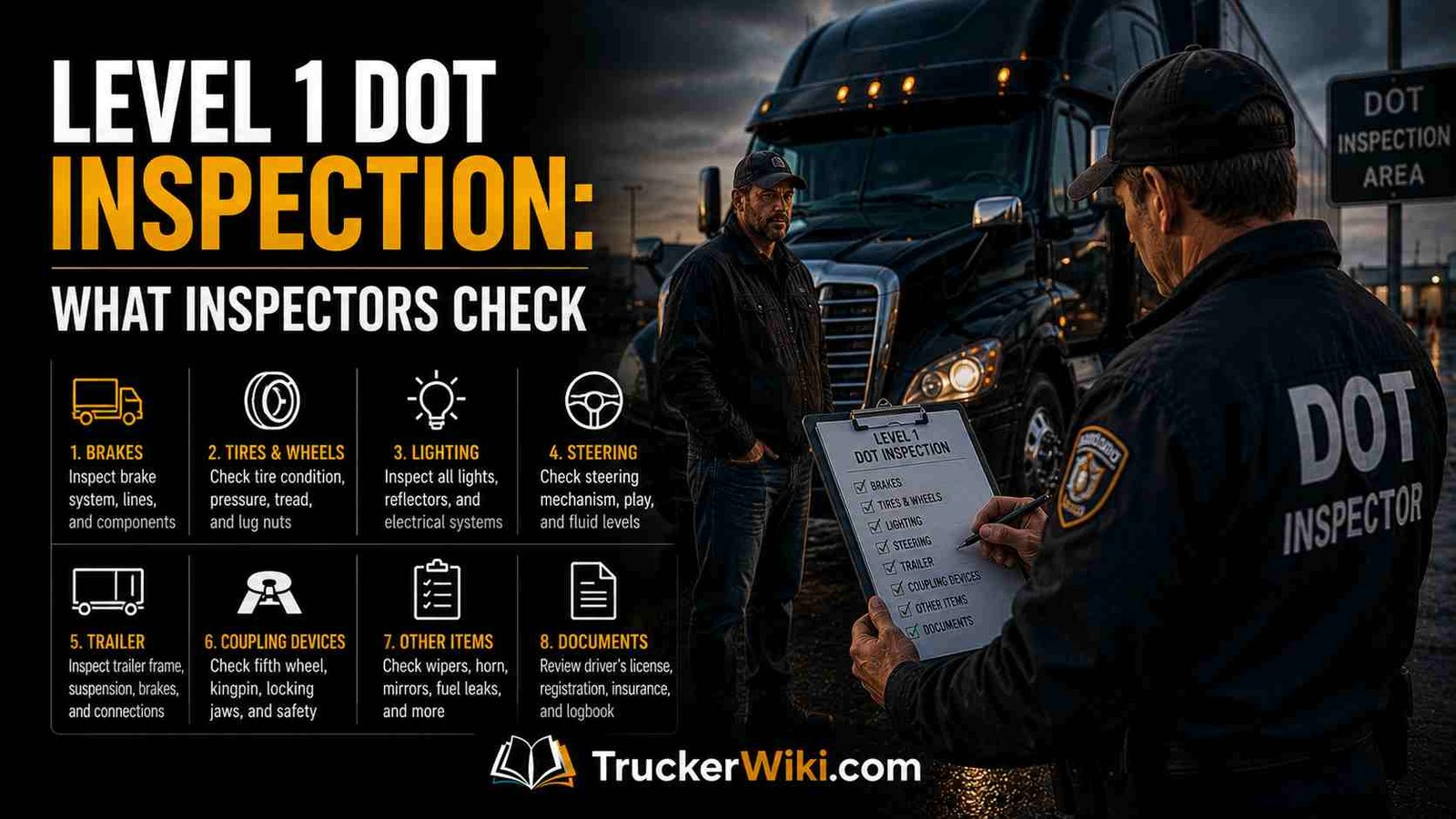
Level 1 DOT Inspection: What Inspectors Check
The Level 1 DOT inspection, formally called the North American Standard Inspection, is a 37-step procedure covering both the driver’s credentials and documentation and the vehicle’s complete mechanical condition. It is conducted by CVSA-certified enforcement personnel and typically takes 45 to 60 minutes for a tractor-trailer combination. A vehicle and driver that pass a Level I inspection are eligible for the CVSA decal, valid for three months. Levels II through VI inspect fewer areas and are described in the DOT Roadside Inspections pillar article; the focus here is the full detail of what specifically gets checked at Level I.
During the 2025 International Roadcheck, more than 50 percent of all inspections were Level I. A clean Level I is the highest-value single inspection result a carrier can accumulate: it generates a CVSA decal, produces a clean record in every applicable CSA BASIC, and protects the vehicle from reinspection for three months. A Level I with violations generates citations and potentially OOS orders in the specific BASIC categories where violations were found. What follows is the complete inspection scope organized by section.
The Driver Portion: Credentials, Documentation, and HOS
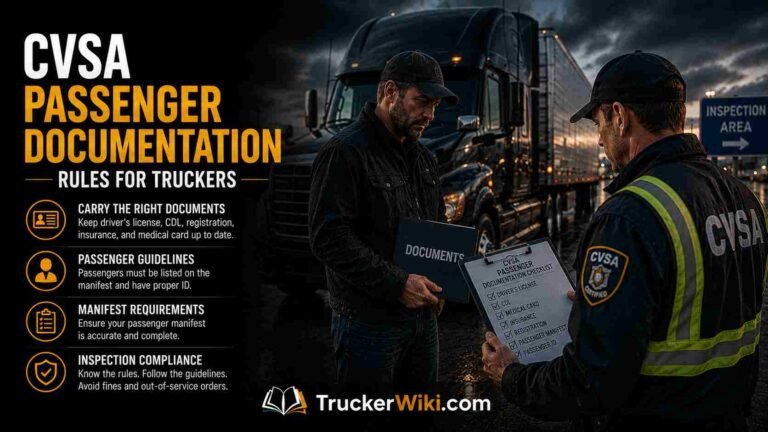
The driver portion of a Level I inspection is the same as a standalone Level III inspection. The officer checks every document, credential, and compliance status that governs the driver’s legal authority to operate the vehicle. The driver is required to be in the cab or immediately available and must produce documents on request.
Commercial Driver’s License. The officer verifies that the CDL is valid (not expired, suspended, or revoked), that the class matches or covers the vehicle being operated (Class A for combination vehicles with a GVWR exceeding 26,001 pounds), and that any required endorsements appear on the license. The officer checks CDLIS to confirm the CDL’s current status beyond what the physical card shows. A suspended CDL that appears valid on the card but is active in CDLIS produces an OOS order.
Medical Examiner’s Certificate. The officer verifies that the medical certificate is current (not expired, maximum 24-month validity) and that any medical restrictions on the certificate are being followed. Drivers with corrective lens restrictions must have their glasses or contacts in use. Drivers with hearing aid requirements must have the device in use. The medical certificate must be the physical card or an acceptable digital version. Drivers whose medical information has been transmitted to their CDL state through the national medical registry may satisfy this requirement without a separate physical card, depending on state implementation.
Drug and Alcohol Clearinghouse status (United States only). Officers conducting Level I inspections in the United States have access to the FMCSA Drug and Alcohol Clearinghouse query system. A driver with a prohibited status in the Clearinghouse (positive drug test result without completing return-to-duty requirements) is placed OOS regardless of the appearance of their CDL or other documents.
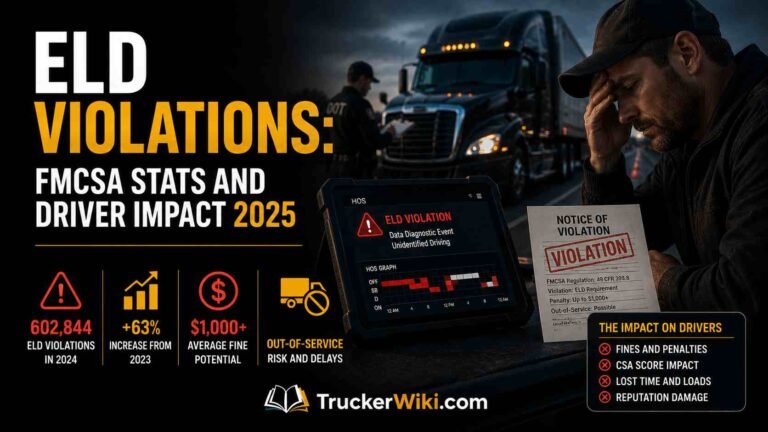
Hours of Service records and ELD. The officer requests an ELD data transfer covering the current day and the previous 7 days. The officer’s inspection software automatically flags HOS limit violations from the transferred data. An ELD that cannot transfer data, a driver who cannot demonstrate the transfer process, or records that show HOS violations results in citation or OOS depending on the violation type and severity. The HOS violations and OOS thresholds article details which specific HOS conditions produce OOS orders versus citations.
Skill Performance Evaluation (SPE) certificate. For drivers who have received an SPE certificate authorizing operation with a physical condition that would otherwise disqualify them, the certificate must be present and must cover the current vehicle type.
Driver Vehicle Inspection Report (DVIR). The officer verifies that the driver has reviewed and signed the most recent DVIR and that any reported defects were certified as repaired or repair determined unnecessary before driving began.
Seatbelt. The officer confirms the driver’s seatbelt is properly fastened. A driver not wearing a seatbelt is OOS.
Shipping papers. If the vehicle is transporting hazardous materials, the officer verifies the shipping papers are present, accessible (within driver’s reach while buckled), and accurately describe the cargo.
The Vehicle Portion: Mechanical Systems
The vehicle portion of a Level I inspection covers every mechanical system that affects safe operation. The officer examines components from outside the vehicle, inside the cab, and from underneath the vehicle. This under-vehicle component is what distinguishes Level I from Level II.
Brakes. The brake system is the most consistently cited vehicle OOS category, accounting for the largest share of vehicle OOS orders at every Roadcheck event. The Level I brake inspection includes:
- Air pressure: system must build to at least 90-100 PSI and hold; low-air-pressure warning light must activate at approximately 60 PSI; spring brakes (trailer parking brakes) must apply at approximately 20-45 PSI on pressure loss.
- Service brake adjustment: pushrod stroke at each brake chamber must not exceed the adjusted stroke limit for the chamber size; this is the most frequently violated brake standard.
- Brake drums and linings: drums must not have heat cracks that extend to the drum surface; linings must not be worn below minimum thickness; linings must not be contaminated with grease or oil.
- Brake hoses and connections: no chafing, crimped, or leaking air lines; couplings must be secure.
- ABS: ABS malfunction indicator lamp must not remain illuminated after startup for vehicles equipped with ABS
The CVSA OOS standard for brakes is any vehicle where 20 percent or more of its brakes are out of adjustment or defective. For a 5-axle combination with 10 brake surfaces, 2 defective brakes meet the 20 percent threshold. A single brake defect on a steering axle may also produce an OOS order due to the steering axle’s disproportionate contribution to brake effectiveness.
Tires and wheels. The officer checks tread depth at multiple points, sidewall condition, and tire mounting. OOS thresholds are: less than 4/32 inch tread on any steer axle tire; less than 2/32 inch tread on any other axle tire; any tire with exposed cord or fabric; tires that are flat; dual tires that are in contact with each other. Wheels and rims are checked for missing lug nuts, cracks, and damage. Under the 2026 OOS criteria update effective April 1, 2026, rims with missing pieces exceeding 3 inches at the bead area are an OOS condition.
Lighting. The officer checks all required lights: headlights (high and low beam), taillights, brake lights, turn signals (front and rear), clearance and marker lights, side marker lights, and reflectors. Any required light that is inoperative is a citation. A brake light that is non-functional can produce an OOS order. The lighting check is frequently called a “gateway violation” because a burned-out clearance light that triggers a stop often leads to a more comprehensive inspection that uncovers additional violations.
Steering mechanism. The officer checks for excessive play in the steering wheel (generally no more than 10 degrees on a 20-inch wheel with power steering), secure mounting of the steering gear box, and condition of the pitman arm, drag link, and steering gear. Loose or damaged steering components are OOS conditions.
Suspension. The officer inspects suspension components for broken or shifted spring leaves, missing or loose U-bolts, cracked or broken spring hangers, and air suspension bags that are collapsed or leaking. Specific suspension component failures are OOS conditions under the CVSA criteria.
Frame. The officer checks for cracks, breaks, or broken welds in the frame rails and cross members. Any frame crack in a stress area is an OOS condition.
Fuel system. No leaks from the fuel tank, tank mounts, fuel lines, or fuel cap. A fuel leak is a fire hazard and an OOS condition.
Exhaust system. The exhaust routing must not pass through the cab; it must not have leaks at or forward of the last crossmember; it must be clear of wiring, fuel lines, and components that could be damaged by heat.
Coupling devices. Fifth wheel condition and mounting, locking mechanism engagement, kingpin condition, and coupling security. The officer physically tests the fifth wheel lock by pulling forward against the kingpin with the brakes applied. Loose or defective coupling devices are OOS conditions.
Cargo securement. The officer verifies that cargo is properly secured per 49 CFR 393 Subpart I requirements. The minimum tie-down count, condition of tie-downs, and proper blocking and bracing are all checked. Cargo securement was the 2026 Roadcheck vehicle focus, with inspectors specifically trained to evaluate load distribution, anchor point integrity, and working load limit adequacy of tie-down equipment.
The Under-Vehicle Inspection: What Level II Cannot See
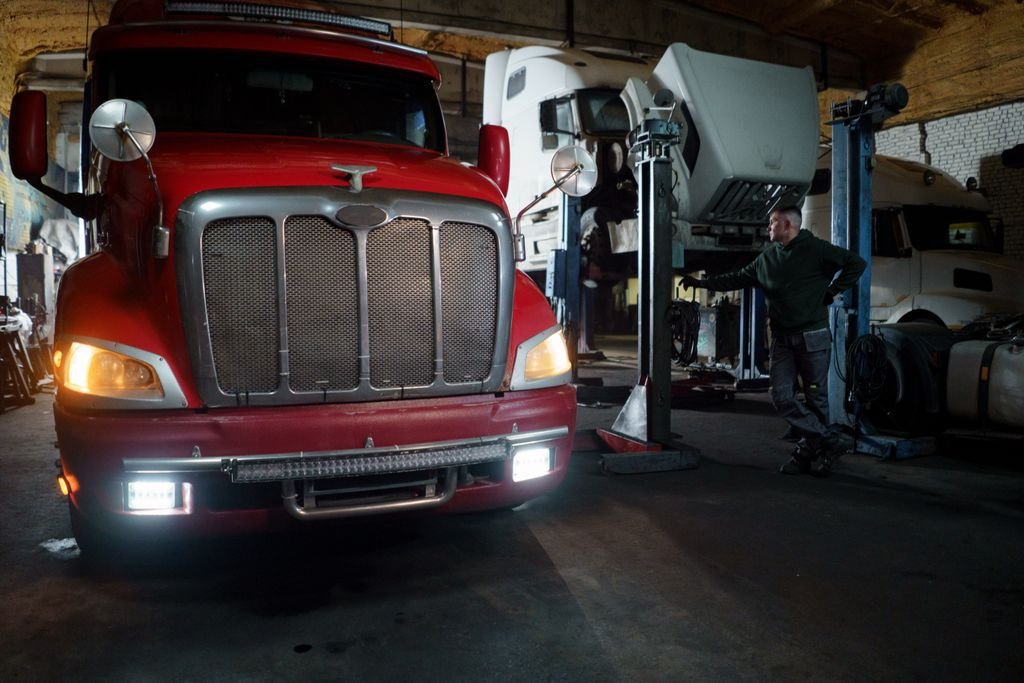
The defining difference between a Level I and a Level II inspection is the physical under-vehicle check. The officer crawls beneath the truck and trailer to inspect components that are not visible from the exterior walk-around. This is the segment of the inspection that catches the defects most likely to produce catastrophic road failures, and it is the segment that drivers who receive only Level II inspections never face.
Under-vehicle inspection items include:
- Brake drums and linings inspected directly rather than inferred from exterior observation.
- Suspension components examined from below: spring seats, U-bolt plates, air spring mounting points, torque rods, and shock absorbers.
- Frame rails and cross members inspected for cracks and breaks at welded joints that are not visible from outside.
- Drive shafts and universal joints checked for worn or missing components; a damaged U-joint is an OOS condition.
- Exhaust system routing verified from underneath to confirm it does not pass through the cab or contact fuel system components.
- Fuel and air lines checked from below for chafing against frame components that would not be visible during a walk-around.
- Axle housings inspected for oil leaks at the axle seals
A Level II inspection conducted at the same location and time as a Level I will typically find fewer violations simply because the under-vehicle items go unchecked. A vehicle with a cracked frame crossmember or a brake drum with a heat crack that is not visible from outside passes a Level II inspection and fails a Level I. This is why earning a CVSA decal through a passed Level I or Level V inspection provides a genuine compliance signal beyond just the decal’s reinspection deferral benefit.
The CVSA Decal: What Passing Produces
A vehicle and driver combination that passes a full Level I inspection without any OOS conditions is eligible for the CVSA decal. The decal is displayed on the driver’s side of the cab, typically on the front bumper or below the driver’s window. It shows the inspection date, the jurisdiction where the inspection was conducted, and the inspector’s identification.
The CVSA decal is valid for three months from the date of the inspection. During the decal’s validity period, vehicles displaying a current decal are generally not subject to reinspection for the vehicle portion of a roadside inspection. Officers at weigh stations checking inbound traffic typically bypass vehicles with current CVSA decals for vehicle inspection. The decal does not protect against driver-only (Level III) inspections.
A non-OOS violation found during a Level I inspection does not necessarily prevent the decal from being issued. A minor citation (burned-out clearance light, minor paperwork deficiency) may result in both a citation and a decal if the overall inspection finds no OOS conditions. The decal certifies that the vehicle passed an inspection; it documents the inspection result on a specific date, not a guarantee of continued compliance.
For the full framework of how Level I inspection results feed into the CSA Safety Measurement System and how clean inspection records lower BASIC percentiles, see the How to Improve Your CSA Score article.
After the Inspection: DVER, Citations, OOS Orders, and CSA Impact
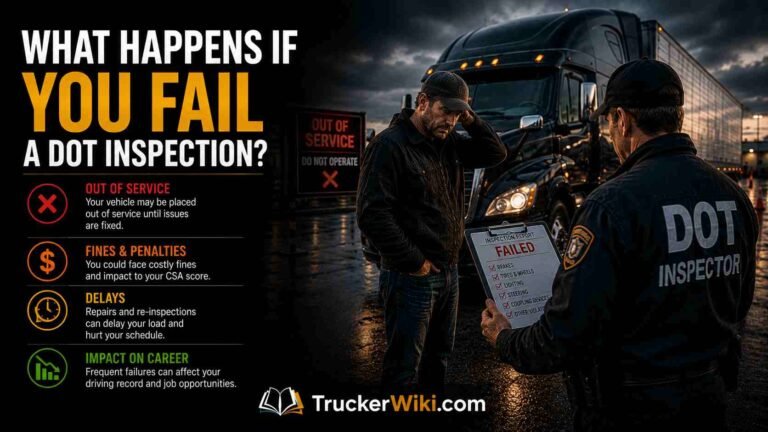
Every Level I inspection produces a Driver/Vehicle Examination Report (DVER), regardless of whether violations were found. The DVER documents the inspection level, the inspector’s certification, the vehicle and carrier identification, the driver’s identification, and every item checked with its result. The driver receives a copy on the spot. The carrier receives a copy through FMCSA’s notification system within days.
The DVER distinguishes between citations (violations found but not severe enough to trigger an OOS order) and OOS conditions. A driver reviewing the DVER after an inspection should understand both categories. A citation that is not an OOS order still enters the CSA Safety Measurement System and still affects the relevant BASIC percentile. The absence of an OOS order does not mean the violation had no consequence.
When an OOS order is issued, the specific required action appears on the DVER. For driver OOS conditions based on HOS, the DVER specifies the required off-duty duration before the driver can resume. For vehicle OOS conditions, the DVER specifies the defect that must be repaired. The vehicle cannot move until either the condition is corrected and documented or a qualified inspector clears the OOS.
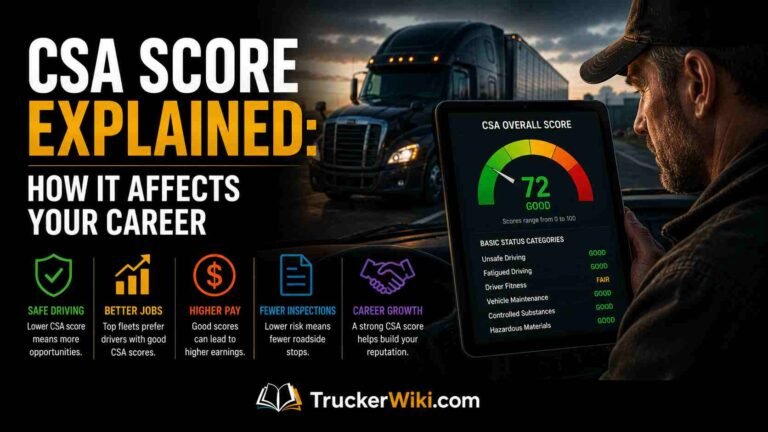
Under the 2026 Enhanced SMS methodology, every OOS violation from a Level I inspection carries a severity weight of 2 in the relevant BASIC calculation. Non-OOS citations carry a weight of 1. The Vehicle Maintenance BASIC captures all vehicle violations. The HOS Compliance BASIC captures all driver HOS and ELD violations. The Unsafe Driving BASIC captures seatbelt violations and any moving violations observed during the stop. Each violation enters the scoring window and remains for 24 months.
The post-inspection DataQs process is available if any violation on the DVER is factually incorrect. Common grounds include wrong USDOT number assigned, duplicate entries, incorrect violation code, or outcome of a citation that was later dismissed or reduced in court. Challenges should be submitted within 30 days of the inspection. A successful DataQs challenge removes the violation from the BASIC calculation entirely and recalculates the percentile as if the violation was never recorded. The DataQs system at dataqs.fmcsa.dot.gov handles factual data corrections; disputes about whether the officer was correct in issuing a citation require the state citation appeal process.
Drivers who receive a Level I inspection and pass should note the inspection date and the approaching CVSA decal expiration date. The decal expires exactly three months from the date stamped on it. Scheduling a follow-up Level I or Level V inspection before the expiration, particularly for vehicles with high mileage that may develop brake or tire wear between inspections, maintains the decal benefit continuously. Carriers that build a rotating Level I inspection schedule across their fleet, ensuring each vehicle has a current CVSA decal at all times, reduce the frequency of random roadside stops and accumulate clean inspection records that steadily lower their Vehicle Maintenance and HOS Compliance BASIC percentiles.
By TruckerWiki Editorial Team | Sources: CVSA North American Standard Inspection Program, CVSA Official 2026 Roadcheck Announcement (February 2026), Rush Truck Centers 2026 Roadcheck coverage, CVSA 2025 Roadcheck Results, 49 CFR Part 393 Parts and Accessories. Level I inspection criteria current as of the 2026 CVSA OOS Criteria edition (effective April 1, 2026).