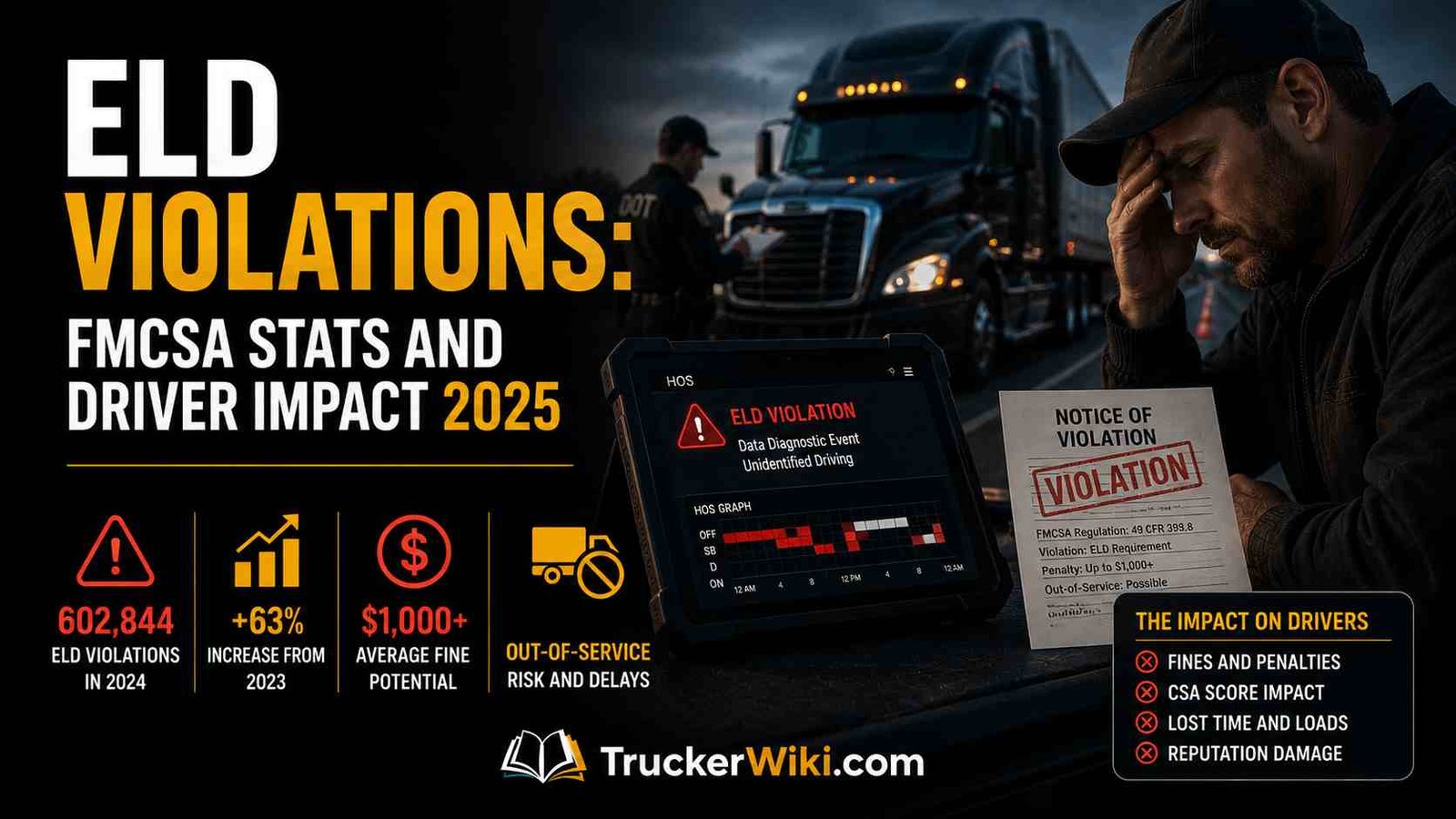
ELD Violations: FMCSA Stats and Driver Impact 2025
False records of duty status were the second most-cited driver violation across all FMCSA roadside inspections in 2025, at 58,382 total violations, according to CVSA data cited in FreightWaves’ coverage of the 2026 International Roadcheck.
Five of the top ten driver violations in the 2024 FMCSA enforcement dataset were hours-of-service or ELD-related. On the device compliance side, FMCSA revoked 28 ELD devices in 2025 alone, the highest single-year revocation total since the mandate took full effect in December 2019, per JJ Keller Compliance Network’s 2025 year-in-review.
These numbers establish the enforcement context for 2026. The false RODS volume at 58,382 annual violations indicates that log integrity problems did not diminish after the ELD mandate’s first five years.
The revocation acceleration indicates that device compliance is actively deteriorating, not stabilizing. Both trends directly shaped the 2026 enforcement calendar: CVSA designated ELD tampering as the 2026 International Roadcheck’s primary driver focus, the first time in the program’s history that device manipulation rather than limit violations was the named enforcement target.
The 2025 ELD Violation Landscape: Full-Year Data

The 58,382 false RODS violations recorded in 2025 place the category behind only 11-hour driving limit violations in total volume among driver-side citations. This is a meaningful positioning: it means that inaccurate or falsified ELD records are found at the roadside more often than violations of the 14-hour window, the 30-minute break rule, the 70-hour weekly limit, or the ELD registration requirements individually. Log integrity is the dominant ELD violation category by volume.
The 2025 International Roadcheck (May 13-15) gave a 72-hour cross-section of how these violations distribute across a concentrated enforcement window. During those three days, 56,178 inspections were conducted across North America. Among the 3,342 drivers placed OOS, 332 (10 percent of all driver OOS findings) were specifically for falsified logs or false records of duty status. This was the direct result of CVSA’s special driver focus for 2025: inspectors entered the Roadcheck specifically trained to detect false RODS patterns rather than focusing on limit violations.
The false RODS category covers a range of behaviors. Under ELDs, falsification does not require deliberately altering a record after the fact. It includes misusing personal conveyance status to log driving time to a shipper as off-duty, logging non-existent yard moves to absorb driving time, and making retroactive duty status edits with inaccurate or absent annotations. Inspectors in 2025 were cross-referencing ELD records against supporting documents (fuel receipts, toll records, bills of lading) and flagging specific technical anomalies: driving time recorded while the device was in an unidentified or disconnected state, status changes that do not match GPS movement data, and edit patterns concentrated around shift-end times.
According to JJ Keller’s review of the 2024 FMCSA enforcement dataset, five of the top ten driver violations by citation volume were HOS or ELD-related. The concentration of HOS and ELD violations in the top-ten list reflects both the volume of inspections and the effectiveness of ELD data transfer at surfacing violations that would have required manual calculation to find under paper logs.
The driver population that generates the most false RODS findings is not a single type. Post-mandate enforcement data shows false RODS citations distributed across solo owner-operators, small carrier drivers, and large fleet drivers. Owner-operators face a particular structural risk: as both driver and carrier, any false RODS finding triggers both a driver-side CSA data entry and a carrier-side HOS Compliance BASIC impact simultaneously. A company driver’s false RODS citation affects the carrier’s BASIC score but not the driver’s personal carrier record. For the owner-operator, there is no separation. A single finding from a 2025 or 2026 inspection stays in the CSA database for 24 months with elevated time-weighting for the first 6 months.
The 2025 Device Revocation Surge
The 28 ELD devices revoked in 2025 represented the most revocations in any single calendar year since the ELD mandate began. According to FreightWaves (March 4, 2026), revocations ran more than 80 percent higher in 2025 than in 2024. FMCSA attributed the acceleration to two factors: intensified agency oversight of ELD vendors and a new vetting process launched December 1, 2025, that subjected device applications to stricter technical review before registration.
The December 1, 2025, vetting process change is significant because it altered the self-certification framework that the mandate has operated under since 2017. Under the original framework, manufacturers self-certified compliance with Appendix A to Subpart B specifications, and FMCSA listed the device without independent testing. The new vetting process adds a pre-registration review step that is intended to reduce the number of non-compliant devices reaching the registered list in the first place, rather than relying on post-deployment enforcement and reactive revocation.
The 2026 revocation pace has continued the 2025 acceleration. According to FMCSA’s ELD news and events page, 27 additional devices were removed from the registered list between January and March 2026, including nine in February and 14 in March. The most recent batch of 12 devices was removed in May 2026 with a transition deadline of July 20, 2026. After that date, carriers using those devices will be cited under 49 CFR 395.8(a)(1), and drivers will be placed OOS.
The practical impact on carriers falls into two categories. Carriers that actively monitor FMCSA’s email alerts and the registered device list will have replaced revoked devices before the transition deadline and avoided enforcement exposure. Carriers that are unaware of the revocation continue operating under a device they believe is compliant until they encounter an enforcement officer who identifies the device as revoked. At that point, the driver is placed OOS and the carrier faces a citation regardless of whether the underlying log records are clean. The device status is the violation, not the records.
Since the mandate took full effect in December 2019, FMCSA has now revoked devices representing a meaningful share of the ELD market’s smaller vendors. The common pattern in revoked devices has been failure to meet data transfer specifications, failure to accurately record all required data fields, or inability to prevent unauthorized editing of core driving records. Large platform providers (Motive, Samsara, Geotab) have not appeared on the revoked list. Revocations have concentrated among smaller vendors, many offering devices at significantly lower price points than the major platforms.
The revocation pattern has practical implications for purchasing decisions. Carriers that selected low-cost ELDs from smaller vendors to reduce monthly expenses in 2022 or 2023 may now be operating devices that have been revoked or are at elevated revocation risk. The upfront savings from a discounted device disappear quickly when the device is revoked, and the carrier must purchase and deploy replacement hardware across an entire fleet.
Carriers evaluating ELD options in 2026 should weigh vendor stability and the provider’s track record on the registered list as heavily as the monthly subscription cost. A device that has remained on the registered list continuously since 2019 or 2020 without a revocation notice has a demonstrated compliance record that a newer or cheaper alternative cannot match.
FMCSA’s December 1, 2025, enhanced vetting process applies prospectively to new device applications. Devices that were already on the registered list before December 2025 were not retroactively re-reviewed under the new process.
This means devices that passed the original self-certification review in 2016 or 2017 and have remained on the list may still have technical compliance gaps that the new vetting process would have caught. The post-December 2025 vetting strengthens the list going forward, but does not guarantee that all currently registered devices are fully compliant with current Appendix A specifications.
How ELD Violations Are Classified and Penalized

FMCSA and CVSA treat ELD violations across several distinct categories with different penalty levels and CSA severity weights. Understanding the classification matters because not all ELD violations carry the same enforcement consequences.
Operating without a registered ELD: Carriers and drivers using a device not on the FMCSA registered list, including devices operating beyond the 60-day revocation transition window, face fines of $1,000 to $3,000 per violation per day. The driver is placed OOS until the records situation is resolved. This citation appears as a no-ELD violation under 49 CFR 395.8(a)(1), not as an HOS violation, though its CSA impact falls in the Hours-of-Service Compliance BASIC.
Falsification of ELD records: Knowing falsification of electronic records of duty status carries a civil penalty range of $3,000 to $10,000 per entry under the current FMCSA civil penalty schedule. Willful or egregious violations can reach $16,000 per offense. Criminal charges are available in severe cases, though rarely pursued for individual driving violations. Falsification is treated as a separate violation from any underlying HOS limit breach; both can be cited simultaneously.
ELD data transfer failure at inspection: A driver who cannot complete a data transfer at a roadside inspection receives a citation regardless of the content of their records. The failure to transfer is an independent enforcement event under 49 CFR 395.22(e). This category catches drivers whose ELDs are technically registered and whose records are clean, but who have not practiced the transfer process, or whose device has a connectivity issue at the inspection site.
Form and manner violations: Missing annotations, missing mileage data, absent location entries at duty status changes, and unresolved unassigned driving time generate form-and-manner citations under 49 CFR 395.8. These carry lower penalties than falsification but accumulate in CSA records. As covered in the ELD vs Paper Logs article, these ELD-era form violations replaced the paper-era form violations of illegible handwriting and missing signatures.
In the CSA Safety Measurement System, ELD violations are recorded in the Hours-of-Service Compliance BASIC under the 2026 enhanced SMS methodology. OOS-producing violations carry severity weight 2; non-OOS violations carry severity weight 1. The 65th percentile intervention threshold triggers FMCSA warning letters and targeted investigations.
The financial exposure compounds when multiple violation categories appear on the same inspection record. A driver who is cited for operating a revoked ELD, falsifying a duty status entry, and failing to produce supporting documents in the same inspection faces three separate penalty calculations: $1,000-$3,000 for the revoked device, $3,000-$10,000 for the falsification, and a separate citation for the supporting document failure. The total civil penalty assessment for a single inspection event can reach $25,000 or more in the most serious multi-category findings. This penalty stacking is not theoretical; FMCSA enforcement cases from 2024 and 2025 show multi-count ELD violation findings from individual inspections.
For the driver, ELD violations also affect the CDL record independently of the carrier’s CSA consequences. A false RODS citation remains in the driver’s inspection history regardless of carrier changes. A driver who leaves a carrier after a false RODS finding does not leave the finding behind; it travels with the CDL record and is visible to any subsequent employer who checks FMCSA’s Pre-employment Screening Program (PSP) records. Drivers with multiple false RODS citations in a 24-month window face increasing difficulty passing carrier background checks, particularly with larger carriers whose insurance underwriters review PSP data as part of onboarding screening.
The 2026 Roadcheck: ELD Tampering as the Named Focus
The 2026 International Roadcheck (May 12-14, 2026) marked the first time in the program’s history that ELD tampering, rather than an HOS limit category, was named as the primary driver enforcement focus. CVSA selected this focus because the 2025 underlying data demanded it: 58,382 false RODS violations in a single year, combined with the 2025 Roadcheck’s finding that 10 percent of all driver OOS findings were for falsified logs, established the magnitude of the problem.
During the 2026 Roadcheck, inspectors specifically examined ELD records for: evidence of device manipulation affecting when driving and rest periods were recorded; unauthorized edits made without required annotations; unassigned driving time that had not been reviewed and assigned within the required 13-day window; and log transfer readiness, including whether the driver could complete a data transfer under inspection conditions. The 2026 focus represented a technical evolution in enforcement. The 2025 focus targeted record content. The 2026 focus targeted the device integrity layer underneath the record.
Drivers and carriers entering the post-Roadcheck inspection environment should treat ELD tampering as a standing enforcement priority, not a temporary Roadcheck-period concern. CVSA’s selection of a special focus does not mean enforcement returns to a lower baseline after the three-day event.
The 58,382 false RODS violations recorded in 2025 occurred across the full year, concentrated in no single event. The post-Roadcheck months of any year typically see sustained elevated enforcement attention as officers return from the event with renewed focus on the patterns they found. The data from 2025 and the 2026 revocation pace indicate that ELD log integrity and device compliance are structural enforcement priorities, not seasonal ones.
What the Data Means for 2026 Compliance
The 2025 data, combined with the 2026 enforcement trajectory, points toward three specific compliance priorities for carriers and drivers.
First, log annotation discipline is now a front-line enforcement concern, not a paperwork formality. The 58,382 false RODS violations include a significant portion that resulted from missing or inadequate annotations rather than deliberate falsification. A driver who edits a duty status without a reason, or who invokes the adverse driving conditions exemption without annotating the specific condition, is generating a false RODS exposure even if the underlying behavior was legitimate. Training drivers on annotation requirements is not a compliance checkbox; it is the primary preventive action against the most-cited ELD violation category.
Second, the revocation pace requires active monitoring. Twenty-eight revocations in 2025 and at least 39 more in 2026 through May mean that roughly 67 devices have been removed from the registered list in 18 months. Carriers that check the registered device list once at device purchase and never again are operating on a false assumption of current compliance. Building a quarterly registered-list check into the compliance calendar is the minimum response to the revocation environment. Subscribing to FMCSA’s email alerts at eld.fmcsa.dot.gov provides proactive notification when devices are removed.
Third, the 2026 Roadcheck focus on ELD tampering signals that FMCSA enforcement is moving toward auditing device integrity, not just record content. Carriers whose back-office ELD management shows patterns of unresolved unassigned driving time, high volumes of driver edits without annotations, or frequent device disconnection events are building a profile that will attract scrutiny in compliance reviews, not just at roadside inspections. Addressing these patterns before an investigation begins is significantly less costly than addressing them after enforcement has already started. The HOS violations fines and penalties article covers the full civil penalty schedule and CSA consequence framework in detail.
By TruckerWiki Editorial Team | Primary sources: CVSA 2025 International Roadcheck Results, FreightWaves ELD Revocation Coverage (March 2026), FreightWaves 2026 Roadcheck Opening Coverage (May 2026), JJ Keller 2025 FMCSA Year in Review (December 2025), FMCSA ELD News and Events. As of May 2026, 2024 full-year FMCSA MCMIS data has not been released; 2025 figures reflect Roadcheck data and CVSA annual summaries.