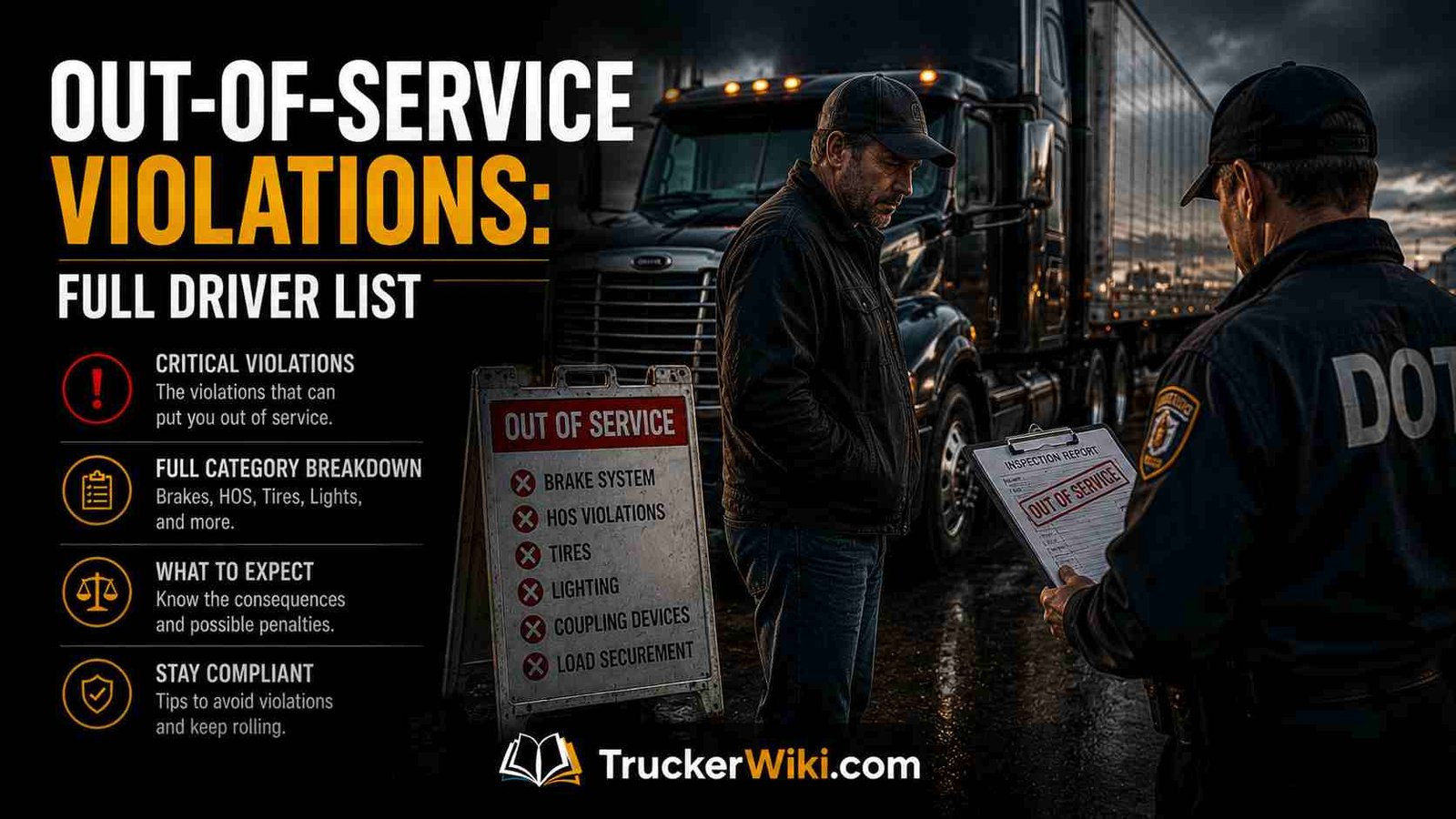
Out-of-Service Violations: Full Driver List
An out-of-service order issued at a roadside inspection means the driver may not operate the commercial motor vehicle until the specific condition causing the order is corrected. The North American Standard Out-of-Service Criteria, maintained by the Commercial Vehicle Safety Alliance and updated annually (effective April 1 each year), is the authoritative document that enforcement officers use to determine when a driver or vehicle crosses from a citable violation into an OOS condition. The two are not the same thing. Many violations are cited without producing an OOS order. OOS conditions are the subset of violations serious enough to stop movement immediately.
The CVSA approved 17 changes to the 2026 Out-of-Service Criteria effective April 1, 2026. The most significant driver-side change is a new OOS condition specifically for ELD tampering that makes it impossible to determine driving and resting periods. This article covers every driver-side OOS condition organized by category, the specific thresholds for each, what the driver must do to clear the order, and how the 2026 changes affect the framework.
A driver OOS order and a vehicle OOS order are separate. A driver can be placed OOS while the vehicle remains operable, in which case a different qualified driver can take the load. A vehicle can be placed OOS while the driver is compliant, in which case the vehicle must be repaired before it moves but the driver can be reassigned. Both types of OOS conditions appear on the same inspection report. The Driver/Vehicle Examination Report (DVER) identifies which conditions apply to the driver, which apply to the vehicle, and what is required before each can be cleared.
What an OOS Order Means and How It Is Resolved

When a driver is placed OOS, movement stops at that location. The driver cannot operate the CMV for any purpose until the specific OOS condition is resolved. If the condition is a credential issue (expired medical certificate, wrong CDL class), the driver must either produce the correct credential or the vehicle cannot move until a qualified replacement driver arrives. If the condition is an HOS violation (exceeded driving limit or weekly cap), the driver must complete the required off-duty rest at that location before resuming operation.
The driver receives a copy of the Driver/Vehicle Examination Report (DVER) documenting the OOS condition and citing the applicable regulation. The report specifies how long the driver must remain out of service for HOS violations, or what action is required to clear a credential or equipment violation.
The inspecting officer notes the required off-duty duration for HOS OOS orders on the DVER. A driver placed OOS for exceeding the 14-hour window must take 10 consecutive hours off duty before driving again. A driver placed OOS for exceeding the 70-hour weekly limit must wait for enough hours to recap through the rolling window or complete a 34-hour restart.
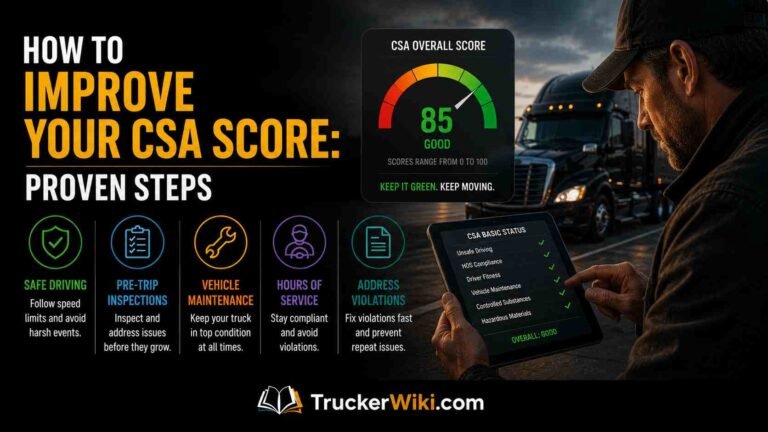
Every OOS violation generates an inspection record that enters FMCSA’s Safety Measurement System. Under the 2026 Enhanced SMS methodology, OOS violations carry a severity weight of 2, compared to a weight of 1 for non-OOS violations. An OOS citation from a driver-side condition enters the carrier’s CSA score under the relevant BASIC category and the driver’s PSP record simultaneously.
If a driver believes an OOS citation was incorrect (wrong USDOT attributed, incorrect violation code, factually inaccurate data), the appropriate remedy is a DataQs challenge at dataqs.fmcsa.dot.gov. DataQs handles factual data corrections, not disputes about officer judgment.
CDL and Driver Qualification OOS Conditions
The largest category of driver OOS conditions involves licensing, medical certification, and driver qualification status. These are credential-based conditions that the officer verifies from documents rather than from physical observation of the driver’s behavior on the road.
No valid Commercial Driver’s License. A driver operating a CMV that requires a CDL without possessing a valid CDL is placed OOS. This includes operating on a learner’s permit without a licensed CDL holder present in the vehicle as required.
Wrong CDL class for the vehicle being operated. A driver holding a Class B CDL operating a Class A combination vehicle (tractor-trailer) is placed OOS. The CDL class must match or exceed the vehicle class being operated. A driver operating under a Class A license may drive any Class B or C vehicle. A Class B license does not cover Class A combination vehicles.
CDL suspended, revoked, or disqualified. A driver whose CDL has been suspended, revoked, or disqualified is placed OOS regardless of whether they are aware of the suspension status. Officers check CDLIS (Commercial Driver’s License Information System) at inspection to verify current CDL status. A suspension from a traffic violation or administrative action that the driver believes is still under appeal does not protect against an OOS order if the suspension is showing as active in CDLIS.
Required CDL endorsement absent. A driver transporting hazardous materials in quantities requiring a HazMat endorsement without that endorsement on their CDL is placed OOS. A driver hauling double or triple trailers without a doubles/triples endorsement is OOS. The endorsement must appear on the physical CDL.
Under 2026 OOS criteria update: CVSA clarified the treatment of CDL restriction violations. Violating a CDL restriction does not automatically constitute an OOS condition. An OOS order for a restriction violation applies only if required under the specific state law for the jurisdiction where the inspection is conducted. This distinction matters for drivers with restriction codes they may have forgotten about; not all restrictions produce OOS conditions.
No valid medical examiner’s certificate. A driver who cannot produce a current medical certificate, or whose medical certificate is expired, is placed OOS. Medical certificates have a maximum validity of 24 months. A driver certified with specific medical conditions (e.g., insulin-treated diabetes, vision waivers) must carry the applicable exemption or waiver documentation along with the medical certificate.
Operating in violation of medical restrictions. A driver required by their medical certificate to wear corrective lenses while driving who is found without them is placed OOS. A driver required to use a hearing aid who is found without it is OOS. The medical restrictions listed on the certificate are enforceable OOS conditions.
Drug or alcohol impairment. A driver showing signs of alcohol or controlled substance impairment is placed OOS. This condition is based on the officer’s observation and field sobriety assessment; a roadside OOS for apparent impairment can precede a formal drug or alcohol test. A driver operating after a positive drug test who has not completed the return-to-duty process under 49 CFR Part 382 and the Drug and Alcohol Clearinghouse requirements is also OOS.
Operating in violation of an existing OOS order. A driver who was previously placed OOS and operates a CMV before the OOS condition is resolved commits a separate violation for operating in violation of an OOS order. This is a significantly more serious offense than the original OOS condition.
HOS and ELD Out-of-Service Conditions
Hours of service OOS conditions are the most commonly encountered driver OOS findings at roadside inspections, with HOS violations accounting for over 32 percent of driver violations at the 2025 International Roadcheck.
Exceeded 11-hour driving limit by more than 3 hours. The OOS threshold for the 11-hour driving limit is not the limit itself but an overage of more than 3 hours beyond it. A driver who has accumulated 11.5 hours of driving has a violation but is not necessarily placed OOS. A driver who has accumulated 14.1 or more hours of driving (more than 3 hours past the 11-hour limit) meets the OOS threshold. Resolution requires 10 consecutive hours off duty.
This 3-hour buffer for the 11-hour limit does not mean a driver who is at 11.5 hours faces no consequences. The violation is cited on the DVER, enters the CSA HOS Compliance BASIC, and appears on the driver’s PSP record. The OOS order does not trigger, but the enforcement exposure is real. Many drivers misinterpret the absence of an OOS order as an absence of any consequence, which is incorrect.
Any driving after the 14-hour window expires. Unlike the 11-hour limit, the 14-hour on-duty window produces an OOS condition the moment any driving occurs after it expires. There is no 3-hour grace period for the 14-hour window. A driver who is found to have driven even 15 minutes after their 14-hour window expired meets the OOS threshold. Resolution requires 10 consecutive hours off duty.
Exceeding the 60/70-hour weekly limit. A driver who has accumulated more than 60 hours on duty in 7 consecutive days (or 70 hours in 8 days) and has been driving after exceeding the weekly cap is OOS. Resolution requires either waiting for enough hours to recap from the rolling window or completing a full 34-hour restart. This condition is less commonly found at roadside than the daily limit violations because ELDs proactively display the weekly accumulation and alert drivers before they reach the cap. However, drivers who do not monitor their rolling total, particularly those who switch between carriers or who have a second job contributing on-duty hours, can reach the cap without realizing it.
No records of duty status for the current day and previous 7 days. A driver who cannot produce any ELD records or paper logs for the current day and the 7 prior days is OOS for no records. A driver who can produce some records but not all 8 days may receive a citation but not necessarily an OOS order, depending on the specific circumstances and inspector judgment.
False records of duty status. Recording or maintaining false records of duty status is an OOS condition when the inspector can determine from available evidence that the records do not reflect actual driving and rest periods. The inspector cross-references ELD data against GPS movement, fuel receipts, and toll records to identify discrepancies.
ELD tampering (2026 addition, effective April 1, 2026). A new OOS condition added to the 2026 CVSA criteria states that when ELD tampering makes it impossible to determine what driving or resting events occurred, the driver is placed OOS. This is separate from the false RODS condition, which requires the inspector to be able to determine the actual periods from available evidence. The 2026 addition specifically addresses situations where tampering has so thoroughly corrupted the record that no determination can be made. Resolution requires completing a qualifying off-duty rest period with verifiable records.
No valid ELD when one is required. A driver required to use a registered ELD who cannot produce one, including drivers operating a device that has been revoked from the FMCSA registered list after the transition deadline, is in a no-ELD condition. Resolution requires the driver to maintain paper logs going forward and the carrier to replace the device within the malfunction repair window.
Additional Driver OOS Conditions
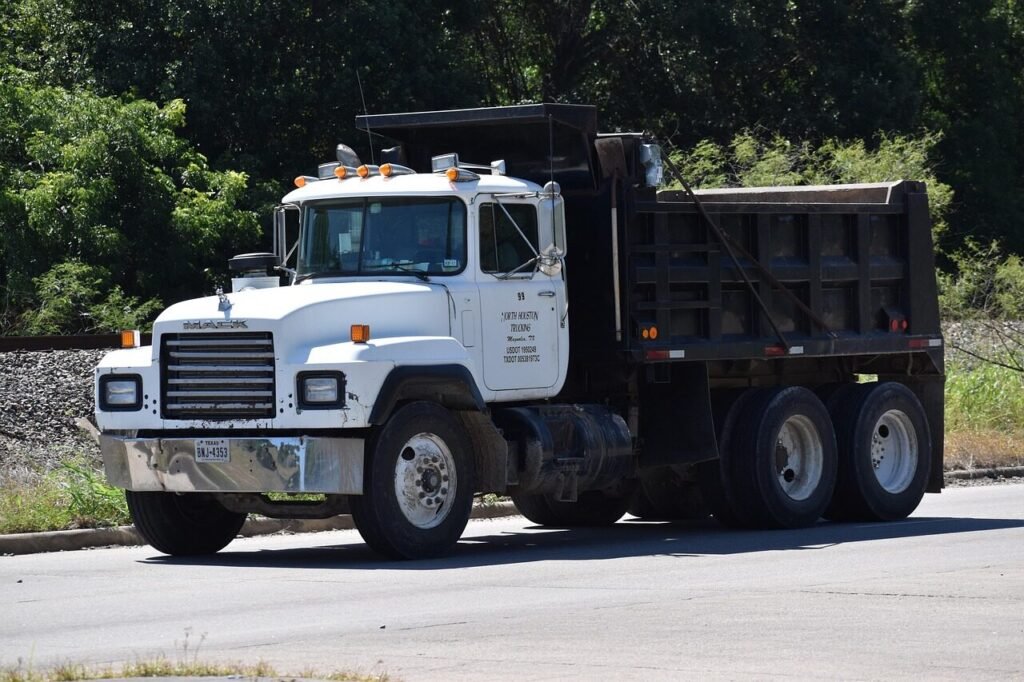
Several OOS conditions fall outside the CDL/medical and HOS categories.
Seatbelt not in use. A driver not wearing a seatbelt when the vehicle is in motion is OOS. This is one of the few OOS conditions that produces an immediate, observable violation without requiring document review. The seatbelt requirement applies to the driver at all times when the vehicle is moving; there is no exception for slow-speed yard movements or short distances.
Driver is ill or fatigued to the point of being unable to safely operate. Under 49 CFR 392.3, a driver who is ill, fatigued, or otherwise in a condition that makes safe operation impractical shall not operate a CMV. An inspector who determines the driver cannot safely operate may place the driver OOS. This is an officer discretion condition based on direct observation and conversation with the driver.
English proficiency (effective June 25, 2025). Following FMCSA’s May 20, 2025 enforcement policy, drivers who fail a two-part English proficiency test at a roadside inspection are placed OOS beginning June 25, 2025. The driver must be able to respond to official inquiries and maintain required records in English. This condition is enforced at the roadside, not just at the pre-employment stage. The test is administered by the officer during the inspection and consists of reading a regulatory sign and responding to a standard inquiry in English.
Skill Performance Evaluation (SPE) certificate absent. A driver who has received an SPE certificate authorizing them to operate with a physical condition that would otherwise disqualify them, and who cannot produce that certificate at a roadside inspection, may be placed OOS. The SPE certificate must be on the driver’s person at all times when operating.
After an OOS Order: Waiting, Resolving, and Challenging
The driver’s immediate obligation after receiving an OOS order is to comply with it. Operating a CMV in violation of an OOS order is a separate federal offense that carries higher penalties than the original condition and a greater CSA severity weight.
The timeline for resolution depends entirely on the specific condition. A credential OOS (expired medical certificate) can potentially be resolved in hours if the driver can obtain a same-day medical exam and new certificate. An HOS OOS (14-hour window expiration) requires a minimum of 10 consecutive hours off duty before the driver can legally resume, which means the truck is stationary for at least 10 hours from the point of inspection. A weekly cap OOS requires either a 34-hour restart or recap math showing enough hours have dropped off the rolling window.
The operational cost of a driver OOS order extends beyond the direct downtime. The carrier typically cannot move the load until either the driver clears the order or a replacement driver arrives. If a time-sensitive load misses its delivery window, the carrier may face contractual penalties with the shipper. If the OOS occurs late in the evening or on a weekend when replacement drivers are unavailable, the truck may sit for many hours. The cost of a single OOS order, accounting for downtime, replacement logistics, and any shipper penalties, frequently exceeds the civil penalty for the underlying violation by a significant margin.
Carriers should have a protocol for responding to driver OOS orders that includes notifying the safety department immediately, dispatching a replacement driver if a load cannot wait, and initiating the DataQs review process if any part of the inspection record appears inaccurate. The most effective challenge window is within 30 days of the inspection, when supporting documentation is current and accessible.
The pre-trip inspection is the most practical prevention tool for vehicle-related OOS conditions. The DOT Pre-Trip Inspection Checklist covers every component that enforcement officers check at a Level I inspection.
By TruckerWiki Editorial Team | Sources: CVSA North American Standard Out-of-Service Criteria 2026, FreightWaves coverage of 17 OOS criteria changes (February 2026), CVSA Operational Policy 14 (ELD transfer procedures), 49 CFR 392.3 (ill/fatigued driver), FMCSA English proficiency enforcement policy (May 2025). The 2026 OOS criteria edition is effective April 1, 2026; prior-year criteria govern inspections conducted before that date.


[…] show HOS violations results in citation or OOS depending on the violation type and severity. The HOS violations and OOS thresholds article details which specific HOS conditions produce OOS orders versus […]
[…] and what the recovery path looks like. For the specific conditions that produce OOS orders, see the Out-of-Service Violations: Full Driver List […]
[…] For context on how these violations affect the CSA Safety Measurement System and BASIC percentiles, see the CSA Score Explained article. For the specific conditions that produce OOS orders, see the Out-of-Service Violations: Full Driver List. […]