What Happens If You Fail a DOT Inspection?
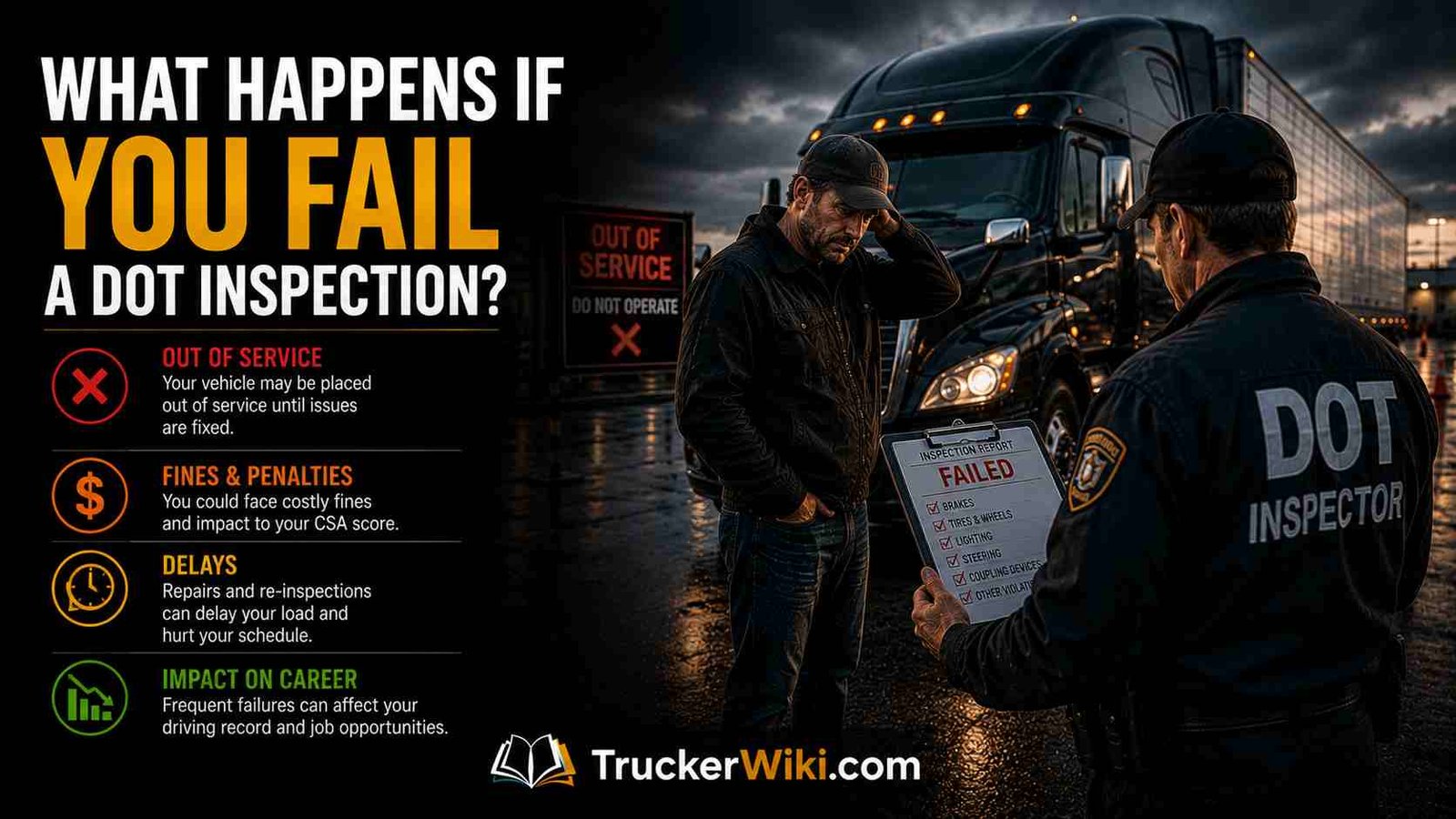
“Failing” a DOT inspection is not a single outcome. It is a spectrum. A roadside inspection can produce a written warning with no immediate operational consequence, a citation that allows the driver to continue but records a violation, or an out-of-service order that stops the truck immediately. Understanding which outcome applies in a given situation and what each one triggers downstream is the practical knowledge that separates a driver who manages inspection results effectively from one who is caught off guard by consequences they did not anticipate.
This article covers each outcome in sequence: what happens at the roadside, what happens in the CSA database, what happens to the carrier’s insurance and business relationships, and what the recovery path looks like. For the specific conditions that produce OOS orders, see the Out-of-Service Violations: Full Driver List article.
The Three Outcomes at the Roadside
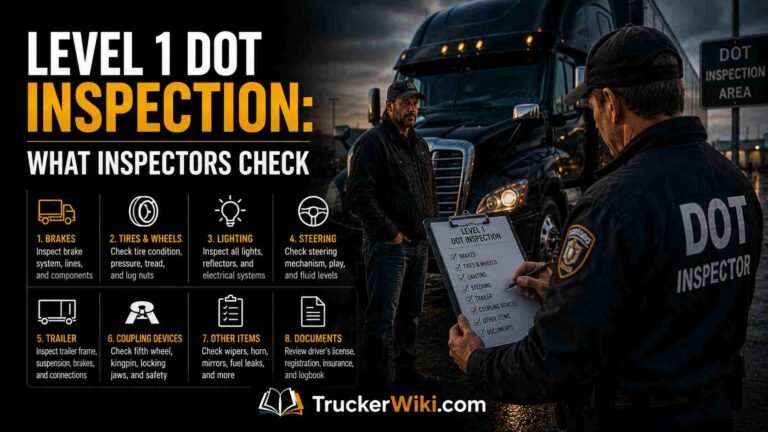
Every DOT inspection ends with one of three results. The officer documents the inspection outcome on the Driver/Vehicle Examination Report (DVER) and provides a copy to the driver before the vehicle leaves.
Outcome 1: No violations. The driver and vehicle fully pass the inspection. The officer completes the DVER with no violations cited. If the inspection was a Level I or Level V, the vehicle is eligible for a CVSA decal. The driver is released immediately. A clean inspection record enters the FMCSA Safety Measurement System as a positive data point that actively improves the carrier’s BASIC percentile. This is the only outcome that produces a CVSA decal.
Outcome 2: Violations found, no OOS order. The officer finds one or more violations but none meets the CVSA out-of-service threshold. The driver receives a DVER with citations for the violations found. The driver is permitted to continue operating immediately. The vehicle is not detained.
However, all citations on the DVER enter the CSA Safety Measurement System within days of the inspection and affect the relevant BASIC categories for 24 months. A non-OOS citation is a less immediate consequence than an OOS order, but it is not a minor administrative matter.
It generates a violation record that affects the carrier’s percentile ranking and the driver’s PSP history. A non-OOS brake citation that would not produce an OOS order at the current inspection can push a carrier’s Vehicle Maintenance BASIC closer to the 80th percentile intervention threshold, where it combines with prior violations to trigger a warning letter or targeted inspection attention.
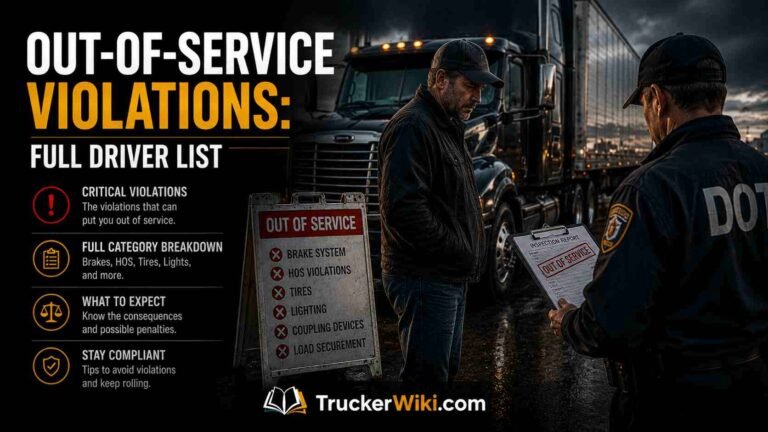
Outcome 3: OOS order issued. One or more conditions meet the CVSA OOS threshold and the driver, vehicle, or both are placed out of service. Operation stops immediately at that location. The driver may not drive and the vehicle may not move until the OOS condition is corrected. What constitutes an OOS condition for drivers versus vehicles is covered in detail in the Out-of-Service Violations article. The DVER documents the specific OOS condition and specifies what is required to clear it.
The Immediate OOS Consequence: Where the Truck Stays
When a vehicle is placed OOS at a roadside location, it cannot be moved by the cited driver until the OOS condition is resolved. If the OOS is vehicle-based (brake defect, tire condition, frame crack), a qualified repair must be completed at or near the inspection location before the vehicle can move under its own power. In some cases, the vehicle must be towed to a repair facility, which adds towing costs on top of the repair cost.
If the OOS is driver-based (HOS violation, expired medical certificate, no valid CDL class), the vehicle itself may be movable by a different qualified driver who has no OOS condition. The carrier’s first step when a driver receives an OOS order is to determine whether the load can be transferred to a replacement driver and whether the delivery timeline can still be met. If no replacement driver is available, the load sits until either the driver clears the OOS condition or an alternative is arranged.
The geography of where the OOS order is issued affects the practical resolution significantly. A driver placed OOS at a major weigh station on an interstate has access to truck stop repair facilities, nearby shops, and potentially the carrier’s nearest terminal. A driver placed OOS at a rural secondary highway inspection site may face a 50-mile tow to the nearest diesel repair shop, no immediate replacement driver availability, and a multi-day wait for parts. The compounding costs of a rural OOS event can far exceed those of the same violation found at a well-served urban weigh station.
Operating a vehicle or driver in violation of an active OOS order is a separate and more serious federal offense. The driver faces fines up to $25,000 per violation for continued operation under an OOS order, potential criminal charges for willful violations, additional CSA points, and potential CDL license suspension or revocation. The carrier faces a maximum penalty of $25,000 per violation for permitting a driver to operate under an OOS order. The operational pressure to move a freight load is not a defense; the OOS order supersedes any delivery commitment.
The time required to clear an OOS order depends entirely on the type:
- Driver HOS OOS: minimum 10 consecutive hours off duty before driving may resume; for weekly cap OOS, enough recap hours must drop off the rolling window or a 34-hour restart must be completed.
- Driver credential OOS (expired medical card): driver must obtain a current medical examination and new certificate; same-day resolution is possible in some locations.
- Vehicle mechanical OOS (brake defect, tire condition): repair must be completed by a qualified mechanic who certifies the repair; a follow-up inspection may be required depending on the severity of the original defect and the location of the repair
The DVER and What Enters the CSA Database
The DVER is the source document for everything that follows the inspection. The driver should read it completely before leaving the inspection site and request clarification on any item that is unclear. The DVER lists every violation by federal regulation number, the violation description, and whether the violation produced an OOS order. It also lists the inspection level conducted, the officer’s certification number, the carrier’s USDOT number, the vehicle’s VIN and license plate, and the driver’s CDL number and state. Every one of these data fields has been a source of DataQs challenge when incorrectly recorded.
Drivers who receive citations during an inspection should retain the DVER permanently. Even after the 24-month SMS window has closed and the violation is no longer affecting the BASIC percentile, the DVER serves as the contemporaneous record of what the officer found and cited.
In litigation following a crash that occurs months after a failed inspection, plaintiff attorneys routinely request all DVER records from the prior 2 to 3 years as part of discovery. A carrier that has retained these records and can demonstrate a pattern of addressing cited violations through subsequent repairs and clean inspections is in a stronger evidentiary position than a carrier whose records are incomplete. The pre-trip inspection discipline that prevents failed inspections is also the discipline that prevents the crashes that generate the most severe litigation exposure.
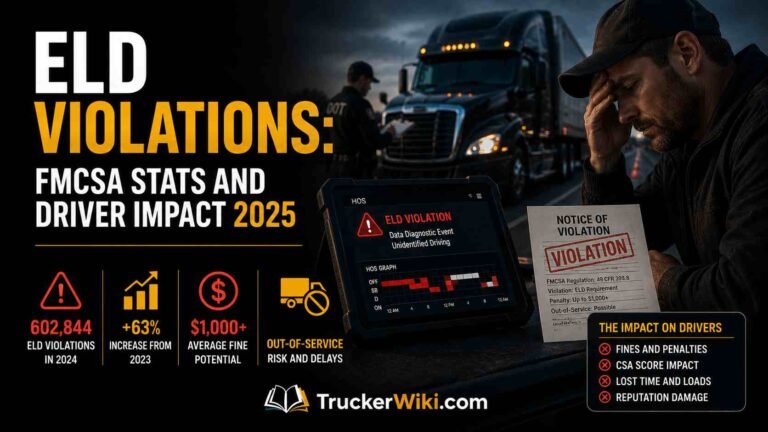
The DVER data is transmitted to FMCSA’s Motor Carrier Management Information System (MCMIS) within days of the inspection. From MCMIS, the violation data flows into the Safety Measurement System and updates the carrier’s BASIC percentiles during the next monthly SMS data update (typically the first week of each month). The CSA violations appear at the carrier’s USDOT number and in the driver’s PSP record simultaneously.
Under the 2026 Enhanced SMS methodology, OOS violations carry a severity weight of 2; non-OOS violations carry a weight of 1. Both types are time-weighted in the 24-month scoring window, with violations in the most recent 6 months carrying three times the weight of violations from the previous year. A single OOS violation from a failed inspection this month has six times the BASIC percentile impact of a non-OOS violation from 18 months ago, which is why preventing new OOS violations is always the highest-priority action for a carrier with an elevated BASIC score.
For drivers, the PSP record retains inspection violation data for 5 years and crash data for 10 years, which is longer than the 24-month SMS calculation window. A driver who receives OOS citations at one carrier and moves to another employer does not leave those citations behind. The new employer’s pre-employment PSP screening will show the same history. A driver with a pattern of HOS violations or OOS conditions in their PSP record will face scrutiny from carriers whose insurance underwriters require clean driver records as a condition of coverage.
If any violation on the DVER is factually incorrect (wrong USDOT number, wrong regulation code, violation already dismissed in court), the carrier or driver can file a DataQs challenge at dataqs.fmcsa.dot.gov. A successful challenge removes the data from both the SMS calculation and the PSP record. Challenges should be submitted within 30 days when supporting documentation is most accessible. The DataQs system handles factual corrections; disputes about whether the officer should have cited the violation require the state court citation appeal process.
Financial Consequences: Fines, Insurance, and Lost Freight
The immediate financial cost of a failed DOT inspection comes from several directions that are usually underestimated when drivers focus only on the civil penalty line.
Civil penalties. FMCSA civil penalties for vehicle maintenance violations range from $1,000 to $19,277 per violation for carriers operating an OOS vehicle, per 49 CFR Appendix B to Part 386. HOS violations range from $1,000 to $19,246 per violation for carriers. These maximums apply to the most egregious cases; typical enforcement assessments are lower but can still reach several thousand dollars for a single inspection with multiple violations. Civil penalties for the same violation are assessed separately against the driver and the carrier, meaning a single OOS event can produce two distinct penalty assessments.
Repair costs. An OOS vehicle condition requires repair before the vehicle can move. Emergency roadside brake repairs typically cost significantly more than scheduled shop maintenance. A single brake adjustment completed roadside at a truck stop shop costs less than a systematic brake repair at a terminal shop, but a brake drum replacement or an air chamber failure found on the road at an inspection site can cost $500 to $2,000 or more depending on the repair facility and parts availability.
Towing. A vehicle that cannot be driven to a repair facility requires towing. Commercial vehicle towing rates vary significantly by location but typically range from $150 to $500 for short-distance tows and can reach $1,000 or more for specialty equipment. An oversized or overweight load may require specialized towing equipment at significantly higher rates.
Load delay penalties. If the OOS condition causes the load to miss a delivery window, the carrier may face contractual penalties with the shipper. Time-sensitive freight (food, medical supplies, just-in-time manufacturing parts) may carry liquidated damages clauses that the carrier is liable for when delivery windows are missed due to compliance-related delays. A single OOS event with a 12-hour repair and restart delay can produce shipper penalty exposure that exceeds the combined fines, repair, and towing costs.
Insurance impact. Insurance underwriters access FMCSA SMS data at policy renewal. Carriers with elevated BASIC percentiles, particularly in Unsafe Driving, Vehicle Maintenance, and Crash Indicator, face premium increases of 10 to 30 percent in the renewal cycle following the violation. A carrier with a single severe OOS violation that crosses the Vehicle Maintenance BASIC intervention threshold may face policy non-renewal in the surplus lines market if the violation is not resolved and the BASIC score is not improved before the renewal date. The insurance impact is not immediate; it arrives at the next renewal, which can be 6 to 12 months after the original inspection.
The Enforcement Cascade: How Repeated Failures Escalate

A single failed inspection, while consequential, does not trigger a compliance review. The enforcement cascade begins when the pattern of violations pushes one or more BASICs above the intervention threshold. The intervention threshold for the HOS Compliance, Unsafe Driving, and Crash Indicator BASICs is the 65th percentile among peer carriers. For Vehicle Maintenance, Driver Fitness, and Hazardous Materials, it is the 80th percentile.
When a BASIC crosses its threshold, FMCSA initiates the intervention ladder: warning letter, targeted roadside inspections, off-site investigation, on-site focused investigation, on-site comprehensive investigation, and in the most severe cases, safety rating downgrade and potential operating authority suspension. Each step represents escalating FMCSA commitment of enforcement resources and escalating consequences for the carrier.
The connection between individual inspection failures and the enforcement ladder is direct and data-driven. Every failed inspection is a data point. A carrier whose drivers consistently fail inspections in the same violation category is building a profile that leads predictably to focused enforcement attention in that area. The most effective response to a failed inspection is addressing the root cause of the violation, not just waiting for the specific violation to age out of the 24-month window.
A practical example: a carrier that receives brake OOS violations at three separate roadside inspections over 6 months is not facing three isolated events. Each violation enters the Vehicle Maintenance BASIC with a 3x time weight. Three OOS violations at severity weight 2 each, with 3x recency multiplier, represents 18 weighted units flowing into the BASIC calculation within a single quarter.
Depending on the carrier’s peer group and total inspection count, that pattern can push the Vehicle Maintenance BASIC well past the 80th percentile threshold and trigger a focused on-site investigation directed at the carrier’s maintenance program. The investigation is not triggered by the most recent brake violation; it is triggered by the accumulation.
Shippers and freight brokers also check CSA scores as part of carrier qualification. A carrier whose BASICs are above threshold may find that shippers with CSA score requirements begin rejecting their loads. Spot market brokers who screen carrier safety ratings before tendering freight will pass over carriers with elevated scores in favor of competitors with clean profiles. The revenue impact of lost freight contracts frequently exceeds the direct penalty costs of the violations that produced the elevated scores.
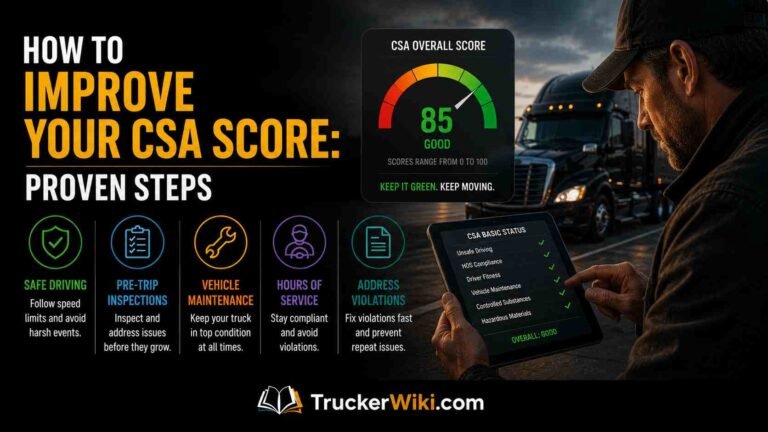
For the complete framework of how violations affect BASIC percentiles and what actions consistently lower CSA scores, see the How to Improve Your CSA Score: Proven Steps article. For what each inspection level covers, see the DOT Roadside Inspections: All 6 Levels Explained article.
By TruckerWiki Editorial Team | Sources: FMCSA CSA Safety Measurement System, 49 CFR Appendix B to Part 386 via Cornell LII, FileFlo failed inspection guide (April 2026), FleetCollect roadside inspection guide (February 2026). SMS violation window is 24 months as of May 2026; no change to this timeline has taken effect.