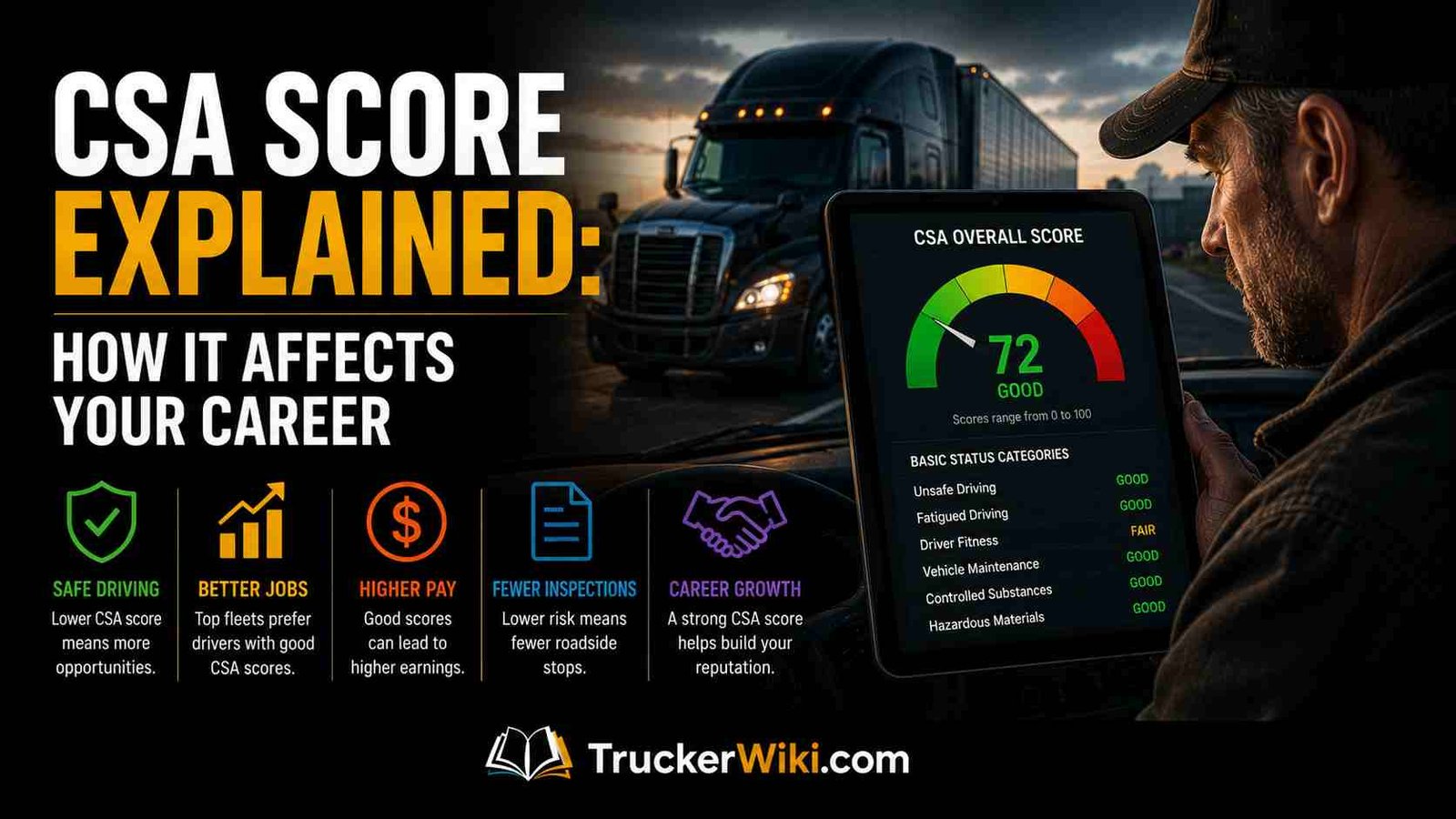
CSA Score Explained: How It Affects Your Career
The Compliance, Safety, Accountability (CSA) program is FMCSA’s enforcement targeting and safety management system, built around the Safety Measurement System (SMS) that scores motor carriers across seven categories of safety performance. CSA scores are assigned to motor carriers, not to individual drivers.
A driver does not have a CSA score. What a driver has is a Pre-employment Screening Program (PSP) record containing five years of roadside inspection history and ten years of crash data. Both the carrier’s CSA scores and the driver’s PSP record affect career outcomes, but they are different data systems with different audiences and different consequences.
This distinction matters practically. A driver who changes carriers does not bring their former carrier’s CSA BASIC percentiles with them. They bring their own PSP inspection record.
A driver who accumulated OOS violations while working for a carrier with a poor Vehicle Maintenance BASIC is carrying those violations in their personal PSP history regardless of where they work next. Understanding both systems, how they interact, and how long each type of data persists is the basis for managing your compliance profile over a career.
What the CSA Program Is and How Scores Are Calculated

The CSA program replaced FMCSA’s previous SafeStat system in 2010 and has operated as the primary carrier safety measurement tool since then. The Safety Measurement System collects data from three sources: roadside inspection reports, crash reports, and investigation findings from FMCSA compliance reviews and audits. Every data point is assigned to the responsible motor carrier’s USDOT number within days of the event.
CSA scores are percentile-based, not absolute. A carrier’s SMS score in any BASIC category is a percentile ranking compared to other carriers with a similar number of inspections in the same 24-month window. This means a carrier with 3 violations out of 10 inspections is scored differently than a carrier with 3 violations out of 100 inspections.
Low-inspection carriers with any violations can have elevated percentiles even if their absolute violation count appears small. High-volume carriers with many clean inspections can maintain lower percentiles despite having more total violations in their record.
The peer group comparison has practical implications for owner-operators and small carriers. An owner-operator with 1 OOS violation out of 2 total inspections has a 50 percent violation rate. A large fleet with 10 OOS violations out of 200 inspections has a 5 percent violation rate.
The owner-operator is likely to have a much higher BASIC percentile despite having far fewer violations in absolute terms. This is why owner-operators must treat every inspection as proportionally more significant than a driver at a large fleet: the statistical weight of each individual inspection is higher when the total inspection count is low.
FMCSA updates SMS data monthly, typically during the first week of each month. New inspections, violation reports, and crash reports may appear with a delay of a few days to a few weeks as state agencies submit their data to FMCSA’s national database. A roadside inspection conducted today may not appear in the carrier’s SMS score until the following monthly update cycle.
The 2026 Enhanced SMS methodology introduced two significant changes from the scoring system in place since 2010.
First, the severity weight scale was simplified from a 1-to-10 range to a 1-or-2 scale: OOS violations carry a weight of 2, all other violations carry a weight of 1.
Second, carriers are now segmented by vehicle type (straight trucks versus combination vehicles) within their peer group comparisons, producing more relevant percentile rankings by comparing carriers with similar operational profiles rather than mixing straight-truck-heavy operations with tractor-trailer-heavy operations in the same percentile pool.
The Seven BASIC Categories and Intervention Thresholds
The CSA SMS organizes violations across seven Behavior Analysis and Safety Improvement Categories (BASICs). Each BASIC has an intervention threshold expressed as a percentile. When a carrier’s percentile in a BASIC exceeds the threshold, FMCSA intervention can begin. The thresholds vary by category based on the safety criticality of the violations involved.
| BASIC Category | What It Measures | Intervention Threshold |
|---|---|---|
| Unsafe Driving | Speeding, reckless driving, improper lane changes, failure to use seatbelt | 65th percentile |
| Hours-of-Service Compliance | 11-hour, 14-hour, 30-minute break, 70-hour violations; false RODS; ELD violations | 65th percentile |
| Vehicle Maintenance | Brakes, tires, lights, steering, suspension, coupling devices, cargo securement | 80th percentile |
| Controlled Substances and Alcohol | Drug and alcohol violations; positive drug test results | 65th percentile |
| Hazardous Materials Compliance | HazMat placard, packaging, documentation violations | 80th percentile |
| Driver Fitness | Expired CDL, missing endorsements, expired medical certificate, invalid driver documentation | 80th percentile |
| Crash Indicator | Crash involvement rates weighted by crash severity and frequency | 65th percentile |
The 65th percentile threshold applies to the four categories considered most directly linked to crash risk: Unsafe Driving, HOS Compliance, Controlled Substances and Alcohol, and Crash Indicator. The 80th percentile threshold applies to the three categories considered more operational in nature. A carrier must be worse than 80 percent of similar carriers before triggering intervention in Vehicle Maintenance, HazMat, or Driver Fitness.
Exceeding a threshold in a single BASIC triggers warning letters and targeted inspection attention. Exceeding thresholds in multiple BASICs simultaneously signals a systemic safety problem to FMCSA and is significantly more likely to result in an on-site comprehensive investigation rather than a focused single-BASIC inquiry. FMCSA’s prioritization model weights carriers with multiple elevated BASICs more heavily for intervention resources.
HOS Compliance is the BASIC most directly within a driver’s individual control. Every HOS violation found at a roadside inspection enters the carrier’s HOS BASIC as a data point. A driver who consistently runs legal, keeps annotations complete on their ELD, and maintains clean records is actively protecting the carrier’s HOS BASIC percentile with every clean inspection they pass. For owner-operators who are both driver and carrier, every clean inspection improves the HOS BASIC percentile directly; there is no separation between the driver’s behavior and the carrier’s score.
Drivers Do Not Have CSA Scores, But PSP Records Affect Your Career Directly
The single most common misconception about CSA in the driver community is that individual drivers have CSA scores that follow them from carrier to carrier. They do not. CSA BASIC percentiles are assigned to the motor carrier’s USDOT number. When a driver changes carriers, they do not take the former employer’s CSA scores with them, and they do not inherit the new employer’s BASIC percentiles.
What drivers carry with them is their Pre-employment Screening Program (PSP) record. The PSP database contains:
- Five years of roadside inspection history, including every OOS violation and non-OOS citation recorded against the driver’s CDL number
- Ten years of crash involvement data, including crashes where the driver was the operating driver regardless of fault determination
The PSP record is distinct from the CSA SMS in two important ways. First, it is keyed to the driver’s CDL number rather than the carrier’s USDOT number. Second, its retention periods are longer: five years for inspections versus the 24-month SMS window, and ten years for crashes versus the SMS’s shorter crash data window.
Drivers can purchase their own PSP report at psp.fmcsa.dot.gov for $10. Reviewing your own PSP report before a job search reveals exactly what prospective employers and their insurance underwriters will see. A driver who has not reviewed their PSP record in several years may be unaware of citations that are still within the 5-year window and are appearing on every employer background check.
Carriers accessing PSP data for pre-employment screening must comply with the Fair Credit Reporting Act (FCRA) requirements. The driver must sign an FCRA disclosure and authorization before the carrier pulls the PSP report. The carrier must provide an adverse action notice if it uses PSP data to make a negative employment decision. A carrier that refuses to hire a driver based on PSP findings without providing the required adverse action notice is in violation of FCRA, giving the driver legal recourse.
Large carriers and those with specific insurance underwriting requirements often screen PSP records as part of standard hiring. Multiple OOS violations in a 5-year PSP window, particularly in HOS or driver fitness categories, create barriers to employment at carriers whose insurers impose driver record requirements as a condition of coverage. An owner-operator running under their own authority also carries their PSP record in the context of broker and shipper vetting, where some load boards require PSP review as part of carrier qualification.
The practical career implication for drivers is direct. A driver who accumulates OOS violations at one carrier, then moves to a different carrier, is not starting fresh. The PSP record moves with the CDL.
The new carrier’s HR team sees the same inspection history that the old carrier’s insurer reviewed. Drivers who want to improve their employment prospects at better-paying carriers, or who want to qualify for carriers with strict safety programs, need to understand that the 5-year PSP window means violations from 4 years ago are still fully visible and carry the same weight as a violation from last month in most employer screening processes.
How an Elevated BASIC Score Triggers Enforcement and Business Consequences

Crossing a BASIC intervention threshold initiates FMCSA’s enforcement response process. The process follows a structured ladder with escalating consequences based on how elevated the BASIC percentile is and whether the carrier is responsive to earlier interventions.
Warning letter. FMCSA issues a formal notice identifying the BASIC of concern and requesting corrective action. This is not a penalty; it is a documented notification that creates a record of FMCSA’s awareness and gives the carrier an opportunity to address the problem before further escalation.
Targeted roadside inspections. Carriers with elevated BASIC scores are flagged in the inspection targeting system, meaning their vehicles are more likely to be selected for inspection at weigh stations and mobile enforcement operations. The increased inspection frequency creates additional data points that can further affect the BASIC score if violations continue, or begin to improve the score if clean inspections accumulate.
Off-site investigation. A safety investigator reviews the carrier’s records remotely, including driver logs, maintenance records, and driver qualification files. No on-site visit is required, but the carrier must produce requested records on a specified timeline.
On-site focused investigation. An investigator visits the carrier’s facility to examine specific compliance areas identified by the elevated BASIC. An HOS-driven investigation focuses on driver logs, ELD records, and dispatch practices. A Vehicle Maintenance-driven investigation focuses on maintenance records, DVIR completion, and repair documentation.
On-site comprehensive investigation. A full audit of all operational compliance areas. Every BASIC category is reviewed. These investigations typically produce multiple violation findings and frequently result in civil penalty assessments.
Safety rating downgrade. FMCSA can assign a Conditional or Unsatisfactory safety rating following an investigation. A Conditional rating restricts certain business activities and triggers insurance scrutiny. An Unsatisfactory rating can result in an order to cease operations.
Beyond FMCSA enforcement, elevated CSA BASIC scores affect carrier relationships throughout the supply chain. Insurance underwriters access SMS data when quoting and renewing commercial auto policies. Carriers with elevated percentiles in Unsafe Driving, Crash Indicator, and Vehicle Maintenance face premium increases of 10 to 30 percent as BASICs approach intervention thresholds, according to Foley Carrier Services’ March 2026 analysis. Very elevated scores can result in non-renewal and surplus lines placement where standard markets decline coverage.
Shippers and brokers incorporate CSA data into carrier vetting programs. Load boards used by owner-operators and small carriers may include CSA score filters that exclude carriers above certain BASIC thresholds from freight opportunities. A carrier that loses access to a load board’s shipper base due to CSA scores loses revenue directly, independent of any FMCSA enforcement action.
How Long CSA Violations Stay on Your Record
The 24-month SMS scoring window is the most important timeline for operational CSA management, but it is not the only timeline that matters.
Within the 24-month SMS window, violations are time-weighted by recency. Violations from the most recent 6 months carry the highest weight in the BASIC percentile calculation. Violations from months 7 through 12 carry a reduced weight. Violations from months 13 through 24 carry the lowest weight. After 24 months, a violation drops out of the SMS scoring calculation entirely and no longer affects the carrier’s BASIC percentiles.
However, violations do not disappear from all FMCSA databases after 24 months. The Motor Carrier Management Information System (MCMIS) retains inspection and violation data indefinitely as a historical record. FMCSA investigators conducting compliance reviews can access MCMIS history beyond the 24-month SMS window. A pattern of violations that has fallen off the active SMS scoring window may still be visible to an investigator reviewing the carrier’s long-term compliance record.
For drivers, the PSP retention periods are the operative timelines: 5 years for inspection violations and 10 years for crash involvement. These are independent of the 24-month SMS calculation and cannot be shortened by the passage of time alone. A driver with an OOS citation from 4 years ago still has that citation visible in every PSP report pulled during pre-employment screening.
Clean inspections actively shorten the practical impact of violations even within the 24-month window. Every clean Level I inspection that produces no violations is a positive data point in the BASIC percentile calculation. Carriers that proactively accumulate clean inspections through the CVSA decal program, PrePass participation, or voluntary roadside compliance checks reduce their BASIC percentiles through positive data, not just by waiting for old violations to age off. The DOT Roadside Inspections article covers how the CVSA decal program works and which inspection levels produce decal-eligible outcomes.
For drivers specifically, the most effective long-term PSP management strategy is preventing citations in the first place. Understanding HOS rules thoroughly, maintaining compliant ELD records, and passing vehicle pre-trip inspections before every shift are the actions that keep the PSP record clean. A driver who avoids OOS citations for 5 years effectively has a clean PSP record regardless of what the first years of their career looked like, because the 5-year window will have rolled past the older citations.
TruckerWiki’s How to Improve Your CSA Score: Proven Steps article covers the specific strategies in detail.
For a full breakdown of the specific violations that affect HOS BASIC scores and the civil penalties that accompany them, see the HOS Violations: Fines, Penalties and CSA Impact article.
By TruckerWiki Editorial Team | Sources: FMCSA CSA Safety Measurement System, FMCSA PSP Pre-employment Screening Program, Foley Carrier Services CSA Guide (March 2026), Forward Thinking Systems CSA Guide (April 2026), FMCSA Enhanced SMS Methodology documentation 2026. Intervention thresholds and SMS methodology current as of May 2026; confirm at csa.fmcsa.dot.gov before relying on specific threshold values.

[…] on how BASIC percentiles are calculated and what thresholds trigger FMCSA intervention, see the CSA Score Explained article […]
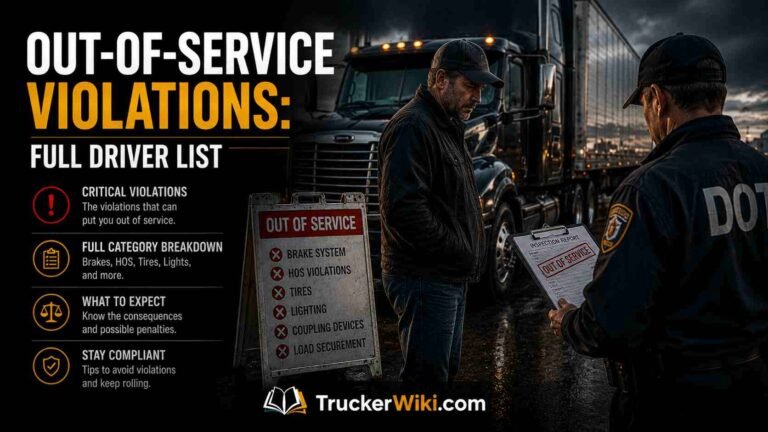
[…] 1 for non-OOS violations. An OOS citation from a driver-side condition enters the carrier’s CSA score under the relevant BASIC category and the driver’s PSP record […]
[…] context on how these violations affect the CSA Safety Measurement System and BASIC percentiles, see the CSA Score Explained article. For the specific conditions that […]
[…] TruckerWiki’s guide to how CSA scores affect your career covers how individual violations accumulate into a carrier’s public safety percentile over a rolling 24-month window, and a driver who repeatedly triggers this violation across multiple inspections creates a pattern that shows up in that calculation even if any single citation carries a low weight on its own. […]