HOS Rules: Property vs Passenger Drivers Compared
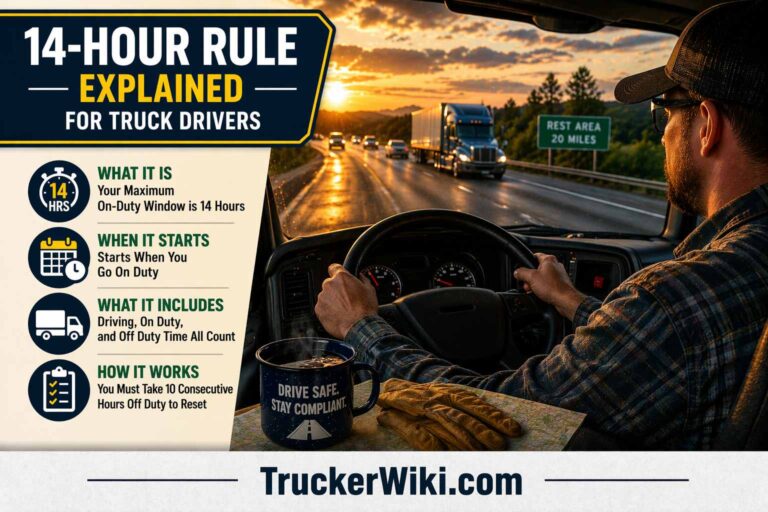
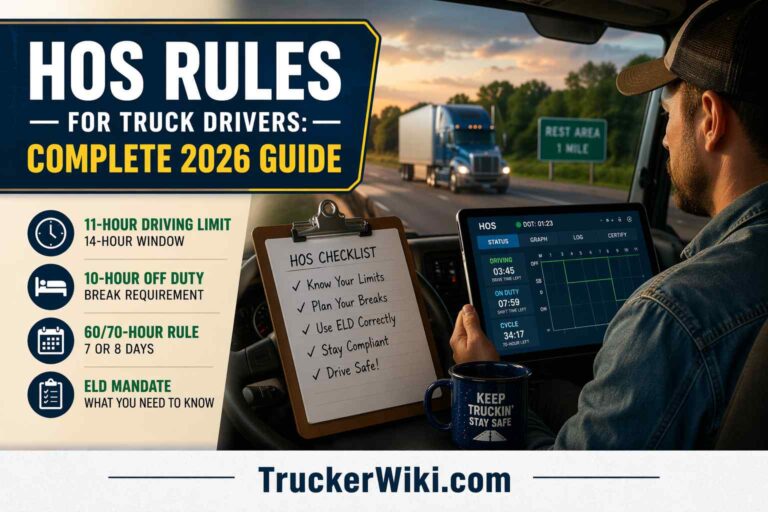
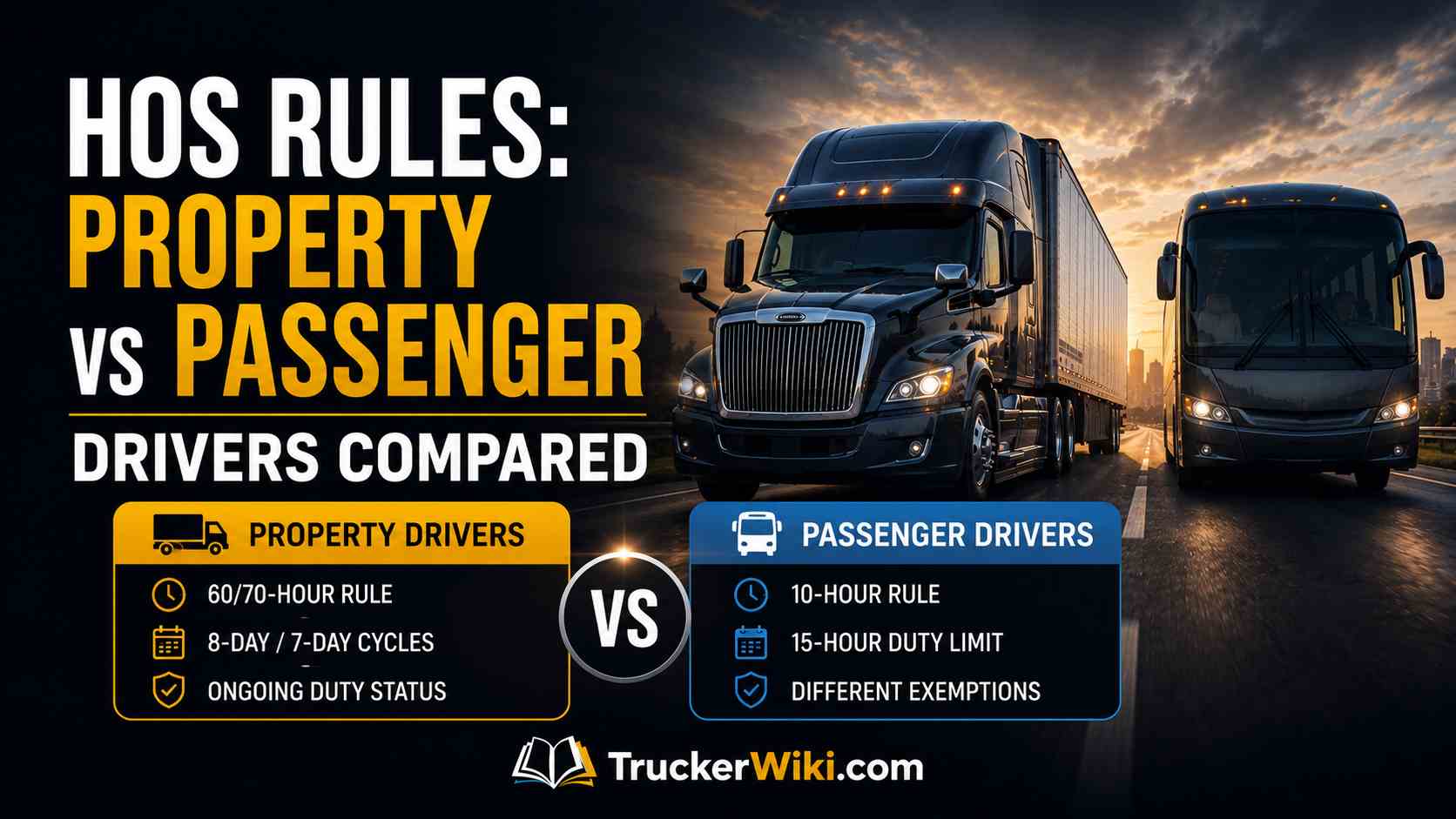
Property-carrying and passenger-carrying CMV drivers both operate under FMCSA’s hours of service framework in 49 CFR Part 395, but the specific limits are set in two different regulations with meaningfully different numbers. Property drivers operate under 49 CFR 395.3, which allows 11 hours of driving after 10 consecutive hours off duty within a 14-hour window. Passenger drivers operate under 49 CFR 395.5, which allows 10 hours of driving after 8 consecutive hours off duty within a 15-hour window.
Several rules that apply to property drivers do not apply to passenger drivers, and vice versa. The 30-minute break requirement applies only to property-carrying operations. The 7/3 and 8/2 sleeper berth splits apply only to property-carrying operations. The 34-hour restart provision under 49 CFR 395.3(c) applies only to property carriers. Passenger operations have different but related rest and berth provisions under a separate section. Drivers who move between both operation types in the same week must apply the rules for each type to the applicable driving periods.
The distinction matters most for commercial drivers who cross between the two operation types, including school bus drivers who occasionally move freight, courier drivers who operate passenger vans for charter jobs, or trucking company drivers who pick up a motorcoach assignment.
Neither the HOS regulations pillar page nor the vehicle itself tells a driver which rule applies; the nature of the operation for that specific trip determines it. A driver must identify the applicable regulation before logging the first on-duty entry each day, because logging under the wrong rule creates a false record problem even if the underlying driving was within both sets of limits.
The Core Daily Limits Side by Side

The clearest way to understand the two frameworks is to put the daily limits directly against each other. Both sets of limits apply in interstate commerce to drivers of CMVs meeting the applicable thresholds. All other HOS requirements, including ELD, RODS, on-duty time definitions, and what counts against the clock, apply identically to both driver categories.
| Rule | Property-Carrying (49 CFR 395.3) | Passenger-Carrying (49 CFR 395.5) |
|---|---|---|
| Minimum off-duty before driving | 10 consecutive hours | 8 consecutive hours |
| Maximum driving limit | 11 hours | 10 hours |
| On-duty window | 14 consecutive hours | 15 consecutive hours |
| 30-minute break required | Yes, after 8 cumulative hours of driving | No |
| Weekly cap (7-day carriers) | 60 hours in 7 consecutive days | 60 hours in 7 consecutive days |
| Weekly cap (7-day-a-week carriers) | 70 hours in 8 consecutive days | 70 hours in 8 consecutive days |
| 34-hour restart | Yes, under 49 CFR 395.3(c) | Not in 395.5 |
| Sleeper berth split | 7/3 or 8/2 under 49 CFR 395.1(g)(1) | Different provision under 49 CFR 395.1(g)(2) |
| Adverse driving extension | 11 hrs → 13 hrs; 14 hrs → 16 hrs | 10 hrs → 12 hrs; 15 hrs → 17 hrs |
| Short-haul exemption | 395.1(e)(1) and (e)(2) | 395.1(e)(1) applies with modifications |
| CFR citation | 49 CFR 395.3 | 49 CFR 395.5 |
The passenger framework is not universally more restrictive than the property framework. Passenger drivers need only 8 hours off before starting, compared to 10 hours for property drivers. The 15-hour on-duty window is one hour longer than the 14-hour window for property drivers. What passenger drivers give up is driving time: a 10-hour daily driving limit versus 11 hours for property drivers.
The CMV Threshold: Which Rule Applies to Your Vehicle
Before applying either set of rules, carriers and drivers need to confirm which threshold triggers CMV status under each framework. The thresholds are not identical, and a vehicle that qualifies as a CMV for property-carrying purposes may or may not trigger the passenger-carrying rules.
For property-carrying CMVs, the standard federal HOS CMV threshold under 49 CFR 390.5 includes vehicles with a gross vehicle weight rating or gross combination weight rating of 10,001 pounds or more, vehicles designed to transport 16 or more passengers (including the driver) not for compensation, vehicles designed to transport 9 or more passengers (including the driver) for compensation, and vehicles transporting hazardous materials in quantities requiring placards.
For passenger-carrying CMVs, the relevant threshold for applying the passenger HOS rules in 395.5 is different. Per FMCSA regulatory guidance, a CMV “designed or used to transport passengers” falls under 395.5 regardless of whether any passengers are actually present in the vehicle at the time of operation.
A driver operating an empty charter bus is subject to the passenger-carrying HOS rules because the vehicle is designed to carry passengers, not because passengers are aboard. Carriers that operate buses in driveaway configurations or empty test operations must apply 395.5 unless a specific exemption covers those operations.
This “designed or used” standard prevents carriers from arbitrarily switching drivers between 395.3 and 395.5 based on load status. A bus operator cannot apply property-carrying rules when the bus is deadheading empty and passenger-carrying rules when carrying a full load. The vehicle’s design determines the applicable rule.
Drivers who operate both vehicle types in different assignments face the classification question at the beginning of each shift. If a driver picks up an 18-wheel dry van for a freight haul in the morning and then operates a 15-passenger airport shuttle in the afternoon, each operation follows its own applicable rule.
The 10 hours of off-duty time required before property driving does not automatically satisfy the 8-hour minimum for passenger operations if the driver switches operation types mid-day without completing the required rest. In practice, most drivers are assigned consistently to one vehicle type, making the dual-classification issue rare but operationally significant when it arises.
One nuance that catches carriers off guard involves vehicles designed as passenger CMVs but used for mixed-purpose transport. A shuttle van designed for 10 passengers but operated on a given day with only 2 passengers and several boxes of cargo is still a passenger-carrying CMV for HOS purposes.
The design controls the applicable rule, not the actual contents on any given trip. Carriers that operate such vehicles should establish a standing policy on which HOS rule applies and train drivers accordingly, rather than leaving the classification to individual driver judgment on each shift.
The 30-Minute Break: Applies Only to Property Drivers
The 30-minute break requirement in 49 CFR 395.3(a)(3)(ii) is a property-carrier rule with no parallel in 49 CFR 395.5. Passenger-carrying CMV drivers are not required to take a 30-minute break after 8 cumulative hours of driving. The FMCSA 2020 HOS Final Rule made several changes to the break rule for property carriers but left 395.5 untouched. As of May 2026, the passenger break exemption remains unchanged.
For property drivers, the 30-minute break is triggered by cumulative driving time, not elapsed clock time since the start of the shift. A property driver who drives 5 hours, takes 2 hours off, and then drives 3 more hours has accumulated 8 hours of driving. That driver must take a qualifying 30-minute break before driving further. The break can be any non-driving status: off-duty, sleeper berth, or on-duty not driving. Under the 2020 rule, time spent in on-duty not-driving status qualifies, which was a meaningful expansion from the 2013 version.
Property drivers who qualify for the short-haul exemption under 49 CFR 395.1(e)(1) or (e)(2) are also exempt from the 30-minute break. For all other property drivers, the break obligation resets after the driver takes a qualifying 30-minute break that interrupts driving status. A driver who drives 7 hours, takes a 45-minute off-duty break, and then continues driving has reset the 8-hour break clock. They may drive another 8 hours before the next required break.
Passenger drivers operating under 395.5 have no equivalent obligation. A passenger driver who drives 9 hours across a work shift, with only brief stops for passenger boarding, does not need to log a 30-minute qualifying break at any point during that time. The rest obligation for passenger drivers runs to the 8-hour off-duty minimum before starting, not to mid-shift break requirements.
The Sleeper Berth Rules Work Differently for Each Operation Type
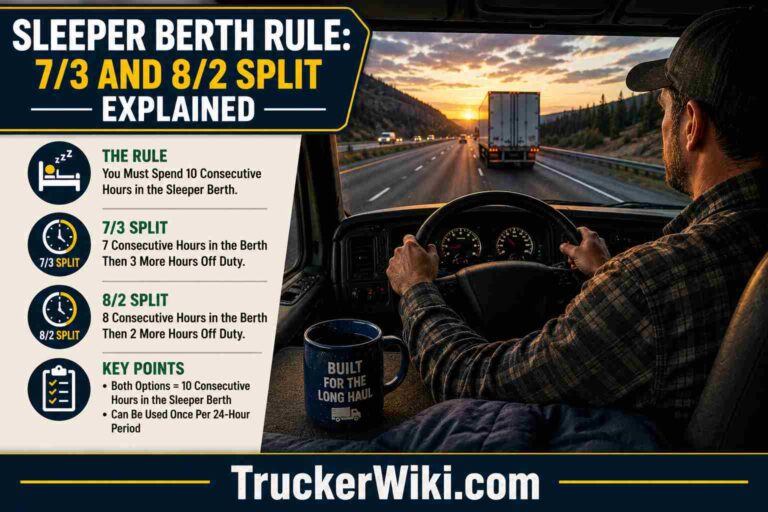
The property-carrying sleeper berth split under 49 CFR 395.1(g)(1) works by breaking the 10-hour rest requirement into two qualifying periods, at least 7 hours in the berth and at least 2 hours off duty or in the berth, with both excluded from the 14-hour window once complete. This is the 7/3 and 8/2 framework covered fully in the Sleeper Berth Rule: 7/3 and 8/2 Split Explained article.
Passenger drivers using a sleeper berth operate under an entirely different provision in 49 CFR 395.1(g)(2). Rather than tracking period lengths independently, the passenger framework tracks driving time accumulated on each side of each rest period. To use the split, neither rest period can be shorter than 2 hours, and the driving time immediately before and after each rest period, added together, cannot exceed 10 hours. No driving may occur after the 15th hour of on-duty time, regardless of how the berth time is split.
A worked example shows how the passenger berth split operates in practice. A driver comes on duty at 6:00 a.m. and drives for 5 hours until 11:00 a.m. The driver then takes a 3-hour sleeper berth rest from 11:00 a.m. to 2:00 p.m. The driver resumes driving. With 5 hours driven before the berth rest, the driver may drive at most 5 more hours after it (5 + 5 = 10, the combined driving cap).
If the driver drives those 5 hours and reaches 7:00 p.m., they have driven 10 hours total and reached the combined driving cap. They must then take a qualifying 8-hour rest (off duty, in the sleeper berth, or a combination) before returning to driving. The 3-hour berth rest in the middle satisfied neither the off-duty minimum nor the 8-hour berth requirement on its own; it only structured the driving time split.
The passenger driver cannot return to the normal limits under 395.5 without completing at least 8 consecutive hours off duty, at least 8 consecutive hours in the sleeper berth, or a combination of at least 8 consecutive hours of off-duty and sleeper berth time.
The driving-time cap approach used in passenger berth splits means the eligible driving time on each side of a berth rest period is interdependent: heavy driving on one side shrinks what is available on the other. A driver who drives 8 hours, takes a berth rest, and then wants to drive 4 more hours has only 2 hours remaining under the 10-hour combined driving cap, not a fresh allocation.
Property drivers using the 7/3 or 8/2 split have their 14-hour window recalculated from the end of the first qualifying period once both are complete. Passenger drivers using the berth split have no equivalent window recalculation. The 15-hour on-duty window still runs from the original start of the duty period, and the split does not pause or restart it.
The 34-Hour Restart and Weekly Limits
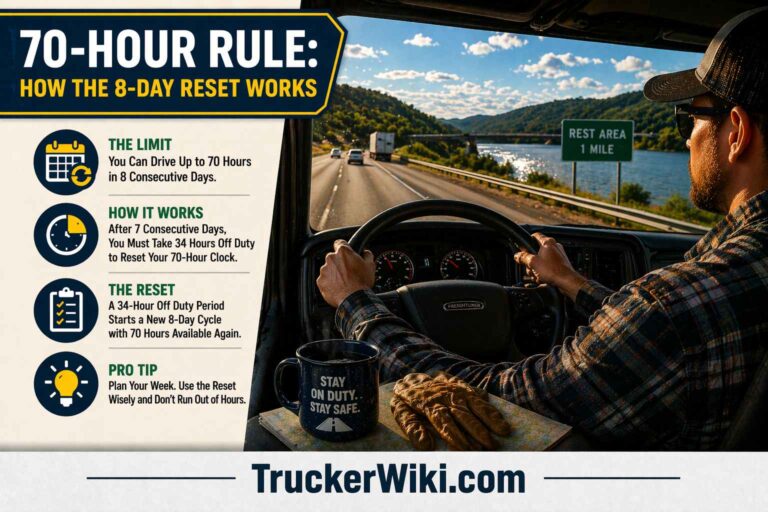
Both property and passenger drivers are subject to the 60/70-hour cumulative weekly limits in 49 CFR 395.3(b) and 395.5(b), respectively. The same 7-day or 8-day rolling cycle structure applies to both. The same carrier-eligibility framework (carriers operating CMVs every day of the week qualify for the 70-hour/8-day cycle) applies to both.
The critical difference is the 34-hour restart. Under 49 CFR 395.3(c), a property-carrying driver may reset the 7- or 8-day cumulative total to zero by taking 34 or more consecutive hours off duty. No equivalent provision exists in 49 CFR 395.5. Passenger-carrying drivers have no restart mechanism to zero out their cumulative weekly hours. They must either allow old hours to drop off the rolling window through the natural recap method or coordinate operations to stay within the 60- or 70-hour cap through scheduling.
The 70-hour rule and its recap mechanics apply equally to passenger drivers, even though no formal restart is available. Passenger drivers running the 70-hour/8-day cycle will see hours from 8 days ago drop off the rolling total at midnight each day, just as property drivers do.
The difference is that when a passenger driver runs out of hours and needs a fast reset, waiting for a recap is the only available path. A property driver in the same situation can take 34 consecutive hours off and start fresh. The structural asymmetry affects charter and tour operators most directly, where demand patterns can require multi-day high-hour operations that property carriers would solve with a restart.
In practice, passenger carrier operations tend to be more predictable in their scheduling patterns than long-haul freight, which reduces the practical impact of not having a restart. A fixed-route bus driver typically works a consistent daily schedule, and carriers plan around the rolling weekly total rather than treating the restart as a routine planning tool. For charter or tour operators with irregular scheduling, the absence of a restart mechanism requires more careful weekly hour management than property carriers face.
The adverse driving conditions extension works differently between the two frameworks. For property drivers, the adverse driving conditions exemption extends the 11-hour driving limit to 13 hours and the 14-hour window to 16 hours. For passenger drivers, the extension applies proportionally: the 10-hour driving limit extends to 12 hours, and the 15-hour on-duty window extends to 17 hours. The qualifying conditions are identical: unexpected weather or road conditions not foreseeable at the start of the duty period or resumption of driving after a rest break. The resulting extended limits differ to reflect each framework’s base numbers.
Drivers who split their time between property and passenger operations in the same rolling week must track two separate sets of hours. Hours accumulated under 395.3 count toward the property-operation cumulative total. Hours accumulated under 395.5 count toward the passenger-operation cumulative total.
Neither set of hours is interchangeable. A driver who drives 40 hours in property operations and then takes a charter bus trip is not starting the charter trip with 30 remaining hours out of a single combined 70-hour pool. Each operation type has its own weekly clock, and both must stay within their respective limits.
The ELD mandate applies equally to both property and passenger-carrying CMV drivers required to maintain RODS under 49 CFR 395.8. Passenger drivers are not carved out of the ELD requirement by virtue of operating under 395.5. The same exemptions that relieve property drivers of ELD obligations, including the short-haul exemption under 395.1(e), pre-2000 model year vehicles, driveaway-towaway operations, and the 8-in-30 threshold for exceeding short-haul conditions, apply to the same extent for passenger operations.
A motorcoach driver on a fixed route who qualifies for the short-haul exemption under 395.1(e)(1) is not required to use an ELD on qualifying days, just as a local freight driver in the same situation would not be. Beyond the exemptions, both operation types are subject to the same ELD technical standards under 49 CFR Part 395 Subpart B, and the same FMCSA-registered device requirements apply to compliant ELD use in either type of operation.
By TruckerWiki Editorial Team | Regulatory sources: 49 CFR 395.3 via eCFR, 49 CFR 395.5 via eCFR, 49 CFR 395.1(g)(2) via eCFR, FMCSA HOS Final Rule (June 2020), FMCSA HOS page. As of May 2026, no changes to 395.5 are pending.