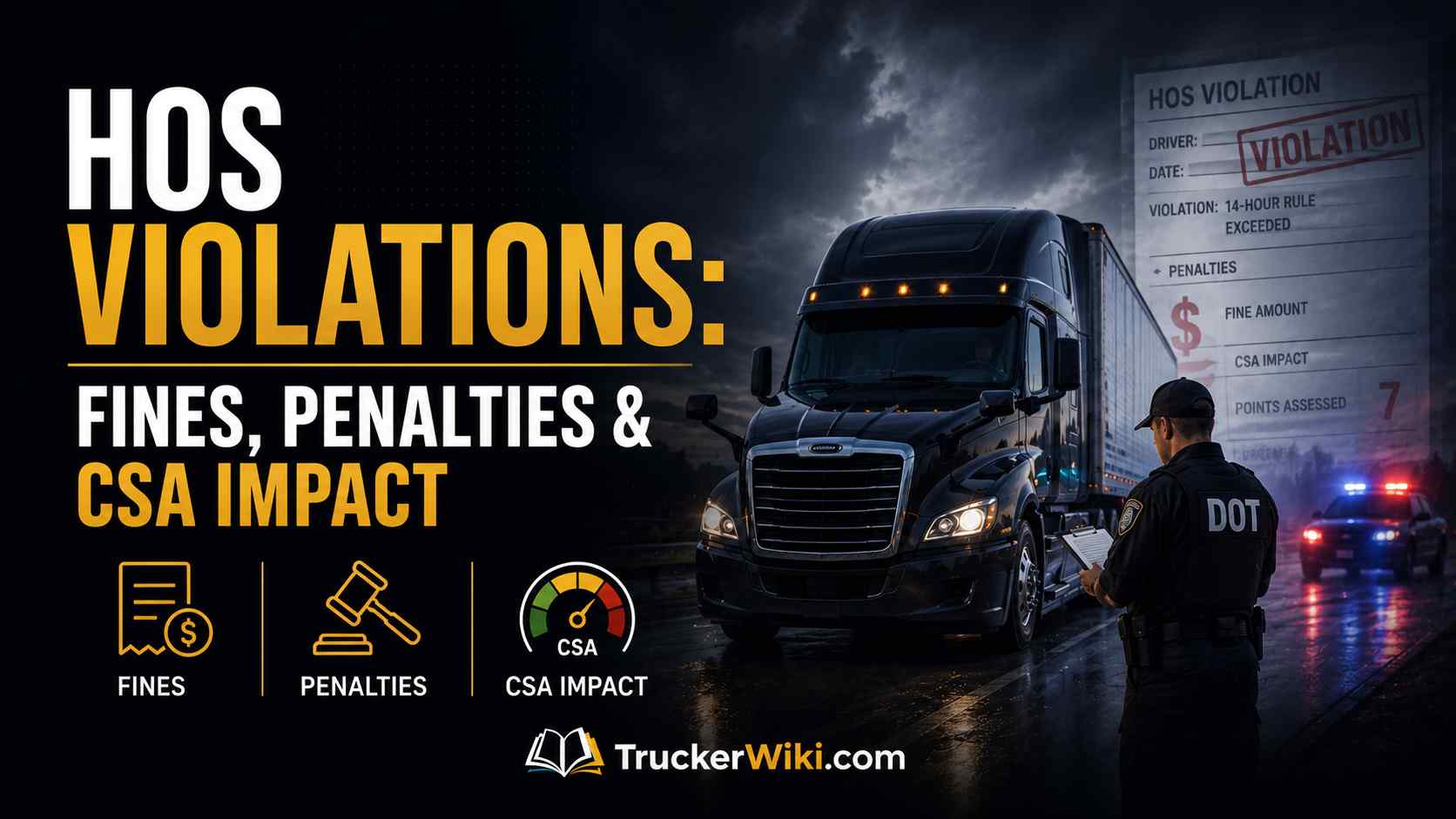
HOS Violations: Fines, Penalties & CSA Impact
The current maximum civil penalty for an HOS violation is $19,246 per violation for motor carriers and $4,812 per violation for drivers, under 49 CFR Appendix B to Part 386. These amounts reflect the February 2026 inflation adjustment published in the Federal Register and represent the highest HOS civil penalties FMCSA has issued to date. Knowing falsification of HOS records carries a separate maximum of $15,846 per entry.
These penalties are not theoretical maximums that appear only in egregious cases. FMCSA assesses civil penalties through administrative enforcement proceedings based on factors including the gravity of the violation, the violator’s prior history, and whether good-faith compliance was attempted. Each day a violation continues, and each separate instance of a violation can constitute a separate offence. A carrier with three drivers who each exceed the 11-hour driving limit on the same day faces three separate violations at up to $19,246 each.
HOS violations also trigger consequences beyond civil fines. An out-of-service order stops a driver’s truck immediately at the roadside until the rest requirement is met. CSA violations accumulate against the carrier’s safety record for 24 months, affecting insurance costs, shipper relationships, and FMCSA enforcement targeting. And in crash litigation, a prior HOS violation on the driver’s or carrier’s record can establish the foundation for a negligence claim. This article covers all three exposure tracks: fines, OOS orders, and CSA impact.
The 2026 HOS Civil Penalty Schedule

FMCSA civil penalties are not static. The Federal Civil Penalties Inflation Adjustment Act Improvements Act of 2015 requires all federal agencies to adjust civil penalty amounts annually to maintain their deterrent value against inflation. FMCSA publishes updated penalty amounts in Appendix B to 49 CFR Part 386. The amounts currently in effect reflect the February 19, 2026, Federal Register update.
The penalty schedule distinguishes between three categories of HOS-related violations. Each carries different maximum amounts and applies to different parties.
| Violation Category | Who It Applies To | 2026 Maximum |
|---|---|---|
| Non-recordkeeping HOS violation (11-hr, 14-hr, 30-min break, 60/70-hr limits) | Motor carrier | $19,246 per violation |
| Non-recordkeeping HOS violation | Driver | $4,812 per violation |
| Recordkeeping violation (incomplete, inaccurate, or false records) | Any person or entity | $1,584 per day, up to $15,846 |
| Knowing falsification of records | Any person or entity | $15,846 per entry |
| Violating an out-of-service order (driver) | Driver | Up to $2,364 |
| Permitting a driver to operate under OOS status | Motor carrier | Up to $23,647 per violation |
Source: 49 CFR Appendix B to Part 386, Cornell LII, current as of May 2026.
One category receives elevated treatment under Appendix B: the egregious violation. Under FMCSA’s enforcement framework, driving time violations where a driver exceeded the 11-hour limit by more than 3 hours, or where the 10-hour off-duty requirement was violated by more than 3 hours, are classified as egregious violations. The penalty ceiling rises significantly in these cases.
Additionally, if any violation subject to civil penalties results in death, serious illness, severe injury, or substantial destruction of property, FMCSA may increase the penalty to a maximum of $107,622 for each offence, per the current inflation-adjusted hazardous outcome multiplier.
The motor carrier bears primary financial exposure in FMCSA enforcement. Under 49 CFR 395.3, the prohibition runs against both the carrier and the driver: no motor carrier shall permit or require a driver to violate HOS limits. A carrier that dispatches a driver it knows or should know is out of hours is liable for the violation, independent of whether the driver also receives a citation.
HOS Out-of-Service Orders: When Driving Stops Immediately
A civil fine is a downstream consequence of an HOS violation. The immediate consequence at the roadside is an out-of-service (OOS) order. Under 49 CFR 395.13 and the CVSA North American Standard Out-of-Service Criteria, a driver placed OOS cannot operate the CMV until the violation condition is resolved. The truck stops where it sits until the required off-duty rest is complete.
CVSA criteria specify which HOS conditions trigger an immediate OOS order at a roadside inspection. The specific thresholds matter because not every HOS violation results in OOS status.
The following conditions result in an OOS order:
- 11-hour driving limit: A driver is placed OOS if they have driven more than 3 hours beyond the 11-hour limit, meaning the driver has accumulated more than 14 hours of driving time since their last 10-hour off-duty reset. A driver who exceeded the limit by 30 minutes or 1 hour is in violation but not necessarily placed OOS at the roadside; the full OOS threshold requires the 3-hour overage.
- 14-hour on-duty window: Any driving after the 14-hour window has expired triggers OOS. There is no 3-hour grace threshold for the 14-hour window; exceeding it by any amount while still operating is an OOS condition.
- 60/70-hour weekly limit: Driving after accumulating 60 hours in 7 days or 70 hours in 8 days triggers OOS. The driver cannot operate until hours recap sufficiently, or a full 34-hour restart is completed.
- 10-hour off-duty rest: A driver who has not taken the required 10 consecutive hours off before beginning a duty period and who has been driving more than 3 hours beyond their remaining allowable time is an OOS candidate.
An OOS driver cannot be dispatched or moved by the carrier until the rest condition is satisfied. Under 49 CFR 395.13(c), a motor carrier that requires or permits a driver subject to an OOS order to operate faces a penalty of up to $23,647 per violation. For the driver, operating in violation of an OOS order carries a maximum fine of $2,364.
The OOS order itself creates a logistical problem that magnifies the operational cost beyond the fine. If a driver is placed OOS 200 miles from the nearest terminal, the truck sits at that location until the driver completes the required rest.
The carrier cannot send another driver to move it without verifying that driver’s HOS status independently. Load receivers who face late delivery may pursue contractual remedies against the carrier. And the driver’s CDL record carries the inspection report regardless of whether a civil penalty is later assessed.
When a driver is placed OOS under the 14-hour rule for driving after the window expired, the resolution requires 10 consecutive hours off duty before the driver can resume. A driver who is OOS under the 70-hour rule must either wait for enough hours to recap from the rolling window or complete a full 34-hour restart. Neither happens quickly when the driver is already at the end of a long week.
OOS violations recorded at a roadside inspection also carry heightened weight in FMCSA’s CSA Safety Measurement System, which is covered in the next section.
How HOS Violations Hit Your CSA Score
Every HOS violation recorded during a roadside inspection or audit enters the carrier’s CSA profile under the Hours-of-Service Compliance BASIC. FMCSA’s Safety Measurement System (SMS) scores carriers on a percentile basis within their peer group. The intervention threshold for the HOS Compliance BASIC is the 65th percentile, one of the two strictest thresholds in the SMS alongside Unsafe Driving.
The CSA scoring methodology underwent its most significant overhaul since the program launched in 2010, with full implementation phased in during 2025 and 2026. The Enhanced SMS methodology (Federal Register notice 2024-27087) replaces the old 1-to-10 severity weight scale with a simplified two-tier system:
- Severity weight 2: Violations that result in an OOS order, plus Driver Disqualifying violations in Unsafe Driving
- Severity weight 1: All other violations that do not result in OOS
Under the old system, major HOS violations such as exceeding the 11-hour, 14-hour, or 60/70-hour limits carried a severity weight of 7 out of 10. Under the new 2026 system, the same violations carry a weight of 1 unless they also resulted in an OOS order, in which case they carry a weight of 2. The practical implication for carriers: an HOS violation that does not result in OOS status scores the same as an administrative paperwork error in terms of raw weight, but volume of violations and OOS conversions become the decisive factors in determining BASIC percentile.
All violations remain in the scoring calculation for 24 months from the date of the inspection. Violations are time-weighted within that window, with violations in the most recent 6 months carrying the highest weight against the carrier’s percentile. A violation’s impact on the BASIC score decreases progressively after the 6-month mark and drops out entirely at 24 months.
When a carrier’s HOS Compliance BASIC score exceeds the 65th percentile intervention threshold, the FMCSA enforcement ladder activates:
- Warning letter: FMCSA notifies the carrier that the HOS BASIC is above threshold. No penalties at this stage, but the letter documents FMCSA awareness for future enforcement purposes.
- Focused investigation: If the score stays elevated, FMCSA conducts an off-site or on-site investigation targeting the HOS BASIC specifically. Investigators examine ELD records, driver logs, time records, and dispatch records.
- Compliance review: A full-scope on-site audit covering all safety management systems, driver qualification files, HOS records, drug testing compliance, and vehicle maintenance systems.
- Safety rating downgrade: In severe cases, FMCSA may assign a Conditional or Unsatisfactory safety rating. An Unsatisfactory rating can result in the carrier’s operating authority being suspended or revoked.
Beyond FMCSA enforcement, CSA scores are publicly visible in the SMS. Shippers, brokers, and insurance carriers use them. A carrier with an elevated HOS Compliance BASIC faces load rejections from shippers who require CSA scores below a given threshold, increased insurance premiums, and heightened broker scrutiny on every load.
Log Falsification: Treated as a Separate and More Serious Offense

Log falsification is not classified as an ordinary HOS violation. Knowing falsification of records under 49 CFR Appendix B to Part 386(a)(2) carries its own maximum penalty of $15,846 per entry, applied separately from any civil penalty for the underlying HOS violation. A driver who falsifies logs to conceal an 11-hour violation faces both the $4,812 maximum for the driving violation and a separate $15,846 maximum for the falsification, with each potentially assessed as a distinct offence.
The “knowing” standard in (a)(2) requires that FMCSA demonstrate the falsification was deliberate, not an error. However, ELD systems make the distinction easier to draw than it was in the paper log era. An ELD records vehicle movement data independently of driver input. If the movement data shows a driver was operating the vehicle while the ELD log shows off-duty status, the discrepancy is direct evidence of knowing falsification rather than clerical error.
Drivers who use paper logs on ELD-exempt operations face the same falsification exposure. Manually entering an off-duty status that does not match actual activity, backdating duty status changes, or preparing a log that omits known on-duty periods all constitute falsification under (a)(2). The 30-minute break rule is a common falsification target: drivers who log an off-duty break they did not actually take to reset the 8-hour driving clock face falsification exposure, not just a break-rule violation.
For carriers, the falsification exposure extends to dispatch records and scheduling logs. A carrier that maintains a consistent pattern of dispatching drivers with unrealistic schedules that cannot be completed without violating HOS limits, and whose records show clean driver logs, faces questions about whether the carrier participated in or directed falsification. FMCSA compliance reviewers are trained to look for the mismatch between carrier dispatch records and driver log patterns as a signal of systemic pressure to falsify.
Falsification violations also enter the CSA record and carry the same 24-month window as other HOS violations. In litigation following a crash, a prior falsification finding is particularly damaging because it establishes a pattern of deliberate non-compliance rather than inadvertent error.
Plaintiff attorneys who handle commercial vehicle crash cases routinely request all driver logs, ELD records, and FMCSA inspection reports during discovery. A falsification citation on the record before a crash significantly strengthens a negligence argument against the carrier.
How Violations Are Detected and How to Challenge Them
HOS violations are detected through two primary mechanisms: roadside inspections and FMCSA compliance reviews. At a roadside Level I or Level II inspection, the officer pulls 7 days of ELD records via data transfer and reviews them against the driver’s current duty status and odometer/GPS data. Violations identified at the roadside generate a Driver/Vehicle Examination Report (DVER), which enters the SMS within days of the inspection.
The DVER records the specific violation code, the severity, whether an OOS order was issued, and the carrier and driver information. Both the carrier and driver receive a copy. The carrier has 30 days from the inspection to review the DVER and initiate a DataQs challenge if any cited violations are believed to be incorrect. Beyond 30 days, the window does not close entirely, but challenges become more difficult to substantiate when inspection records and ELD data have aged.
Carriers and drivers have the right to challenge violation records they believe are inaccurate through FMCSA’s DataQs system at dataq.fmcsa.dot.gov. A successful DataQs challenge removes the violation from the carrier’s SMS record entirely. Common grounds for challenge include officer error in recording the citation, misidentification of the carrier (violation attributed to the wrong DOT number), and inspection data that does not match the actual regulatory requirement. The DataQs process does not address the civil penalty itself; that is a separate administrative proceeding.
Clean inspections also actively improve CSA scores. Under the new Enhanced SMS methodology, a clean Level I inspection where no violations are cited counts as a positive data point in the scoring calculation. Carriers that proactively pursue roadside inspections through programs like the PrePass weigh-station bypass can accumulate clean inspections that offset violations already on the record.
Violations that enter through compliance reviews carry more weight in enforcement proceedings than roadside violations, because compliance reviews typically follow a pattern of elevated SMS scores and represent deliberate FMCSA enforcement targeting rather than a random roadside encounter. Carriers under compliance review whose records show systematic HOS violations face a different enforcement posture than those with isolated roadside citations.
For owner-operators running their own authority, every penalty category hits both the driver record and the carrier record simultaneously. There is no separation between the carrier’s CSA score and the driver’s inspection history when the same person holds both roles.
A single pattern of HOS violations can push an owner-operator’s HOS Compliance BASIC above the 65th percentile intervention threshold with fewer total inspections than a large fleet requires, because the SMS percentile is calculated within a peer group of similarly sized carriers. Owner-operators should monitor their BASIC scores monthly at csa.fmcsa.dot.gov using their DOT number and PIN.
By TruckerWiki Editorial Team | Regulatory sources: 49 CFR Appendix B to Part 386 via Cornell LII, 49 CFR 395.13 via eCFR, FMCSA Civil Penalty Adjustment Final Rule (February 2026), FMCSA Enhanced SMS Methodology (Federal Register 2024-27087), FMCSA CSA Safety Measurement System. Penalty amounts and SMS methodology reflect May 2026 current values.





[…] Compliance is the BASIC most directly within a driver’s individual control. Every HOS violation found at a roadside inspection enters the carrier’s HOS BASIC as a data point. A driver who […]