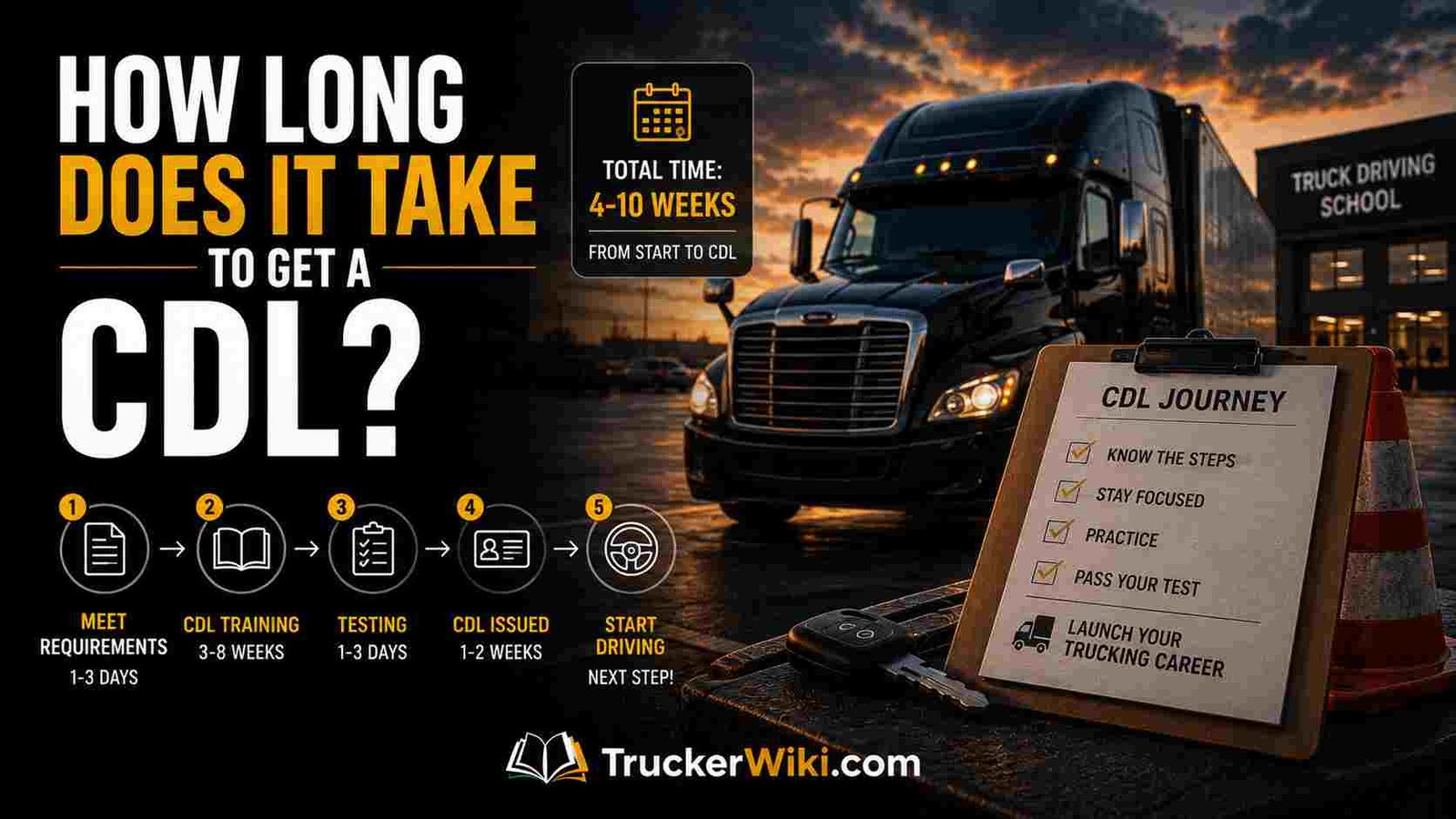
How Long Does It Take to Get a CDL?
Getting a CDL typically takes 4 to 10 weeks from the day a driver applies for a Commercial Learner’s Permit to the day they pass the skills test. The exact timeline depends on how long a training provider’s Entry-Level Driver Training program runs and how well that training overlaps with the mandatory 14-day permit hold period. Class A licenses generally take longer than Class B because of the added skill requirements.
That range holds for most applicants going through a standard training path. Drivers adding endorsements, applying under 21, or hitting scheduling delays at their state DMV should expect the process to run longer.
The CDL Timeline in Order: Permit, Training, Skills Test
Every CDL applicant follows the same federal sequence, regardless of state or training provider. First comes the Commercial Learner’s Permit knowledge test at a state DMV. Once the CLP is issued, the applicant completes Entry-Level Driver Training, waits out the mandatory hold period, then takes the CDL skills test.
The FMCSA’s CDL overview confirms this order is not optional. A state cannot administer the skills test until it verifies, through the federal Training Provider Registry, that the applicant’s required training has been completed and reported.
How Long Does the Commercial Learner’s Permit Step Take
Preparing for the CLP knowledge test is the most variable part of the timeline, since it depends entirely on self-study pace rather than a federal requirement. Most applicants spend one to four weeks studying before testing, though this isn’t a regulated figure and varies by individual.
Once the CLP is issued, 49 CFR 383.25 requires a minimum 14-day hold before the applicant is eligible to take the CDL skills test. There are no exceptions to this waiting period under current federal rule. If a CLP is issued on the 1st of a month, the earliest possible skills test date is the 15th.
FMCSA has a pending proposed rule, Docket No. FMCSA-2023-0115, which would eliminate this 14-day waiting period entirely, arguing it’s no longer necessary now that ELDT already requires supervised behind-the-wheel training before testing. As of this writing, that proposal has not been finalized, so the 14-day hold still applies to every applicant. A CLP itself remains valid for up to one year from issuance, giving applicants a buffer if training or scheduling runs long.
| CLP Step | Typical Time |
|---|---|
| Knowledge test study | 1 to 4 weeks (self-paced, not federally set) |
| CLP issuance to skills test eligibility | 14 days minimum (49 CFR 383.25) |
| CLP validity window | Up to 1 year |
Entry-Level Driver Training (ELDT): The Federal Training Requirement
Entry-Level Driver Training has applied to every first-time Class A or Class B CDL applicant, and to anyone upgrading an existing CDL, since February 7, 2022. It also applies to first-time school bus (S), passenger (P), or hazardous materials (H) endorsement applicants. Drivers who held a valid CDL or those endorsements before that date are not required to complete it.
Training must come from a provider listed on FMCSA’s Training Provider Registry, and covers both theory instruction and behind-the-wheel training on a range and on public roads, per 49 CFR Part 380. Notably, ELDT does not set a fixed minimum number of training hours. It’s performance-based: a driver-trainee has to demonstrate proficiency in each required skill, not just log a set number of hours.
This is the single biggest reason CDL timeline estimates vary so widely across training schools. A driver who demonstrates proficiency quickly can finish faster than one who needs additional range time, even within the same program.
Why Class A Takes Longer Than Class B
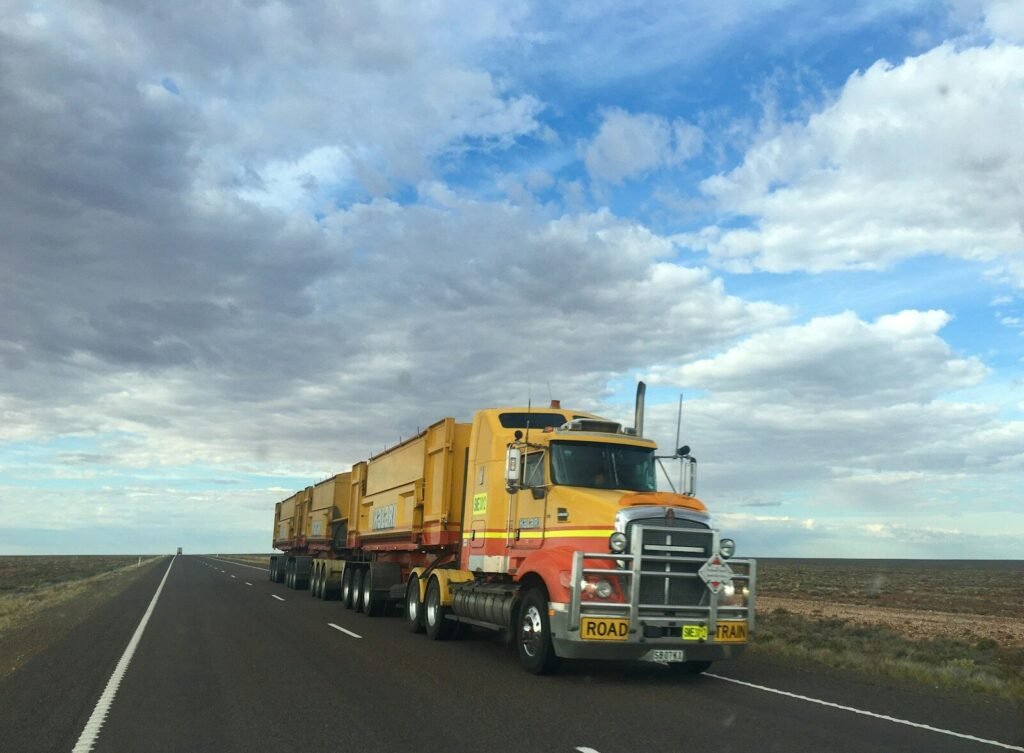
Class A CDLs cover combination vehicles with a gross combination weight rating of 26,001 pounds or more, where the towed unit itself exceeds 10,000 pounds. Class B covers single vehicles at or above that same weight threshold without a heavy trailer attached. The added skill set for maneuvering a combination vehicle, including backing and coupling a trailer, is why Class A training programs typically run longer than Class B programs covering straight trucks or buses.
Both classes fall under the same ELDT and CLP framework described above. The difference in timeline comes entirely from the additional behind-the-wheel proficiency required for combination vehicles, not from a separate regulatory track.
What Can Add Time to the Process
Endorsements extend the timeline because each one, hazardous materials (H), passenger (P), or school bus (S), carries its own ELDT theory module that must be completed before the relevant knowledge or skills test. An applicant pursuing a Class A CDL with a hazmat endorsement is completing two separate training and testing requirements, not one.
Age is a hard federal floor, not a training variable. Under 49 CFR Part 383, a driver can hold an intrastate CDL at 18, but interstate driving, hazmat endorsements, and any federally regulated route require the driver to be at least 21. Applicants under 21 who train early sometimes have to wait on the calendar itself before they can drive interstate, independent of how fast their training goes.
A DOT medical certificate has to stay valid through the skills test date, not just at the CLP application, so a certificate issued too early can lapse mid-process. Scheduling backlogs for the skills test itself are also common in areas with high testing demand, and some states report waits of up to two weeks just to get a test slot after training is complete. Applicants who build in buffer time for both of these tend to avoid the timeline slipping past their original estimate.