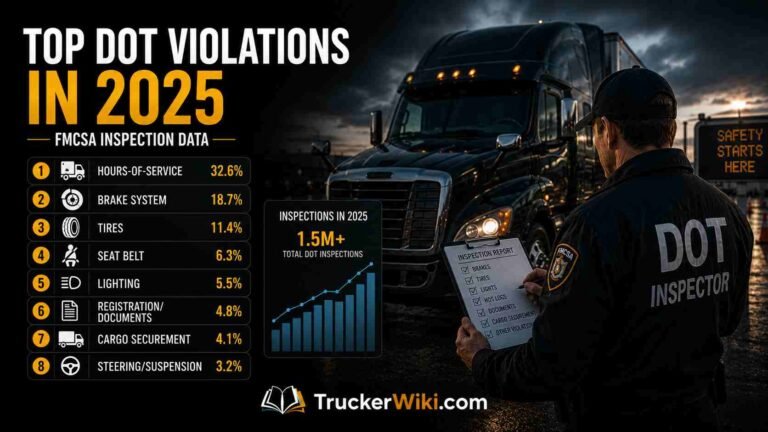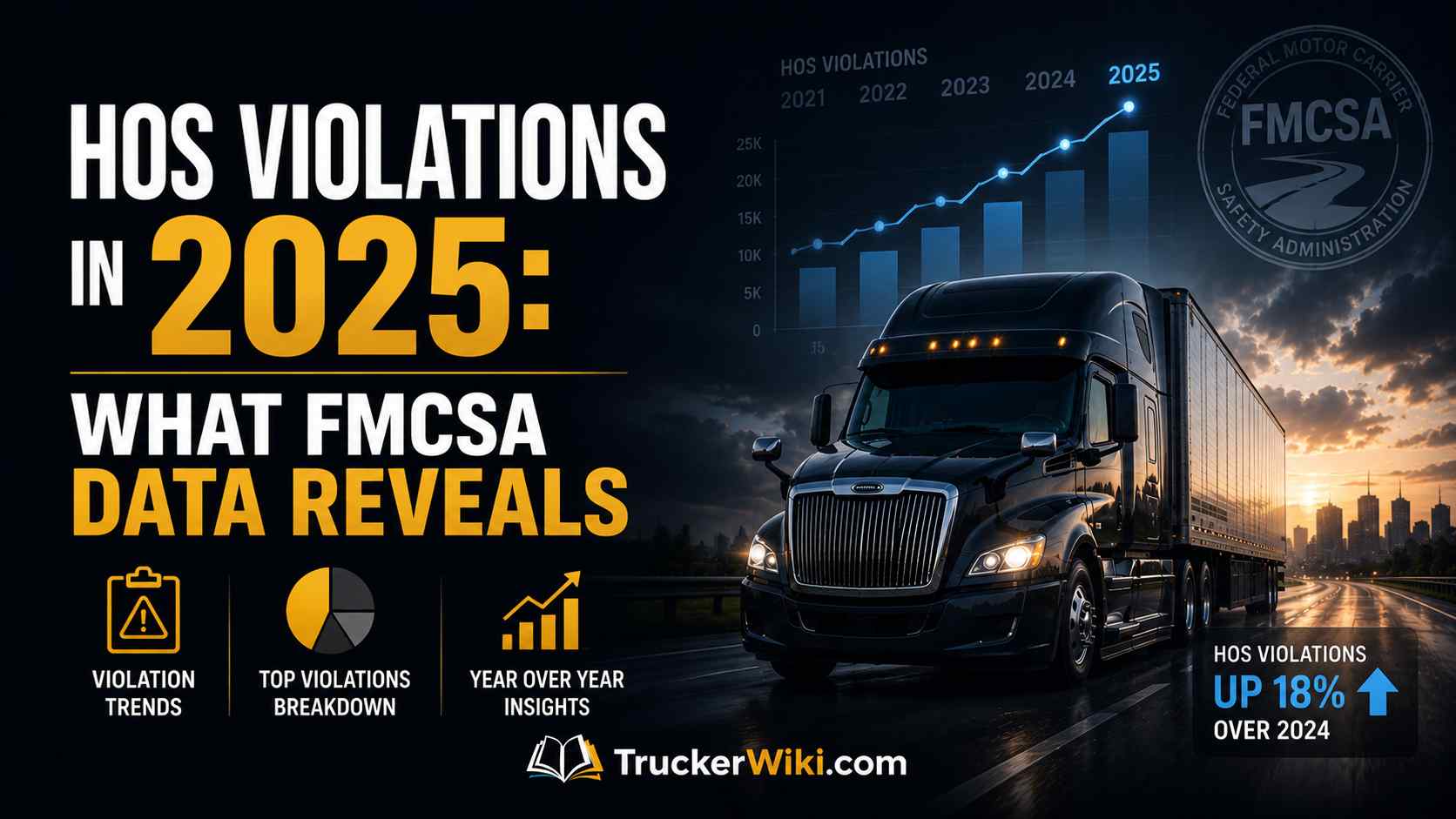
HOS Violations in 2025: What FMCSA Data Reveals
Hours of service violations placed 1,076 drivers out of service during the three days of the CVSA International Roadcheck in May 2025, accounting for 32.4 percent of all driver out-of-service violations recorded across 56,178 inspections. HOS remained the single leading category of driver OOS violations for the year, with false records of duty status (the 2025 Roadcheck’s special driver focus) adding another 332 OOS findings on top of core HOS violations.
The numbers tell a mixed story. Vehicle compliance improved year over year. Driver compliance did not. The vehicle out-of-service rate dropped from 23 percent in 2024 to 18.1 percent in 2025. The driver out-of-service rate moved in the opposite direction, rising from 4.8 percent in 2024 to 5.9 percent in 2025. For carriers and drivers, the data shows where FMCSA and its state enforcement partners are finding violations and where enforcement attention is heading in 2026.
CVSA International Roadcheck 2025: The Three-Day Enforcement Snapshot

The CVSA International Roadcheck is the most concentrated enforcement data point available each year. Conducted May 13–15, 2025, across the United States, Canada, and Mexico, the 72-hour campaign produced 56,178 commercial motor vehicle, driver, and cargo inspections. Every major roadside violation category is recorded, making it the clearest annual cross-section of fleet compliance conditions.
The headline numbers from 2025:
- 56,178 total inspections across North America
- 10,148 vehicles placed out of service (vehicle OOS rate: 18.1%)
- 3,342 drivers placed out of service (driver OOS rate: 5.9%)
- 13,553 vehicle OOS violations recorded
- 3,317 driver OOS violations recorded
- 177 hazardous materials OOS violations recorded
Within the driver OOS total, HOS violations led the way at 32.4 percent (1,076 drivers). No valid CDL was second at 24.4 percent. No medical examiner’s certificate was third at 14.9 percent. False RODS accounted for 10 percent (332 drivers). Suspended CDL accounted for 5.1 percent.
The year-over-year change in driver OOS rates is the more significant data point for HOS compliance. In 2024, 95.2 percent of drivers inspected had no OOS violations, meaning 4.8 percent were placed OOS. In 2025, 94.1 percent had no OOS violations, a 1.1 percentage point deterioration in driver OOS rate compared to 2024.
At the same time, vehicle OOS improved from 23 percent to 18.1 percent, a 4.9 percentage point improvement. Fleets improved their equipment compliance significantly between 2024 and 2025. Driver compliance moved in the other direction.
Looking at longer trend lines adds context. The CVSA reported a vehicle OOS rate of 17.9 percent in 2019, before the 2020 HOS rule change. The 2025 rate of 18.1 percent has returned close to pre-pandemic levels after elevated rates during 2021 through 2024. For driver OOS, the 2019 rate was 4.2 percent. The 2025 rate of 5.9 percent is measurably higher than the pre-pandemic baseline, suggesting that driver compliance has not recovered to 2019 levels even as vehicle compliance has.
The 2025 Roadcheck used a targeted special focus on false records of duty status, making it one of the most scrutinized enforcement events for HOS log accuracy in recent years. Inspectors specifically looked for discrepancies between ELD movement data and logged duty statuses.
The 332 OOS violations for falsified logs represent the count from a single 72-hour window. Across the full year, FMCSA’s own data from the Motor Carrier Management Information System shows the false RODS problem at a much larger scale, covered in the next section.
FMCSA Full-Year Data: HOS Violations in MCMIS
Roadcheck gives a snapshot; FMCSA’s Motor Carrier Management Information System (MCMIS) provides the full-year picture. According to FMCSA’s 2023 roadside inspection data, the most recently released full-year dataset from the MCMIS as of May 2026, there were 2,661,478 driver inspections conducted across all inspection levels, producing 1,097,238 driver violations in 2023.
Within that 2023 driver violation total, HOS violations accounted for 58,918 cases classified in the CSA database, per data cited in FMCSA compliance tracking reports. The 14-hour rule was the most frequently cited HOS violation, accounting for nearly half of all HOS cases in the 2023 data. False RODS violations totaled 52,962 in 2023, making them the third-most-cited driver CSA violation category that year, behind only speeding (65,448) and traffic control device violations (61,267).
The FMCSA 2024 Pocket Guide to Large Truck and Bus Statistics, published July 2025 with data through December 2023, reported that as of December 2023, there were 787,189 active interstate motor carriers with recent activity, operating a fleet of 5.4 million power units with approximately 5.8 million total CMV drivers.
HOS rules apply to the vast majority of drivers in that population. The scale of the enforcement data: over 2.6 million driver inspections generating more than 1 million violations in a single year, putting the per-inspection violation rate at roughly 41 percent, with HOS constituting a meaningful portion of that total.
Carrier size matters in interpreting HOS violation patterns. Small carriers, defined by FMCSA as those with fewer than 6 power units, make up the overwhelming majority of the 787,189 active interstate carrier count. FMCSA data consistently shows that small carriers generate a disproportionate share of HOS violations per inspection when compared to large carriers with dedicated compliance staff.
In 2023, a carrier operating 1 to 5 trucks had no compliance department, no safety director, and often no systematic ELD monitoring beyond the device itself. HOS violations at small carriers are frequently the result of dispatch pressure or schedule planning errors rather than deliberate falsification.
On the investigation side, in 202,4 FMCSA and its state partners conducted nearly 12,300 investigations, including on-site comprehensive reviews, on-site focused investigations, and off-site audits. According to analysis by JJ Keller Compliance Network, nearly half of those investigations were “on-site focused” reviews, where an investigator comes on-site specifically to target one compliance area, such as HOS or driver qualification files, typically triggered by poor CSA scores. Nearly one in four audits in 2024 resulted in a monetary fine. Total civil penalties across FMCSA investigations in 2024 exceeded $27 million.
The HOS-targeted portion of on-site focused investigations is particularly significant because it means nearly half of all investigations in 2024 were directly examining driver logs, ELD records, and dispatch-to-log correlation. An on-site focused HOS investigation that finds systematic violations is likely to produce civil penalties and safety rating consequences, not just a warning letter.
The $27 million in total 2024 fines across all investigation types represents an increase over 2023, which FMCSA analysis attributed partly to the higher rate of on-site investigations finding acute and critical violations. Carriers with HOS BASIC scores above the 65th percentile intervention threshold should treat the focused investigation as a probability, not a possibility. The average carrier under a focused HOS investigation in 2024 faced 6 violations per audit and, in approximately 25 percent of cases, a direct financial penalty.
The False RODS Problem and the 2026 Enforcement Shift
The 2025 Roadcheck’s special driver focus on false records of duty status did not produce its prominence randomly. FMCSA and CVSA select the annual special focus based on enforcement patterns from the prior year. False RODS were chosen for 2025 because enforcement data showed it was a persistent and growing compliance problem. That conclusion is supported by the 52,962 false RODS violations FMCSA recorded in 2023.
When the special focus was announced, the industry understood that inspectors would specifically audit ELD data against GPS and engine data to identify discrepancies. The 332 OOS violations for falsified logs found during the 2025 Roadcheck’s 72 hours represent approximately 10 percent of all driver OOS violations during that window.
Outside of a special enforcement campaign, false RODS violations are detected through more routine comparison of ELD movement data against logged statuses. The ELD mandate’s elimination of paper log flexibility has shifted false RODS detection from a document-review exercise to a data-matching exercise that is both faster and more consistent.
The 2026 Roadcheck, scheduled for May 12–14, 2026, has already announced its special driver focus: ELD tampering. Inspectors will specifically examine records for evidence of device manipulation, unauthorized edits, unassigned driving time that has not been addressed, and log transfer readiness. The progression from false RODS (2025) to ELD tampering (2026) reflects a tightening enforcement lens on log integrity.
Carriers whose drivers have unresolved patterns of unassigned driving time, frequent driver edits, or ELD connectivity issues should treat the 2026 Roadcheck as a direct warning. With 56,178 inspections in 2025, the 2026 campaign is expected to see similar or higher inspection volumes based on CVSA participation trends, and with ELD tampering as the special focus, fleets that have not audited their ELD edit logs since 2025 are entering the campaign with a known vulnerability.
Which HOS Rules Generate the Most Violations
Not all HOS violations are equally represented in the data. The FMCSA MCMIS violation database, reviewed through 2023 data, shows a consistent pattern in which specific rules generate disproportionate volumes of violations.
The 14-hour rule accounts for nearly half of all HOS violations recorded in the 2023 CSA dataset. This reflects the rule’s operational difficulty: unlike the 11-hour driving limit, which is simply a cap on total driving time, the 14-hour window is a hard clock that does not pause for off-duty time within the duty period. Drivers who spend time waiting at shippers or receivers, fueling, or sitting in traffic find their 14-hour window consumed in ways that their actual driving time does not reflect, creating pressure to exceed the window to complete assigned loads.
The 11-hour driving limit accounts for a smaller but still significant share of HOS violations. Exceeding this limit by more than 3 hours triggers an OOS order under CVSA criteria, making it one of the most serious direct violations from an enforcement consequences standpoint. The FMCSA HOS effectiveness study published in May 2023 found that after the 2020 rule change, an average of 8.5 percent of all driver inspections showed at least one HOS violation, compared to lower rates in the pre-2020 period. The study noted that COVID-19 enforcement reductions and the ELD mandate rollout confounded direct pre/post comparison.
The 60/70-hour weekly limit accounts for fewer roadside citations than the daily limits, partly because the accumulation happens over multiple days and ELDs provide proactive alerts before the cap is hit. But the weekly limit produces a higher share of OOS orders per violation found, because exceeding it, unlike borderline 14-hour or 11-hour violations, typically indicates a longer pattern of overwork rather than a single shift miscalculation.
The 30-minute break rule generates fewer OOS orders than the other daily limits because a break violation found in isolation during a roadside inspection typically does not result in OOS status unless combined with other HOS failures. The break rule shows up more frequently in compliance review findings than in individual roadside citations, where investigators reviewing multiple days of logs find patterns of missed breaks rather than catching a single missed break mid-trip.
The false RODS violation carries its own separate civil penalty structure under Appendix B to Part 386, as detailed in the HOS Violations: Fines, Penalties & CSA Impact article, but in the enforcement volume, it showed 52,962 incidents in the 2023 MCMIS data. Much of this volume reflects ELD annotation errors, failure to resolve unassigned driving time, and drivers who do not understand that an ELD edit contradicting underlying movement data creates a false RODS exposure, even if the driver believed the edit was accurate.
What the Data Means for 2026 Compliance
The 2025 enforcement data carries three clear implications for carriers planning their 2026 compliance approach.
First, driver compliance has not improved at the same pace as vehicle compliance. The gap between vehicle OOS improvement (down 4.9 points) and driver OOS deterioration (up 1.1 points) in 2025 indicates that fleets investing primarily in preventive maintenance are getting results, while the human-side compliance challenges around HOS and documentation accuracy remain unresolved. Carriers whose CSA profiles show elevated HOS Compliance BASIC scores despite passing vehicle inspections are seeing exactly this pattern.
The 2026 CSA SMS overhaul adds a layer of complexity to interpreting these trends going forward. Under the new 1-or-2 severity weight scale replacing the old 1-10 scale, an HOS violation that does not result in OOS carries a severity weight of 1, while an OOS-producing HOS violation carries a weight of 2. The practical effect on BASIC percentiles will depend on how the transition interacts with the historical 24-month violation window.
Carriers with high-volume non-OOS HOS violations in their records will see their relative impact decrease under the new scale compared to carriers with fewer but more severe OOS violations. How this shifts intervention threshold triggers for the HOS Compliance BASIC is not yet fully visible in the data, but carriers approaching the 65th percentile should track their BASIC monthly as the new methodology is phased in.
Second, the ELD tampering focus for the 2026 Roadcheck (May 12–14, 2026) signals that FMCSA and CVSA view log integrity as an ongoing enforcement priority that the ELD mandate alone did not solve. The 2020 rule change and the ELD mandate shifted the false RODS problem from paper falsification to electronic manipulation, but did not eliminate it.
Carriers should audit unassigned driving time logs, review driver edit histories in their ELD back-office systems, and ensure every driver knows how to correctly transfer logs to an inspector before May 12, 2026. The 332 false RODS OOS findings in 2025 will be a baseline against which the 2026 ELD tampering findings are compared.
Third, the 14-hour rule’s dominance in the violation data is a scheduling problem as much as a compliance problem. Carriers whose dispatchers plan loads based on driving time alone, without accounting for shipper and receiver dwell time in the 14-hour window, produce drivers who run out of the window before completing assigned loads. That pressure creates the conditions for both genuine violations and falsification attempts. The solution is dispatch planning that treats the 14-hour clock as a hard constraint from the moment the driver goes on duty, not a variable to manage when the driver calls in from the road.
The enforcement trajectory from the available 2023 through 2025 data is consistent: vehicle compliance has improved, driver behavioral compliance has not kept pace, and log accuracy has become the clearest enforcement signal FMCSA is using to identify carriers for intervention.
The 2026 Roadcheck focuses on ELD tampering, combined with the SMS overhaul, elevating OOS violations to severity weight 2, creates a compliance environment where a single falsification finding carries more consequence than several non-OOS HOS citations combined. TruckerWiki will update this article when FMCSA releases full-year 2024 roadside inspection totals from the MCMIS database.
By TruckerWiki Editorial Team | Primary data sources: CVSA 2025 International Roadcheck Results, FreightWaves CVSA 2025 Coverage, FMCSA 2024 Pocket Guide to Large Truck and Bus Statistics, FMCSA MCMIS Roadside Inspection Data, FMCSA HOS Regulations Study May 2023. Full-year 2024 FMCSA roadside inspection totals were not released as of May 2026; 2023 MCMIS data represent the most recent complete annual dataset.