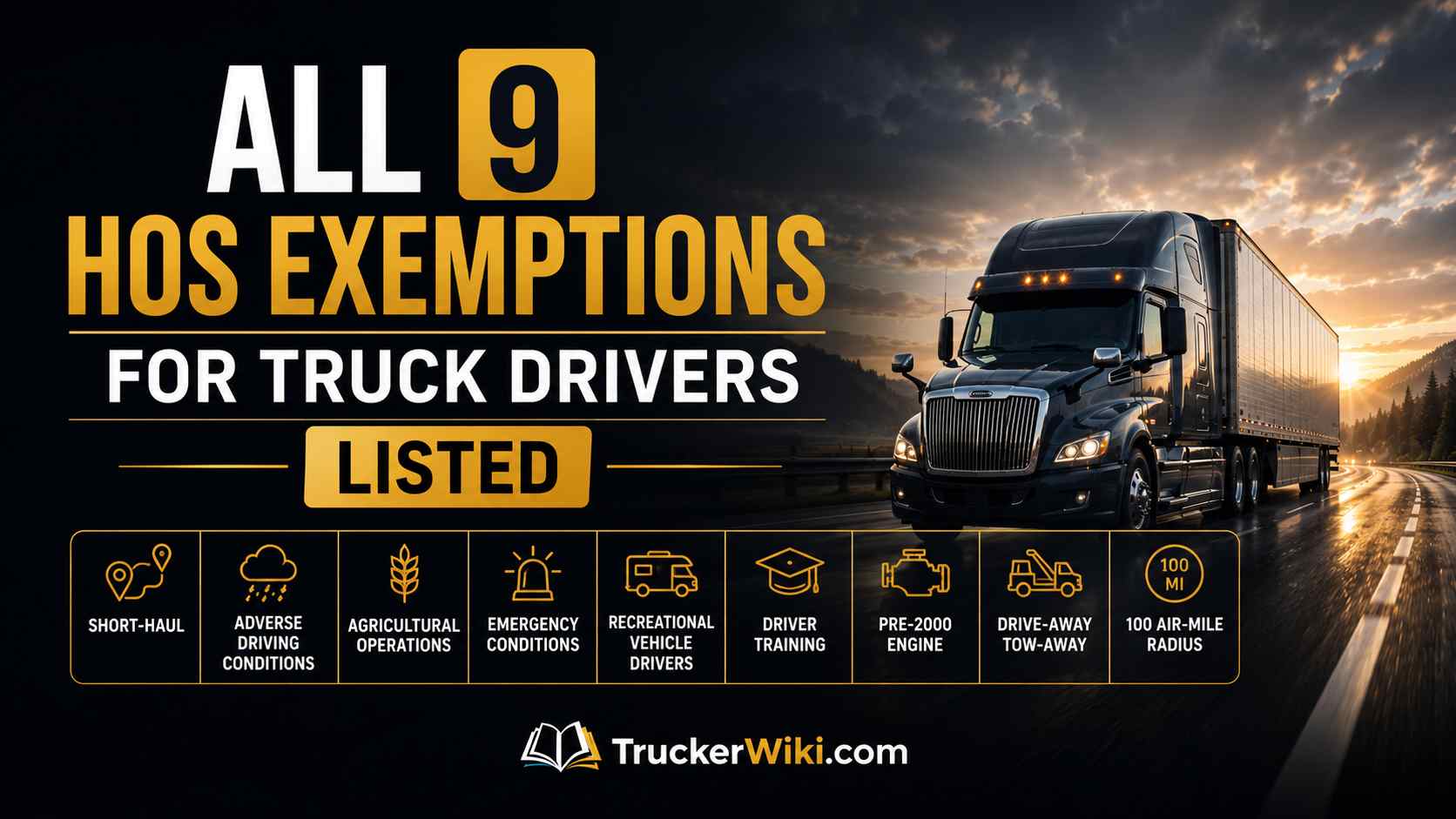
All 9 HOS Exemptions for Truck Drivers Listed
The HOS regulations in 49 CFR Part 395 apply to most property-carrying CMV drivers in interstate commerce, but 49 CFR 395.1 carves out specific exemptions covering nine distinct situations. These exemptions range from complete relief from all HOS requirements to narrow adjustments for a single daily limit. No exemption eliminates every HOS obligation simultaneously; each applies to specific provisions of Part 395 and leaves other requirements intact.
Understanding which exemption applies requires knowing what that exemption actually changes, and what it does not. Several of the nine are covered in dedicated TruckerWiki articles; this article gives drivers and carriers a complete reference of all nine in one place, with the key conditions and limits for each.
A critical distinction runs through the entire framework: some exemptions waive record-keeping obligations (RODS and ELD) while leaving the underlying time limits in place. Others modify time limits while keeping record-keeping intact. And a small number waive Part 395 entirely. Applying an exemption correctly requires knowing which category it falls into.
A driver who assumes the agricultural exemption eliminates all HOS limits and ELD requirements is correct within the 150-air-mile radius during planting and harvesting seasons. A driver who assumes the oilfield waiting time exemption eliminates the 14-hour window is wrong, because (d)(2) only reclassifies certain waiting time as off-duty; the daily limits remain.
The Four Most Commonly Used Exemptions
Four exemptions apply to the broadest range of drivers and operational situations. These are the ones most drivers will encounter or need to evaluate during normal operations.
1. Adverse Driving Conditions (49 CFR 395.1(b)(1))
When unexpected weather or road conditions prevent a driver from safely completing a run within standard HOS limits, the adverse driving conditions exemption extends both the 11-hour driving limit to 13 hours and the 14-hour window to 16 hours by up to 2 additional hours.
The conditions must not have been known, or reasonably knowable, to the driver before the duty day or before resuming driving after a rest break. The 2020 HOS Final Rule expanded the exemption to include the 14-hour window extension, which, before 2020, applied only to the driving limit. Full mechanics covered in the Adverse Driving Conditions Exemption article.
2. Short-Haul Operations (49 CFR 395.1(e)(1) and (e)(2))
Drivers operating within 150 air miles of their work reporting location and returning within 14 consecutive hours (under e(1)) are exempt from RODS, ELD requirements, and the 30-minute break rule. Non-CDL property-carrying CMV operators use (e)(2), which provides the same radius but a different duty window structure. The 60/70-hour weekly limits and 11-hour driving limit still apply in full. Full mechanics covered in the Short-Haul Exemption article.
3. 16-Hour Property-Carrying Driver Exception (49 CFR 395.1(o))
This exemption allows a property-carrying driver to extend the standard 14-hour on-duty window to 16 hours under three conditions that must all be met simultaneously. First, the driver must have returned to their normal work reporting location and been released from duty at that location for each of the previous five duty tours worked.
Second, the driver must return to the normal work reporting location and be released from duty within 16 hours of coming on duty on the day the exception is used. Third, the driver must not have used this exception within the previous 6 consecutive days, unless a 34-hour restart was completed, which resets the 6-day restriction.
The 16-hour exception is a once-per-week tool for local drivers who regularly return to the same terminal but occasionally face a longer day than the standard 14-hour window allows. On any day a driver uses this exception, they must complete a full RODS for that day, even if they otherwise qualify for the short-haul exemption, because the 16-hour use itself exceeds the duty limit that makes a driver eligible to skip daily logs.
A few nuances in (o) catch drivers off guard. The five-prior-duty-tour requirement must be met continuously in sequence. If a driver had even one duty tour in the previous five where they did not return to the normal reporting location and were not released there, the exception is not available. Additionally, the exception cannot be used more than once in any rolling 6-day window.
A driver who used it on Monday cannot use it again until the following Tuesday at the earliest, unless they have completed a qualifying 34-hour restart that zeroes the restriction. This means the exception is genuinely rare. It is available roughly once per work week for drivers maintaining a clean return history, not as a routine planning tool.
The 70-Hour Rule applies normally on any day the 16-hour exception is used. Hours logged during a 16-hour duty day accumulate against the 8-day rolling total at the same rate as any other day. A driver using the exception late in an 8-day cycle when hours are running low will find that the extension provides limited practical benefit if the 70-hour cap is already near.
4. Agricultural Commodity Operations (49 CFR 395.1(k))
During planting and harvesting periods, as determined by each state, drivers transporting agricultural commodities, including livestock, bees, horses, fish for food, and other commodities meeting the definition in 49 CFR 395.2, are fully exempt from all HOS requirements while operating within a 150 air-mile radius of the commodity’s source. Within that radius, no daily driving limit, weekly cap, or RODS/ELD requirement applies. Once a driver exits the 150-air-mile zone, all HOS rules apply immediately for the remainder of that trip.
A separate provision added in November 2021 extends the agricultural exemption to livestock hauliers operating between a point 150 air miles from the source (typically a sales barn) and a point 150 air miles from the delivery destination. This “end-of-trip” exemption is in 49 CFR 395.1(k)(4) and covers the transit segment between those two radii. Farm supply deliveries from wholesale or retail distribution points to agricultural use locations are also covered by (k) during the applicable state-designated periods.
Industry-Specific Exemptions

Three exemptions target specific industries where standard HOS weekly-reset mechanics create operational problems not present in general freight.
5. Oilfield Equipment Transport (49 CFR 395.1(d)(1))
Drivers of CMVs used exclusively in the transportation of oilfield equipment, including stringing and picking up pipeline pipe, and servicing field operations of the natural gas and oil industry, qualify for a modified weekly reset.
Instead of requiring 34 consecutive off-duty hours to restart the 7- or 8-day cumulative total, these drivers may end any 8 days with a 24-hour off-duty period. The 24-hour restart applies only to the 60/70-hour weekly limit mechanics. All daily limits (11-hour, 14-hour) still apply and require the standard 10-hour off-duty reset.
The “used exclusively” language in (d)(1) is a strict standard. A driver who occasionally transports oilfield equipment alongside general freight does not qualify. The vehicle must be dedicated to oilfield equipment transport as its primary and exclusive operational use. Carriers applying the (d)(1) provision to mixed-use fleets face significant compliance risk during audits, where FMCSA investigators verify operational records against the exclusivity requirement.
6. Oilfield Well Service Waiting Time (49 CFR 395.1(d)(2))
A separate and distinct provision covers specially trained operators of CMVs that are specially constructed to service oil wells. These operators often spend extended periods waiting at well sites for their specific expertise to be needed.
Under (d)(2), waiting time at a natural gas or oil well site does not count as on-duty time for HOS purposes. That waiting time must be recorded as off-duty with a remark or annotation identifying it as waiting time. It cannot be counted toward the 14-hour window calculation.
Drivers qualifying under (d)(2) are explicitly not eligible to use the (e)(1) short-haul exemption, per 49 CFR 395.1(e)(1). The two provisions are designed for distinct operational profiles and cannot be combined for the same driver on the same day.
7. Construction Materials and Equipment (49 CFR 395.1(m))
Drivers primarily engaged in transporting construction materials and equipment qualify for the same modified reset structure as oilfield equipment transport under (d)(1): any 7- or 8-day period may end with a 24-hour off-duty period rather than the standard 34-hour restart. The practical effect is a shortened recovery window between rolling cycles, which reflects the stop-start scheduling patterns common in construction operations where daily hours are often short but the schedule runs seven days a week.
The “primarily in the transportation” language requires that construction hauling be the driver’s dominant operational role, not an occasional load. Carriers whose drivers carry construction materials as a minor portion of mixed freight operations should not apply (m) to those drivers without confirming that the actual operational profile qualifies. A driver who hauls concrete forms three days a week and general merchandise two days a week is likely not “primarily” a construction materials carrier under any reasonable reading of (m).
Unlike the 16-hour exception (o), which resets with a 34-hour restart, the construction materials 24-hour restart under (m) can be used every week without a frequency restriction, as long as the qualifying conditions remain met. This makes it operationally significant for contractors running seven-day schedules where the standard 34-hour restart would impose a costly mid-week shutdown.
8. Utility Service Vehicles (49 CFR 395.1(n))
Drivers of utility service vehicles, as defined in 49 CFR 395.2, are fully exempt from all provisions of Part 395. A utility service vehicle is a vehicle owned or operated by a utility and used in the repair, maintenance, or operation of utility infrastructure, that is operated primarily within the utility’s service area except for occasional emergency use. This is the broadest exemption in 395.1 for operational drivers. It eliminates every requirement in Part 395, including daily limits, weekly caps, and RODS.
Situation-Based Exemptions
Two exemptions apply based on specific in-trip circumstances or driver role rather than industry category.
9. Emergency Conditions (49 CFR 395.1(b)(2))
If an emergency occurs after a driver has begun a run that could otherwise have been completed within HOS limits, the driver may complete the run without being in HOS violation. This is distinct from the adverse driving conditions exemption under (b)(1): the emergency conditions provision is broader in scope (it covers any emergency, not just weather or road conditions), and it does not specify a 2-hour extension limit. Instead, it allows completion of the specific run that was underway.
Per FMCSA Guidance Q&A 5 on 395.1(b), the emergency conditions provision does not cover situations such as a driver’s desire to get home, shipper demands, market pressures, shortage of drivers, or mechanical failures. A genuine emergency must be involved. One that arose after the trip began and that the driver could not have anticipated at dispatch.
Driver-Salesperson Exemption (49 CFR 395.1(c))
This exemption removes the 60/70-hour weekly limit (under 49 CFR 395.3(b)) for driver-salespersons whose total driving time does not exceed 40 hours in any period of 7 consecutive days. A driver-salesperson is a driver who sells goods or services while on the road and whose driving is incidental to that sales function. The daily limits (11-hour driving, 14-hour window, 10-hour off-duty reset) still apply in full. Only the weekly cumulative cap is modified.
The practical use case is a route sales driver who drives a smaller commercial vehicle to retail accounts, restocks shelves or refrigerated cases, takes orders, and returns to the terminal daily. If that driver’s driving time stays below 40 hours per week, the 60/70-hour weekly tracking requirement falls away. If the driver’s driving time exceeds 40 hours in any 7 days, the exemption is lost for that week, and the standard 60- or 70-hour cap applies. Carriers should track weekly driving totals for driver-salesperson roles carefully, because the line between qualifying and non-qualifying shifts with weekly route volumes.
Emergency Declarations: A Separate Mechanism Under 49 CFR 390.23

One additional HOS relief mechanism falls outside 49 CFR 395.1 entirely but is frequently referenced alongside the nine exemptions. Under 49 CFR 390.23, HOS requirements are automatically suspended for drivers providing direct assistance in response to a declared emergency. Declarations may be issued by the President, state governors, or local government officials.
Presidential and state declarations activate relief for up to 30 days, automatically and without individual application. Local declarations activate relief for up to 5 days. Only FMCSA’s Field Administrator or Regional Field Administrator can extend relief beyond 30 days. The suspension covers most of Part 395, including daily driving limits, weekly caps, and RODS requirements, for drivers directly engaged in emergency relief operations. Normal HOS compliance resumes once the driver completes the direct assistance mission or the declaration expires.
The scope of “direct assistance” matters for determining who qualifies. A driver hauling water, food, fuel, or emergency equipment to a declared disaster zone qualifies. A driver completing a normal commercial freight load that happens to pass through the affected area does not. FMCSA publishes current emergency declarations on its emergency declarations page, which is the authoritative source for confirming that a specific declaration is active, what geographic scope it covers, and what regulatory relief it includes.
The emergency conditions exemption in (b)(2) applies to individual in-trip emergencies. The 390.23 mechanism applies to declared regional or national emergencies affecting whole operations. The two are legally distinct and serve different situations.
Summary Reference Table
| # | Exemption | CFR Citation | What It Modifies | What Still Applies |
|---|---|---|---|---|
| 1 | Adverse Driving Conditions | 395.1(b)(1) | Extends 11-hr to 13, 14-hr to 16 | 70-hr limit, 10-hr reset |
| 2 | Emergency Conditions | 395.1(b)(2) | Allows run completion in emergency | Normal HOS resumes after |
| 3 | Driver-Salesperson | 395.1(c) | Removes 60/70-hr weekly cap | 11-hr, 14-hr, 10-hr reset |
| 4 | Oilfield Equipment | 395.1(d)(1) | 24-hr restart instead of 34-hr | 11-hr, 14-hr daily limits |
| 5 | Oilfield Waiting Time | 395.1(d)(2) | Well-site waiting = off-duty | Cannot use (e)(1) |
| 6 | Short-Haul Operations | 395.1(e) | No RODS, ELD, 30-min break | 11-hr, 60/70-hr |
| 7 | Agricultural Operations | 395.1(k) | Full HOS exemption within 150 mi | All rules resume past 150 mi |
| 8 | Construction Materials | 395.1(m) | 24-hr restart instead of 34-hr | 11-hr, 14-hr daily limits |
| 9 | Utility Service Vehicles | 395.1(n) | All of Part 395 waived | Other FMCSRs intact |
| + | 16-Hour Exception | 395.1(o) | Extends 14-hr to 16 (once/week) | 11-hr, 60/70-hr |
| + | Emergency Declaration | 390.23 | Most of Part 395 suspended | Other FMCSRs, carrier rules |
Note: The 16-hour exception (o) and emergency declaration (49 CFR 390.23) are included here for completeness alongside the nine primary provisions under 395.1(b) through (n). For a complete breakdown of fines and CSA point impacts when exemptions are misused, see HOS Violations: Fines, Penalties & CSA Impact.
By TruckerWiki Editorial Team | Regulatory sources: 49 CFR 395.1 via Cornell LII, 49 CFR 395.1(k)(4) via eCFR, FMCSA Guidance Q&A 5 on 395.1(b), FMCSA Agricultural Exemptions Factsheet, 49 CFR 390.23 Emergency Relief, FMCSA Emergency Declarations page. As of May 2026, all nine primary exemptions remain in effect as described.