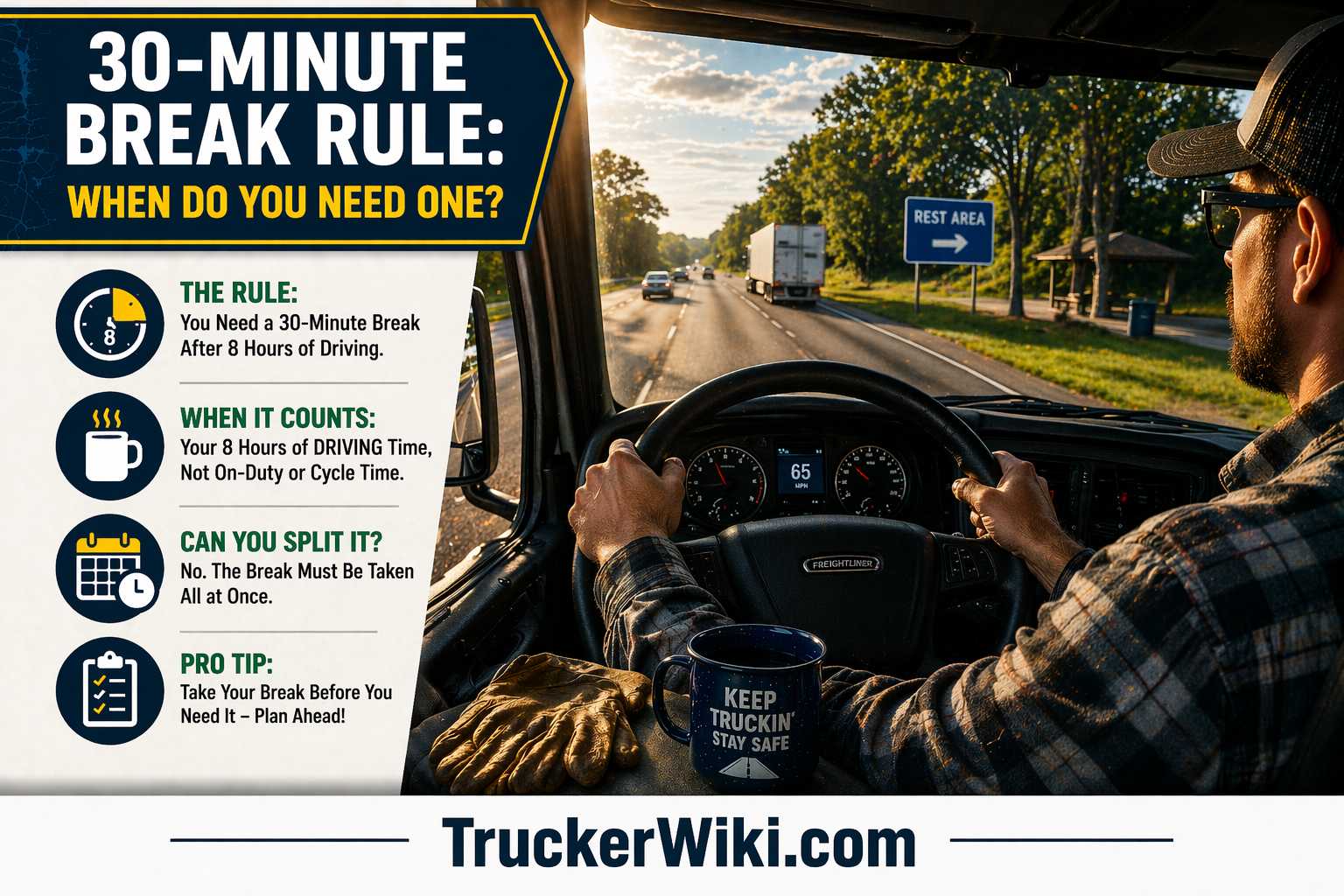
30-Minute Break Rule: When Do You Need One?
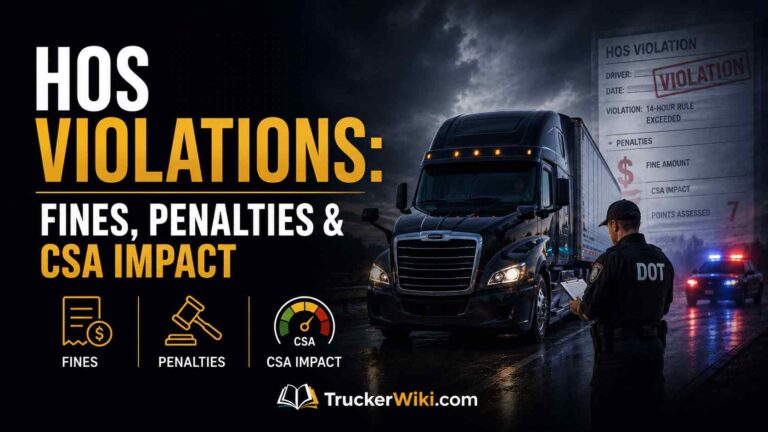
A single missed 30-minute break can cost a property-carrying truck driver approximately $1,307 in federal fines and add 5 points to their CSA score in the Hours of Service BASIC.
Those points remain on a safety record for 24 months and can raise a carrier’s insurance premiums, trigger compliance reviews, and affect load contract eligibility.
This is one of the most consistently cited Hours of Service violations recorded at roadside inspections across the United States.
The rule catches experienced drivers off guard more often than most safety managers expect, largely because the September 2020 HOS revision changed the core measurement without much fanfare.
Before September 29, 2020, the 30-minute break was required after 8 consecutive hours since coming on duty.
Today, the clock runs exclusively on cumulative driving time. A driver can spend two hours loading freight, run a pre-trip inspection, and handle paperwork without the break clock moving at all.
This article explains every operational detail of the current 30-minute break rule: when the 8-hour driving clock starts, when it resets, what qualifies as a valid break, which drivers are fully exempt, and what a violation costs in fines and CSA exposure.
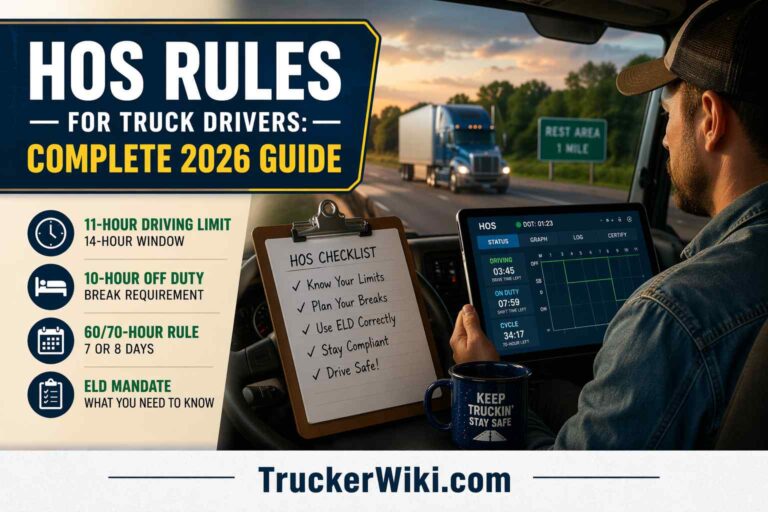
All guidance reflects 49 CFR §395.3 and the current regulatory framework covered in the HOS Rules for Truck Drivers: Complete 2026 Guide.
What the 30-Minute Break Rule Requires in 2026?
The 30-minute break rule for property-carrying drivers is codified at 49 CFR §395.3(a)(3)(ii). It states that a driver may not operate a commercial motor vehicle after accumulating 8 cumulative hours of driving time without first taking a qualifying rest period of at least 30 consecutive minutes.
The requirement applies only to property-carrying CMV drivers subject to standard HOS regulations. Passenger-carrying drivers fall under 49 CFR §395.5, which uses a different rule structure and does not include an equivalent 30-minute break provision.
Team drivers, certain agricultural operations, and exempt commodity haulers may also operate under different conditions.
The Three Numbers That Govern Every Break Decision
Eight hours of cumulative driving is the trigger. Thirty consecutive minutes is the required break length. Zero interruptions are permitted during that 30-minute window, including any recorded driving event.
These three figures determine whether your break legally qualifies or whether you are in violation the moment the vehicle moves again.
How the 2020 HOS Revision Changed the Break Rule?
The FMCSA’s 2020 Final Rule, published in the Federal Register on June 1, 2020 and effective September 29, 2020, made two changes that fundamentally affected how the break requirement works in practice.
First, it shifted the break trigger from 8 consecutive hours since coming on duty to 8 cumulative hours of driving time. Second, it expanded the list of qualifying break types to include on-duty not-driving periods for the first time.
Under the pre-2020 rule, two hours of pre-trip inspection and loading counted against the 8-hour clock before a driver ever left the yard. Under the current rule, that same time is invisible to the break clock.
This is the change that most often catches drivers who are operating on habit rather than updated knowledge of the regulations.
Before and After: What the 2020 Revision Changed
| Rule Element | Before September 29, 2020 | After September 29, 2020 |
|---|---|---|
| Break trigger measurement | 8 consecutive hours since coming on duty | 8 cumulative hours of driving time only |
| Off-duty qualifies as break | Yes | Yes |
| Sleeper berth qualifies as break | Yes | Yes |
| On-duty not-driving qualifies as break | No | Yes (30 or more consecutive minutes) |
| Pre-trip and loading time counted toward break clock | Yes | No |
| Regulatory citation | 49 CFR §395.3 (pre-2020 version) | 49 CFR §395.3(a)(3)(ii) |
What Counts as a Valid 30-Minute Break
A qualifying break must be at least 30 consecutive, uninterrupted minutes in one of three approved duty status types. Any driving event during that window invalidates the entire period, and the cumulative driving clock continues from wherever it was.
This is the most common documentation error flagged by ELD systems during roadside inspections.
The 2020 rule change gave drivers a meaningful operational advantage by allowing on-duty not-driving time to satisfy the requirement.
For drivers who regularly wait at loading docks, shipper facilities, or weigh stations, a properly logged on-duty not-driving period of 30 or more consecutive minutes now resets the break clock without the driver going off duty.
What Qualifies as a Valid Break
- Off-duty for 30 or more consecutive minutes
- Sleeper berth for 30 or more consecutive minutes
- On-duty not-driving for 30 or more consecutive minutes (added by the 2020 HOS revision)
What Does Not Qualify as a Break
- Any period that contains even one minute of recorded driving
- Two or more short stops that together total 30 minutes but are not consecutive within a single duty status period
- A 20-minute fuel stop logged as off-duty, regardless of whether you left the cab
- Sitting in a running vehicle without logging an approved duty status change
- A break that was interrupted by a brief yard move or repositioning maneuver
How the 8-Hour Driving Clock Accumulates and Resets
The break clock is a running total of driving minutes since your last qualifying break or since the start of your shift if no break has been taken.
It advances only when your ELD records active driving. It does not advance during on-duty not-driving, off-duty, or sleeper berth periods, regardless of how short those periods are.
This means multiple short on-duty not-driving periods throughout a shift do not pause or stop the driving clock unless one of them reaches 30 consecutive minutes.
A 15-minute dock wait followed by 10 minutes of paperwork followed by 5 more minutes of on-duty not-driving does not satisfy the rule, even though 30 minutes elapsed across those three periods.
The Relationship Between the Break Rule and the 14-Hour Window
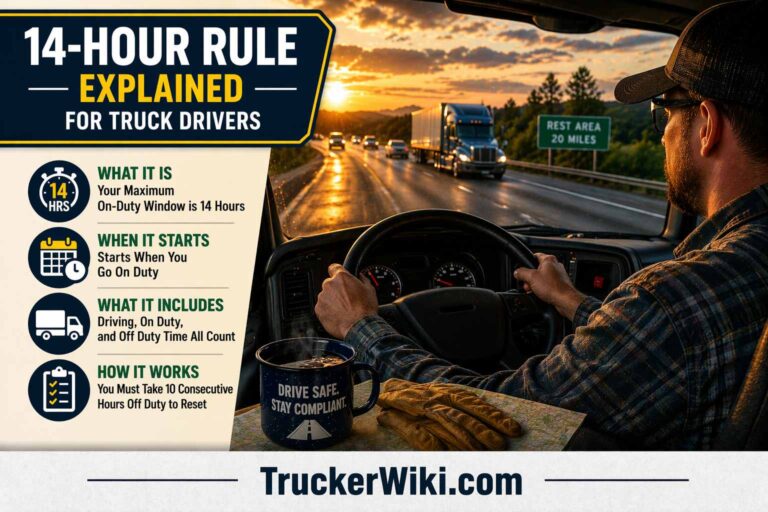
One of the most persistent misconceptions is that taking a 30-minute break pauses your 14-hour driving window. It does not. As explained in the 14-Hour Rule Explained for Truck Drivers, the 14-hour window is a fixed clock that starts when you begin your shift and runs continuously, regardless of break activity.
Taking your 30-minute break satisfies the break requirement but gives you no additional time in your driving day.
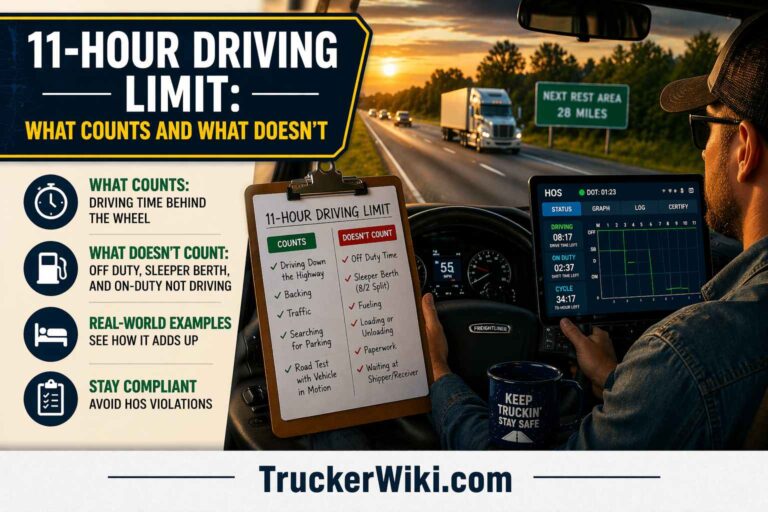
The break also does not add to your available hours under the 11-Hour Driving Limit: What Counts and What Doesn’t. A qualifying 30-minute break resets the break clock only. Your cumulative driving total toward the 11-hour maximum continues to accumulate as normal, and the 14-hour window keeps running.
Who Is Exempt From the 30-Minute Break Rule?
Several driver categories are not required to take the 30-minute break under current FMCSA regulations.
The most widely applicable exemption for property-carrying drivers is the short-haul exemption, which covers both CDL and non-CDL commercial drivers who operate within a defined radius and return to their home terminal within a set time window.
Understanding whether your operation qualifies for an exemption before assuming the rule does not apply is essential. Incorrectly claiming an exemption that does not fit your actual route or schedule carries the same violation consequences as knowingly skipping the break.
CDL Short-Haul Exemption (49 CFR §395.1(e)(1))
CDL short-haul drivers are exempt from the 30-minute break requirement if they operate within a 150 air-mile radius (approximately 172.6 road miles) of their normal reporting location, return to that location within 14 hours, and do not use a sleeper berth.
If any single trip exceeds the 150-air-mile boundary, the exemption is lost for that entire workday, and the full break rule applies retroactively to that shift.
Non-CDL Short-Haul Exemption (49 CFR §395.1(e)(2))
Non-CDL drivers operating within 150 air miles of their home terminal and returning within 12 hours are also exempt from the 30-minute break requirement.
These drivers remain subject to all other applicable HOS limits, including driving time maximums.
The Short-Haul Exemption: Do You Qualify? covers both versions of this exemption in full detail, including edge cases that disqualify drivers mid-shift.
Other Applicable Exemptions
- Agricultural operations during planting and harvest seasons in qualifying states under 49 CFR §395.1(k)
- Livestock and insect haulers under specific agricultural exemption provisions
- Oilfield operations using the 24-hour restart provision
- Emergency relief operations declared under federal or state authority
- Utility service vehicles responding to utility emergencies
Fines, CSA Points, and Out-of-Service Risk for Break Violations
A missed break is not a warning-level infraction at the roadside. The federal civil penalty for failing to take a required 30-minute break is approximately $1,307 per violation under current FMCSA civil penalty guidelines.
Both the driver and the carrier can be cited separately arising from the same inspection event, meaning one missed brake can produce two citations, two sets of CSA points, and two fine amounts.
The CSA point impact extends the consequence beyond the immediate fine. A break violation adds approximately 5 severity points to the HOS BASIC on both the driver’s and carrier’s safety record.
Violations from the most recent six months are weighted more heavily under the FMCSA’s time-based weighting system, but all points remain on record for 24 months and influence insurance calculations and shipper-carrier vetting decisions throughout that period.
Break Violation Fine and CSA Reference Table
| Violation Type | Federal Fine (Per Violation) | CSA Points (HOS BASIC) | Out-of-Service Risk |
|---|---|---|---|
| Missing required 30-minute break entirely | ~$1,307 | ~5 points | Yes, if driving past the 8-hour limit |
| Incomplete break (under 30 consecutive minutes) | ~$1,307 | ~5 points | Possible depending on driving time exceeded |
| ELD documentation error on break status | ~$750 | 1 to 3 points | Low |
| Falsifying log records related to the break | Up to $15,846 | 10 points | High |
| Carrier instructing driver to skip required break | Up to $16,000 | Carrier record impact | N/A (driver vehicle stopped, carrier cited) |
An out-of-service order is issued on the spot when an enforcement officer determines a driver has operated past the 8-hour cumulative driving mark without a qualifying break. The vehicle cannot move until the required 30 minutes are completed at the roadside location.
Combined with the fine, CSA exposure, and potential insurance rate increase, a single missed break is one of the costliest single-line HOS errors a driver can accumulate in a 24-month period. For a complete breakdown of how these violations affect long-term safety scores, see HOS Violations: Fines, Penalties, and CSA Impact.
Two Drivers, Two Different Shifts: Real-World Scenarios
The break rule is best understood through practical application rather than abstract rule text. The two scenarios below walk through realistic shift structures and show exactly when the break is required, how a common mistake happens, and what the outcome looks like when an ELD log is reviewed at a roadside inspection.
Scenario 1: The Dock Wait That Saved the Shift
Driver A starts her shift at 5:00 AM and drives from 5:00 AM to 9:00 AM, accumulating 4 cumulative driving hours. She arrives at a delivery dock at 9:00 AM and logs on-duty, not driving, while she waits for a dock door to open.
The wait runs 45 uninterrupted minutes, which qualifies as a valid break under the current rule and resets her cumulative driving clock to zero at 9:45 AM.
She drives again from 9:45 AM until 5:45 PM, accumulating another 8 hours of driving. Her break clock now reads 8 hours exactly. Before driving a single additional mile, she must take another qualifying 30-minute break.
She has not yet hit her 11-hour driving limit, but the break rule requires a stop regardless of how much driving time remains available. She logs 30 minutes of off-duty at the delivery yard and is fully compliant to continue.
Scenario 2: The Split Stops That Did Not Count
Driver B starts his shift at 6:00 AM. He drives 5 hours to a fuel stop, parks, and logs 15 minutes off-duty. Satisfied that he took a break, he drives another 90 minutes to a second stop and logs another 15 minutes off-duty. He believes his broken clock has been reset twice. It has not been reset even once.
Neither stop was 30 consecutive minutes in a qualifying status, so the cumulative driving clock ran through both stops without interruption. By the time he reaches 8 total driving hours later in the afternoon, he has been in technical violation since the moment he exceeded the threshold.
At the next weigh station, an enforcement officer reviews his ELD log, identifies the continuous driving accumulation without a qualifying break, and issues an out-of-service order along with a $1,307 citation. The two 15-minute breaks counted for nothing under the current rule.
Stay Compliant With the 30-Minute Break Rule
The most reliable compliance step is to treat your ELD’s cumulative driving counter as an active management tool, not just a passive record. Check it at every stop, especially when you are in the middle of a long segment. Do not wait until you are approaching the 8-hour mark to start planning where and when your break will happen.
Use dock time and shipper delays strategically. If you are waiting at a facility for 45 minutes and your break clock sits at 6 hours of driving, log that wait as on-duty, not-driving from the moment you stop. When you leave the dock, your break clock reads zero. That single consistent habit eliminates most break violations before they start and adds no extra time to your delivery window.
- Monitor your ELD’s cumulative driving total actively throughout every shift, not only near the end of a run.
- Log dock waits and extended shipper or receiver delays, as on-duty not-driving to capture the qualifying break time you are already taking.
- Never combine two short stops and assume they count as one qualifying break period.
- Verify your short-haul route stays within 150 air miles before assuming the short-haul exemption applies to your workday.
- Review your ELD duty status log at the end of each shift to identify any documentation gaps before your next dispatch.
- If a dispatcher assigns a load that would push you past 8 hours of driving without a break opportunity, communicate the issue before accepting the dispatch, not after
Carriers and fleet managers share direct responsibility under FMCSA regulations. A carrier that instructs or allows a driver to operate in violation of the break rule can face civil penalties of up to $16,000 per violation.
Drivers who receive pressure to skip required breaks have the right and the federal obligation to refuse. Build break compliance into your dispatch planning the same way you build in fuel stops and delivery windows, because the cost of skipping it far exceeds the cost of scheduling around it.