
14-Hour Rule Explained for Truck Drivers
A single 14-hour rule violation adds 7 CSA severity points to your record under FMCSA’s Hours of Service BASIC, and those points remain active for 24 months. Fines start at approximately $2,500 per citation and can reach $7,500 for repeat violations.
If an officer determines the violation is egregious, meaning you exceeded your allowable driving time by more than 3 hours, the penalty can climb to $16,000 in a single inspection.
The 14-hour rule is one of the most consistently misapplied regulations in commercial trucking, not because it is complicated, but because drivers frequently misidentify when the window actually begins.
Most enforcement cases stem from a driver assuming the clock started when the wheels started rolling.
In reality, the 14-hour window opens the moment you perform any on-duty activity at all, whether that is completing a pre-trip inspection, signing paperwork at a shipper, or fueling the truck before departure.
This article breaks down exactly how the 14-hour rule works under 49 CFR 395.3, what activities count against your window, how the sleeper berth split interacts with it, and which three legal provisions allow you to modify it.
You will also find two real-world driver scenarios that illustrate the most common errors on the road, plus a step-by-step compliance checklist to apply on your next dispatch.
14-Hour Rule Actually Means for Your Workday
The 14-hour rule sets a maximum on-duty window for property-carrying commercial drivers. Once that window opens, you have 14 consecutive hours in which you are permitted to drive a commercial motor vehicle.
After those 14 hours have elapsed, you cannot legally drive again until you have taken a full 10 consecutive hours off duty.
The rule does not cap how long you can remain on duty performing non-driving tasks. You can continue completing paperwork, waiting at a delivery dock, or assisting with unloading past the 14-hour mark. What you cannot do is drive.
Drivers who plan their shift around 14 hours of driving time, rather than 14 hours of available driving opportunity, are the ones most frequently cited at roadside inspections.
When Your 14-Hour Clock Starts and What Triggers It?
The clock begins the instant you go on duty, regardless of whether you are behind the wheel. Under 49 CFR 395.3(a)(2), the 14-hour window is measured from the first moment you come on duty after completing the required 10 consecutive hours off.
A pre-trip inspection at 6:00 AM starts your window at 6:00 AM, and your 14 hours expire at 8:00 PM whether you drove 50 miles or 600.
Activities that open the clock include pre-trip and post-trip inspections, time spent waiting at a shipper or receiver, fueling, loading and unloading assistance, and administrative work such as completing manifests or checking in with dispatch.
Your ELD records every duty status change in real time. A federal officer reviewing your logs during a roadside stop will calculate your 14-hour window from your very first on-duty entry, not from your departure time.
What Counts as On-Duty Time Inside the Window?
On-duty time is defined under 49 CFR 395.2 and covers every minute you are not in a qualifying off-duty or sleeper berth status. Driving time counts against both your 11-hour driving limit and your 14-hour window at the same time.
Non-driving on-duty time, such as waiting at a shipper, fueling, attending a weigh station, or performing inspections, eats into your 14-hour window without touching your driving clock. This is the distinction that causes the most compliance failures.
A driver who spends 3 hours at a loading dock before departure has only 11 hours of usable window remaining, even though their driving log still shows a full 11 hours available.
How the 11-Hour Driving Limit Fits Inside the 14-Hour Window?
The 14-hour rule and the 11-hour driving limit are two separate, overlapping restrictions that operate simultaneously.
The 14-hour window is the outer boundary of your workday, and the 11-hour limit is the ceiling on actual driving time within that boundary. Whichever limit you reach first ends your ability to drive.
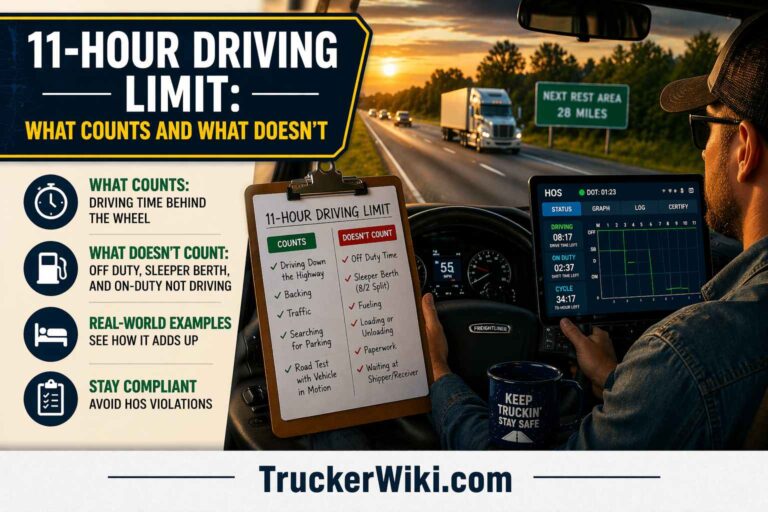
For property-carrying drivers, the maximum driving time within any 14-hour window is 11 hours. Once you reach 11 hours of driving, you must stop even if your 14-hour window has not expired yet.
Before planning your route, understand exactly how the 11-Hour Driving Limit: What Counts and What Doesn’t interact with off-duty periods taken mid-shift, because most short breaks do not pause either clock.
Can You Pause the 14-Hour Clock?
The 14-hour clock generally cannot be paused by taking a rest break during the day. Going off-duty for 2 hours at a truck stop does not add 2 hours to your available window or push back your expiry time. This is a firm rule with very limited exceptions.
The one significant exception is the sleeper berth provision. Under the 7/3 or 8/2 split, the qualifying rest period spent in the sleeper berth effectively pauses the 14-hour window.
The smaller portion of the split (either 3 hours or 2 hours, depending on which combination you use) does not count against your on-duty window. Mastering the Sleeper Berth Rule: 7/3 and 8/2 Split Explained is essential for any driver running multi-day long-haul routes.
Off-Duty Breaks Do Not Extend Your Window
Some drivers assume that taking off-duty time mid-shift adds equivalent time back to their 14-hour clock. This is incorrect. Off-duty time taken during the window does not pause or extend it.
Your 14-hour expiry is fixed from your first on-duty entry, and the only way to reset it is a full 10 consecutive hours off duty.
The 30-Minute Break and Your Available Window
Short breaks matter for a separate HOS rule, not for pausing the 14-hour window. Property-carrying drivers who have accumulated 8 hours of driving without at least a 30-minute off-duty or sleeper berth break must take that break before driving further.
Reviewing the 30-Minute Break Rule: When Do You Need One? will clarify exactly when this applies to your daily schedule and how it relates to your remaining window.
Three Legal Ways to Modify the 14-Hour Window
The FMCSA provides three legal provisions that can change how the 14-hour rule applies to specific drivers or circumstances. Knowing all three gives you real operational flexibility while keeping you fully compliant.
The Sleeper Berth Split Provision
Long-haul drivers operating a sleeper berth-equipped vehicle can split their required off-duty time across two separate rest periods. The most common configurations are 7 hours in the sleeper berth plus 3 hours off duty, or 8 hours in the sleeper berth plus 2 hours off duty.
The qualifying longer period effectively pauses your 14-hour window, allowing you to stretch your usable workday across a longer span without a full 10-hour reset.
Both periods must total at least 10 hours combined, and neither period alone resets the 11-hour or 14-hour clocks. When the two periods are paired together, both clocks are fully reset. This provision is especially valuable on team driving operations and overnight freight lanes.
The Short-Haul Exemption
Drivers who operate within a 150 air-mile radius of their normal work reporting location and return to that location at the end of each shift qualify for the short-haul exemption.
The 2020 FMCSA HOS Final Rule expanded this radius from 100 to 150 air miles, making the exemption accessible to a significantly broader range of regional and local operations.
Qualifying drivers are exempt from both the 14-hour rule and ELD requirements, and may use a paper timecard instead.
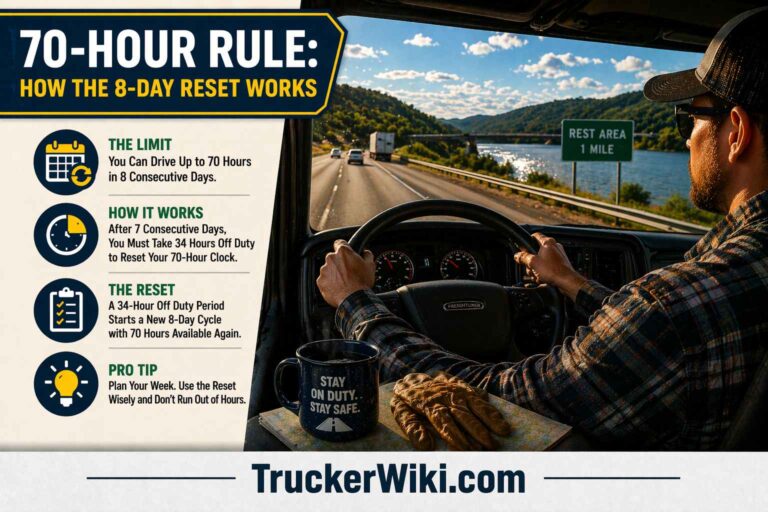
You must still comply with your carrier’s internal shift policies and the 60/70-hour weekly limits even if you qualify for short-haul status.
Check whether your routes and reporting practices meet every condition by reviewing Short-Haul Exemption: Do You Qualify? before relying on this provision.
The Adverse Driving Conditions Exception
When a driver encounters genuinely unforeseeable hazardous conditions after departing, such as a sudden severe snowstorm, an unexpected road closure, or a major accident blocking the route, the adverse driving conditions exception permits up to 2 additional hours of driving.
This expands both the 14-hour window to 16 hours and the driving limit to 13 hours.
The exception applies strictly to conditions that were not known and could not reasonably have been anticipated before the trip began.
Foreseeable conditions such as rush-hour congestion, predicted weather events, or regular seasonal road conditions do not qualify.
Drivers who invoke this exception without meeting the standard risk a violation more serious than the one they were trying to avoid.
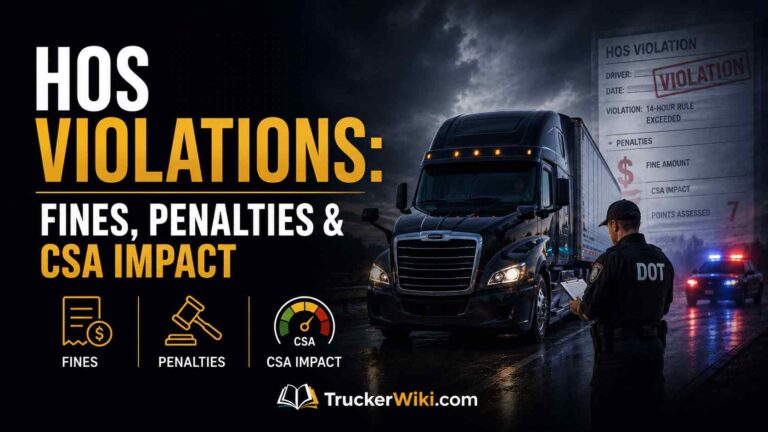
14-Hour Rule Violations: Fines, CSA Points, and Carrier Consequences
A 14-hour violation found during a roadside inspection or post-crash audit carries immediate financial and safety record consequences.
FMCSA civil penalty guidelines set the starting fine at approximately $2,500 per citation, rising to $7,500 for repeat violations within the same inspection period.
Egregious violations, where driving time exceeded the legal limit by 3 or more hours, can result in penalties reaching $16,000 in a single enforcement action.
| Violation Type | CSA Severity Weight | Fine Range | Out-of-Service Risk |
|---|---|---|---|
| Driving beyond the 14-hour window | 7 points | $2,500 to $7,500 | Yes |
| Driving beyond the 11-hour driving limit | 7 points | $2,500 to $7,500 | Yes |
| Egregious HOS violation (3+ hours over limit) | Up to 10 points | Up to $16,000 | Yes |
| Falsification of HOS records or ELD tampering | 10 points | Up to $16,000 | Yes |
| Operating without a required ELD | 5 points | $1,000 to $10,000 | Possible |
Beyond fines, a 14-hour violation logs 7 CSA severity points under the Hours of Service Compliance BASIC, and those points remain active on your record for 24 months.
Carriers with deteriorating HOS BASIC scores face increased roadside inspection frequency, FMCSA intervention letters, and potential insurance premium increases.
For a complete breakdown of how points accumulate and what thresholds trigger carrier intervention, see HOS Violations: Fines, Penalties and CSA Impact.
Out-of-Service Orders at the Roadside
A driver found to be currently in violation of the 14-hour rule during an inspection can be placed out of service on the spot. The truck cannot move until the driver completes the required off-duty time at that location.
Out-of-service orders are recorded permanently in the FMCSA inspection database and appear on PSP (Pre-Employment Screening Program) reports reviewed by future employers.
Two Real-World Scenarios That Catch Drivers Off Guard
Even experienced drivers run into 14-hour problems because real dispatching rarely follows a clean schedule. The two scenarios below represent the most common patterns that result in violations during roadside inspections.
Scenario One: The Long Loading Dock Wait
A driver arrives at a shipper at 7:00 AM and goes on duty to complete the pre-trip inspection.
The dock is backed up, and the driver does not depart until 11:00 AM, after 4 hours of on-duty non-driving time. The driver assumes they have a full productive day ahead and targets a 480-mile run to the delivery point.
By 9:00 PM, the driver has been on duty for 14 hours and is approximately 90 miles short of the delivery. The 14-hour window has closed.
Even though the driver has only logged 9 hours of actual driving time, they cannot move the truck until they have taken 10 consecutive hours off duty.
The dock delay consumed 4 hours of the available window that never appeared on the driving log, and was never factored into the route plan.
Scenario Two: The Mid-Shift Rest That Changes Nothing
A driver starts their shift at 5:00 AM, drives for 6 hours, then takes a 2-hour break in the sleeper berth at a rest area. The driver resumes at 1:00 PM, assuming the rest refreshed their available window.
Their 14-hour clock, however, started at 5:00 AM and expires at 7:00 PM regardless of what happened in between.
By 7:00 PM, the driver has only accumulated 8 hours of driving, but their window is gone. Unless the first rest period was structured as the qualifying portion of a valid 7/3 or 8/2 sleeper berth split, the 2-hour break changed nothing about the 14-hour expiry.
This misunderstanding is among the most frequently cited HOS violations during inspections, particularly among drivers transitioning from local to long-haul operations.
How to Stay Compliant with the 14-Hour Rule Starting Today
Compliance begins before the truck moves. At the start of each shift, record your on-duty time the moment your feet hit the ground for the pre-trip inspection, then calculate your exact 14-hour expiry and write it somewhere visible.
Do not wait until your ELD alert fires to start thinking about where you will park.
- Build known dock time into your route plan before departing, not after arriving at the receiver
- Communicate realistic delivery windows to your dispatcher based on your actual remaining window, not total shift hours
- Set ELD alerts at 2 hours and 1 hour before your 14-hour expiry, so you have time to find legal parking
- If you run sleeper berth operations, structure your rest periods to qualify for the 7/3 or 8/2 split and confirm both periods are logged correctly
- Review your short-haul eligibility if you consistently operate within a regional radius and return to your home terminal daily
- After any inspection or near-miss, pull your ELD report and identify the specific activity that triggered your on-duty start time
Finding a safe parking spot 30 minutes before your window closes is an inconvenience. An out-of-service order, a $2,500 fine, and 7 points on your CSA record are consequences that follow you for two years.
Treat your 14-hour window as a countdown timer that starts ticking the moment you touch anything on that truck.



[…] driving after the 14-hour window expires. Unlike the 11-hour limit, the 14-hour on-duty window produces an OOS condition the moment […]