11-Hour Driving Limit: What Counts and What Doesn’t
A single violation of the 11-hour driving limit adds 7 CSA points to your HOS Compliance BASIC score, can trigger an out-of-service order that grounds you on the spot, and carries civil penalties starting around $3,000 for a first offense.
Yet thousands of drivers rack up these violations not because they ignore the rule, but because they misunderstand what legally counts as driving time in the first place.
FMCSA enforcement data shows that hours-of-service violations account for a significant share of all driver-related roadside citations, and the 11-hour cap sits at the center of that compliance problem.
The confusion is understandable. Not every minute you spend behind the wheel counts against the 11 hours, and not every type of work you do off the road pauses the clock. Yard moves, personal conveyance, sleeper berth splits, and adverse driving conditions all interact with the 11-hour limit in ways that your ELD will not always explain on its own.
This guide breaks down the legal definition of driving time under 49 CFR 395.2, walks through every category of time that counts toward the 11-hour cap and every category that does not, and explains what happens when you cross the line.
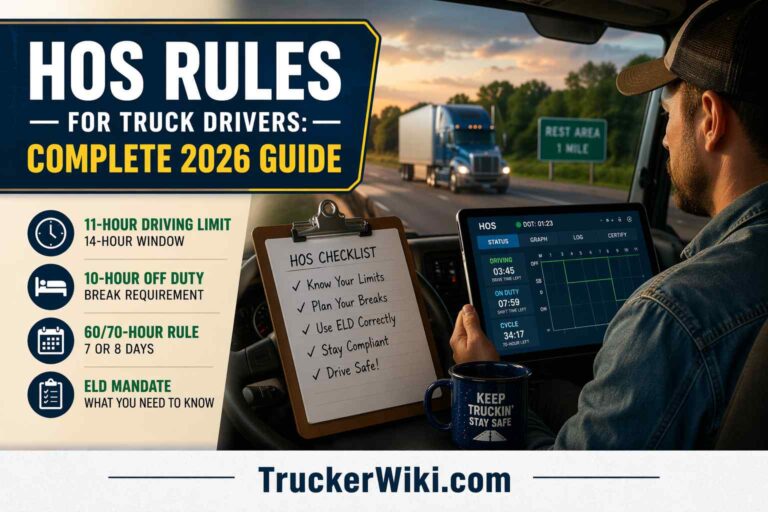
Before reading further, it helps to understand how the 11-hour rule fits into the full picture covered in the HOS Rules for Truck Drivers Guide.
The Legal Foundation of the 11-Hour Driving Limit
FMCSA codifies the 11-hour driving limit for property-carrying commercial motor vehicles in 49 CFR 395.3(a)(3)(i). Under that section, a driver may drive a total of 11 hours during the 14-hour on-duty period that begins the moment the driver first comes on duty after at least 10 consecutive hours off duty.
The 11-hour cap does not stand alone. It links directly to the 14-hour on-duty window, the 30-minute break requirement after 8 hours of cumulative driving, and the 60/70-hour weekly limits. Violating the 11-hour rule almost always means at least one other HOS rule is also under pressure, which is why enforcement officials treat it seriously.
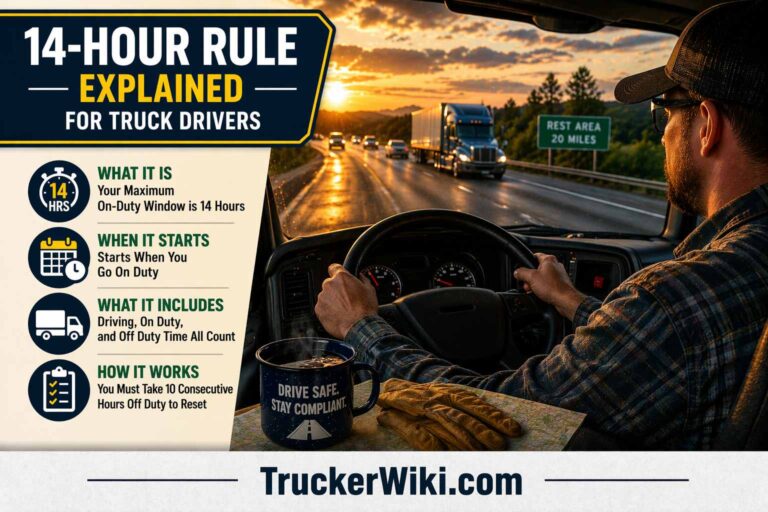
The relationship between the 11-hour limit and the 14-Hour Rule Explained for Truck Drivers is something every driver needs to understand before going on the road.
What “Driving Time” Actually Means Under 49 CFR 395.2
The term “driving time” has a specific legal definition under federal regulations that is broader than most drivers assume. FMCSA defines driving time as all time spent at the driving controls of a commercial motor vehicle in operation. The word “operation” is key here.
If you are seated at the controls and the vehicle is moving for any commercial purpose, that time is driving time. It does not matter whether the truck is loaded or empty, whether you are on an interstate or a private facility road, or whether you are heading to your first pickup or returning to the terminal at the end of the day.
The only exceptions are specific ELD-logged categories like yard moves and personal conveyance, which are covered in detail below.
On-duty time is the larger category. It includes driving time plus all other work activities such as pre-trip inspections, fueling, loading, unloading, and any waiting period where the carrier requires you to remain on site.
Only driving time counts against the 11-hour cap. But on-duty, non-driving time still eats into your 14-hour window, which indirectly limits how many of those 11 driving hours you can actually use on a given day.
What Counts Toward Your 11-Hour Driving Limit?
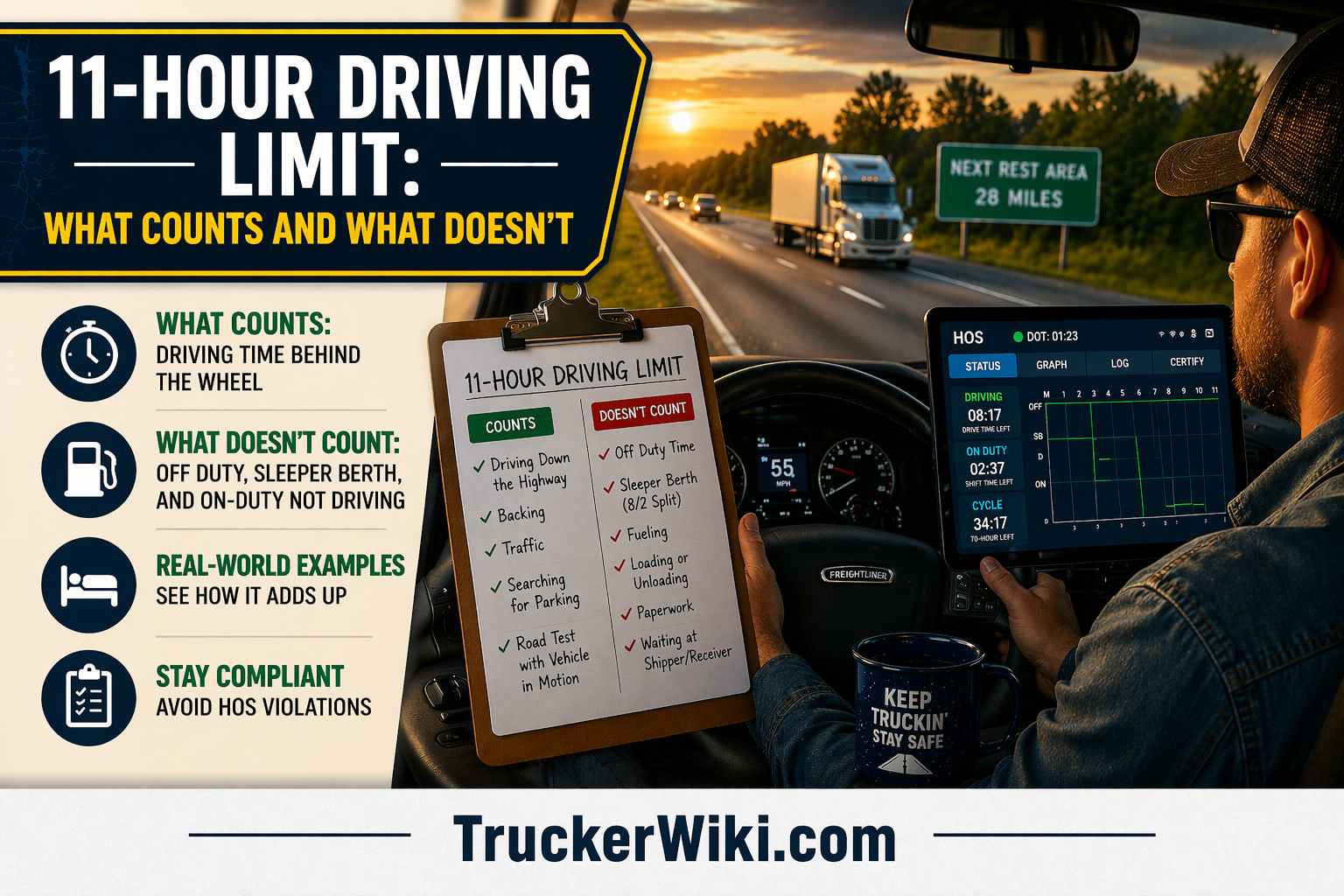
Any time you drive a CMV on a public road for the commercial benefit of your motor carrier counts toward the 11 hours, period. This includes loaded runs, empty repositioning moves, deadhead miles, and driving between terminals or facilities.
It applies whether your carrier is a for-hire carrier, a private fleet, or an owner-operator running under your own authority.
The loaded-versus-empty distinction is one of the most common misconceptions in trucking. Many drivers believe that deadheading does not count against the 11 hours because they are not hauling freight. That is incorrect.
If you are driving a CMV on behalf of the motor carrier, the time is driving time regardless of whether there is a load in the trailer.
Driving on Private Property Without a Special ELD Category
Driving on private property such as customer yards, plant roads, or staging areas also counts as driving time if the vehicle is in motion and you are at the controls for the carrier’s business purposes. The property being privately owned does not change your HOS status unless you correctly log the movement as a yard move in your ELD.
If your ELD is still showing a “driving” status while you move around a customer’s lot, every minute of that movement accumulates against your 11-hour limit. This is a common source of unintentional violations at shipper and receiver locations, particularly during long wait times where a driver may move the truck several times before finally getting a dock.
Driving Under the Adverse Driving Conditions Exception
The adverse driving conditions exception under 49 CFR 395.1(b) allows drivers who encounter unexpected hazardous conditions to extend the daily driving limit from 11 hours up to 13 hours. That additional driving time still counts as driving time toward the expanded cap. It is not a free pass to ignore the clock entirely.
All driving done under this exception must be documented. If the extension is used properly and the conditions qualify, up to 13 total hours of driving is legal. But all 13 hours still accumulate as driving time, and any driving beyond 13 hours would be a violation even under the exception.
The adverse driving conditions exception also extends the 14-hour window to 16 hours, which gives drivers more flexibility but does not change the fundamental counting of driving time.
Off-Duty Time and Sleeper Berth Time
Any period properly logged as off duty or sleeper berth does not count toward the 11-hour driving limit. These periods are completely separate from driving time and do not accumulate hours against the cap. However, they must genuinely meet the FMCSA’s criteria to qualify.
Off-duty status requires that you be fully relieved of all work responsibilities and free to pursue personal activities. Sleeper berth time must be spent in a DOT-compliant sleeper compartment.
If either condition is not met, enforcement officials can reclassify that time as on-duty, which shrinks your available driving hours for the day and could push you into a violation.
On-Duty, Not-Driving Time
Work activities that do not involve operating the vehicle are logged as on-duty, not-driving (ODND) time. Pre-trip and post-trip inspections, fueling, loading, unloading, paperwork, safety meetings, and carrier-required wait time all fall into this category. None of this time counts against the 11-hour driving cap.
This does not mean ODND time is harmless. Every minute logged as on duty counts against your 14-hour driving window and your 60/70-hour weekly cycle. A driver who spends three hours waiting at a shipper before the day really begins has already shortened the time available within the 14-hour window, which makes reaching the full 11 hours of driving increasingly difficult as the day goes on.
Yard Moves Logged Correctly in an ELD
FMCSA permits ELDs to use a special driving category for yard moves, which are defined as low-speed vehicle movements within a controlled, on-premises environment such as a terminal, distribution center, or shipper yard. When correctly logged as a yard move, the time is classified as on-duty, not-driving rather than driving time.
Because yard move time is on-duty rather than driving, it does not count against the 11-hour driving limit. It does count against the 14-hour window and the weekly cycle limits. The critical point is that the yard move status must be used correctly.
If a driver uses yard move status while traveling on a public road or driving at highway speeds, enforcement officials can reclassify the entire segment as driving time and add it to the 11-hour total.
Personal Conveyance Logged Off-Duty
Personal conveyance is the movement of a CMV for personal reasons while the driver is off duty and fully relieved from all work obligations.
Common examples include driving from a shipper’s location to the nearest truck stop after being released from duty, or moving the truck from a rest area to a restaurant nearby for a meal.
When it qualifies, this time is logged as off-duty and does not count against the 11-hour driving limit or the 14-hour window.
The key phrase is “for personal reasons.” If the movement serves any commercial purpose for the motor carrier, including repositioning the truck for the next day’s load, driving to a receiver to stage for early morning delivery, or any move directed by dispatch, it is not personal conveyance.
FMCSA guidance is clear that personal conveyance must be entirely disconnected from the carrier’s commercial interests. Misusing personal conveyance is a 7-point CSA violation on its own (code 395.8E1PC) and can result in reclassification of multiple hours as driving time in a single inspection.
How Yard Moves and Personal Conveyance Are Treated Differently?
Yard moves and personal conveyance are both ELD special categories that allow certain vehicle movement to avoid counting as driving time. But they are governed by different rules and used in different situations.
Understanding the distinction protects you from violations that come specifically from misusing these categories.
| Category | HOS Status | Counts Against 11 Hours? | Counts Against 14-Hour Window? | Valid Use Case | Common Misuse |
|---|---|---|---|---|---|
| Yard Move | On-duty, not driving | No | Yes | Moving trailer at a terminal or shipper yard at low speed | Using it while driving on a public road or at highway speed |
| Personal Conveyance | Off-duty | No | No | Driving to the nearest safe parking after being released from duty | Driving to a shipper or receiver to stage for the next load |
| Regular Driving | Driving | Yes | Yes | All commercial road driving for the carrier | N/A |
| On-Duty, Not Driving | On-duty | No | Yes | Inspections, loading, fueling, paperwork, carrier-required waiting | Using it to avoid logging actual driving time |
The enforcement risk with both categories is the same: inspectors can and do review ELD records in detail.
If the GPS data shows highway-speed travel during a yard move segment, or if a personal conveyance movement ends at a shipper address rather than a rest location, the inspector can reclassify the time.
That reclassification can instantly push a driver over the 11-hour limit even if the ELD showed full compliance at the time of the stop.
The Standard 10-Hour Off-Duty Reset
The most straightforward way to reset your 11-hour driving limit is to take 10 consecutive hours off duty.
Once those 10 hours are complete, both the 11-hour driving cap and the 14-hour on-duty window reset fully. The 10 hours can be taken entirely as off-duty time, entirely in the sleeper berth, or as a combination of both, as long as the block is fully consecutive.
This reset applies every day. There is no limit on how many times you can use the standard 10-hour reset. It is the foundation of daily HOS compliance for property-carrying drivers operating on a regular cycle.
The Split Sleeper Berth Option and How It Affects Your 11 Hours
The 2020 HOS revisions gave property-carrying drivers the ability to split their required 10 hours of off-duty time into two qualifying segments.
This is the sleeper berth split, and it is frequently misunderstood in relation to the 11-hour cap. For a full breakdown of how this works, the Sleeper Berth Rule: 7/3 and 8/2 Split Explained article covers every scenario in detail.
Under the split sleeper berth rule, one period must be at least 7 consecutive hours in the sleeper berth, and the other must be at least 2 consecutive hours either off duty, in the sleeper berth, or a combination of both. Together the two periods must total at least 10 hours. When both qualifying periods are paired, neither counts against the 14-hour driving window.
Here is the critical point for the 11-hour limit: the 11-hour cap still applies in total across both driving segments combined. If you drive 6 hours before your first qualifying rest and 5 hours after your second qualifying rest, you have used exactly 11 hours and remain compliant.
If you drive 7 hours before and 5 hours after, you have a violation regardless of how the sleeper berth split was structured. The split does not give you extra driving hours. It only gives you scheduling flexibility.
The 34-Hour Restart and Weekly Cycle
The 34-hour restart allows drivers to reset their 60/7 or 70/8 weekly on-duty cycle by taking 34 or more consecutive hours off duty. Once the restart is complete, the driver begins the new weekly cycle with a full slate of available hours.
The daily 11-hour driving limit also resets as part of this because the driver must take at least 10 consecutive hours off duty within the 34-hour period before driving again.
FMCSA removed the older requirement that the 34-hour restart include two specific 1:00 a.m. to 5:00 a.m. periods. Any 34 consecutive hours off duty, including time logged as off-duty personal conveyance, now qualifies. This gives drivers and carriers more flexibility in planning long resets without being tied to specific nighttime windows.
Exceptions That Can Modify the 11-Hour Limit
The adverse driving conditions exception under 49 CFR 395.1(b) is the only federal rule that directly increases the 11-hour driving cap for property-carrying drivers.
When a driver encounters unexpected hazardous conditions after a trip has already begun, and those conditions were not foreseeable at the start of the duty period, the driver may drive up to 2 additional hours to reach a safe stopping point or complete the run.
This extends the daily cap from 11 hours to a maximum of 13 hours of driving, and extends the 14-hour window to 16 hours by the same margin.
The conditions must be genuine and unforeseeable. Normal rush-hour traffic, common winter weather in a region where it is expected, or delays caused by normal construction do not qualify.
Using this exception requires documentation in the driver’s log explaining why the adverse conditions were unforeseeable and how much additional time was used.
Short-Haul Exception: What It Does and Does Not Change
The short-haul exception under 49 CFR 395.1(e) is one of the most misunderstood rules in trucking. Many drivers operating locally believe the short-haul exception frees them from the 11-hour cap. It does not.
For CDL drivers operating within a 150 air-mile radius and returning to the home terminal within 14 hours, the exception eliminates the need to maintain a Record of Duty Status (RODS) and removes the 30-minute break requirement.
The 11-hour driving limit remains fully intact. If you want to understand the full criteria for qualifying, the Short-Haul Exemption: Do You Qualify? article lays out every condition in plain terms.
Agricultural operations covered by the exemption in 49 CFR 395.1(k) can be exempt from HOS rules entirely during state-defined planting and harvesting seasons, as long as the driver is operating within 150 air miles of the source of the commodity.
During the exempt portion of the trip, the 11-hour driving limit does not apply. Once the driver travels outside the exempt radius or the season ends, normal HOS rules resume and all driving must be tracked accordingly.
Emergency Conditions
Under 49 CFR 395.1(b)(2), a driver may complete a run that could have been finished within normal HOS limits if not for a genuine emergency, without being held in violation.
This applies to real emergencies such as a sudden road closure or catastrophic event, not to business pressures from dispatchers or customers.
Emergency exceptions are rare in standard enforcement and are typically associated with official federal or state emergency declarations. They are not a routine tool and should not be treated as one.
11-Hour Violations: Fines, CSA Points, and Out-of-Service Risk
When an officer cites you for violating the 11-hour driving limit at a roadside inspection, the violation is recorded under the HOS Compliance BASIC in the CSA scoring system.
The violation codes most directly tied to the 11-hour cap carry a severity weight of 7 points out of a possible 10. These violations include 395.3A1R (11-hour rule violation, property) and 395.3A3-PROP (driving beyond the 11-hour driving limit, property-carrying vehicle).
CSA points are then multiplied by a time weight based on how recently the violation occurred. A violation in the last 6 months carries a time weight of 3, meaning 7 severity points become an effective 21-point contribution to your carrier’s HOS Compliance BASIC score.
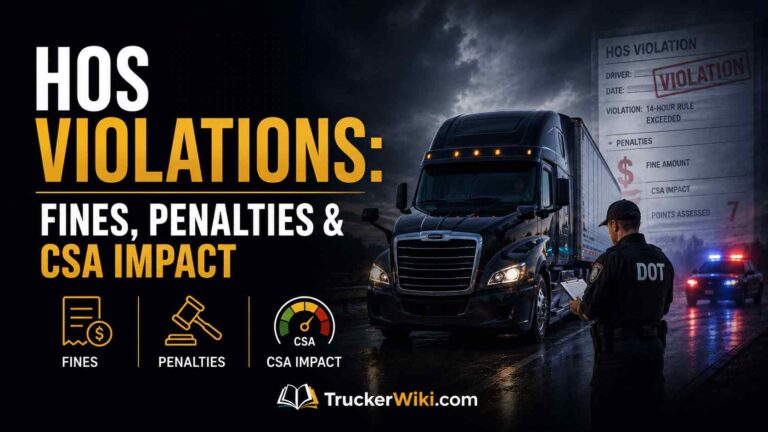
Violations between 7 and 12 months old carry a time weight of 2, and violations between 12 and 24 months old carry a time weight of 1. After 24 months, violations drop off the record entirely. For a full breakdown of how these violations affect your carrier’s rating and your personal record, review HOS Violations: Fines, Penalties and CSA Impact.
The most severe HOS-related CSA violation carries 10 points and is reserved for driving after being declared out-of-service for an HOS violation (code 395.13(d)). If a driver is placed OOS and gets back behind the wheel anyway, the consequences are severe at every level.
Civil Penalty Structure
- Standard first-offense 11-hour violation: approximately $3,000 in civil penalties
- Repeat violations showing a pattern of non-compliance: up to $15,876 per violation
- Egregious violations (driving more than 3 hours beyond the 11-hour cap): fines up to $16,000 and up to 10 CSA points rather than the standard 7
- Systematic carrier-level violations with documented patterns: penalties up to $30,000 or more
- Carrier permitting an out-of-service driver to operate: up to $23,647 per instance
- Driver violating an active OOS order: up to $2,364 per instance
- Log falsification tied to HOS violations: civil penalties up to approximately $15,846, with potential for separate criminal proceedings in intentional cases
FMCSA adjusts these penalty amounts annually for inflation. The figures above reflect current enforcement guidance as of 2025 and early 2026. Actual penalties in a specific case depend on the severity, the carrier’s prior compliance history, and whether the violation is classified as egregious.
Out-of-Service Criteria
Not every 11-hour violation results in an OOS order, but the risk is real. Under the Commercial Vehicle Safety Alliance (CVSA) out-of-service criteria, a driver can be placed OOS for driving beyond the 11-hour limit when the violation is determined to be critical in terms of remaining hours versus hours already used. An OOS order means the driver cannot move the truck until the required off-duty reset is complete. For a driver mid-route, that is an immediate and costly disruption.
Insurance carriers monitor CSA scores as part of their underwriting process. Industry data shows that carriers with significant HOS violations face premium increases of 20% to 40%, and those increased rates typically remain in effect for 3 to 5 years following the violations. The downstream cost of a single serious violation goes well beyond the initial fine.
Real-World Scenarios: Where Drivers Get It Wrong
Scenario 1: The Shipper Delay That Eats Your Day
A flatbed driver signs in at 6:00 a.m. and is immediately placed in a wait queue at the shipper’s facility. By the time the truck is loaded and the driver clears the gate, it is 9:30 a.m. That 3.5 hours was logged as on-duty, not driving. The driver now has a 14-hour window that runs out at 8:00 p.m., but only 10.5 hours remain in that window.
The driver begins driving at 9:30 a.m. and feels fine all afternoon. By 7:00 p.m., the driver has been behind the wheel for 9.5 hours of driving time and is 90 miles from the delivery. The dispatcher calls and says the receiver is open until 9:00 p.m. and the load needs to be there tonight.
The driver does the math and believes 11 hours of driving is still possible because it does not feel like 11 hours have passed. But the 14-hour window closes at 8:00 p.m., and driving past that point would be a 14-hour violation regardless of remaining driving time.
The 11-hour cap and the 14-hour window are two separate limits, and both must be respected simultaneously. Driving past 8:00 p.m. is a violation even though the driver has not yet hit 11 hours.
Scenario 2: The Yard Move That Becomes a Violation
A refrigerated carrier driver arrives at a large distribution center after 10 hours of driving. The facility has an extensive internal road network and requires drivers to move their trucks through three separate staging areas before reaching the dock. The driver switches the ELD to yard move status and moves through the facility. So far, so good.
After unloading, the driver is told to move the empty trailer to an off-site drop yard two miles down a public highway. The driver, still in yard move status, drives those two miles on a public road at 45 mph and parks the trailer.
An inspector later reviews the ELD records and finds that the GPS data shows two miles of public highway travel at highway speeds logged under yard move status. The inspector reclassifies that segment as driving time. Combined with the 10 hours of earlier driving, the driver is now at 10 hours and 8 minutes of driving time.
The driver is still under 11 hours, but the ELD record is now flagged for inconsistency between the GPS data and the logged status, which triggers a deeper review of the full day’s log. The lesson: yard move status ends the moment you leave private property.
How to Stay Compliant With the 11-Hour Rule Every Day?
The most reliable compliance approach is to treat your ELD as a decision-support tool, not just a recordkeeping device. Check your available driving hours before accepting a load, not after you are already on the road.
Communicate your actual available hours to dispatch at the start of every shift so load assignments reflect reality.
Before each shift, confirm the following:
- You have taken at least 10 consecutive hours off duty since your last driving period
- Your ELD is showing the correct starting status and the clock is synced correctly
- Your dispatcher knows your actual available driving hours for the day, accounting for any expected non-driving on-duty time at the pickup
- Any yard move or personal conveyance use is genuinely appropriate for the situation and supported by the facts of where and how you are moving the vehicle
- If adverse driving conditions develop mid-trip, you document the reason in your log immediately rather than after the fact
Dispatcher pressure is one of the leading real-world causes of 11-hour violations. Federal law is clear that both the driver and the carrier are responsible for compliance. A carrier that knowingly dispatches a driver who does not have sufficient hours available faces penalties up to $23,647 per incident.
That does not make the pressure disappear, but it does mean the carrier has legal skin in the game. If you are being asked to run a load you do not have hours for, that request is not just a compliance problem for you. It is a liability for the carrier as well.
Keep your pre-trip and post-trip inspections efficient and logged accurately. Every minute of on-duty, non-driving time recorded correctly is a minute that does not create confusion later during an inspection.
A clean, accurate ELD record is your first line of defense at a weigh station and your strongest protection if a violation is ever disputed. Review your logs at the end of every shift, correct any minor errors while the details are still fresh, and flag any day where you came close to the limits so you can plan your next duty period accordingly.