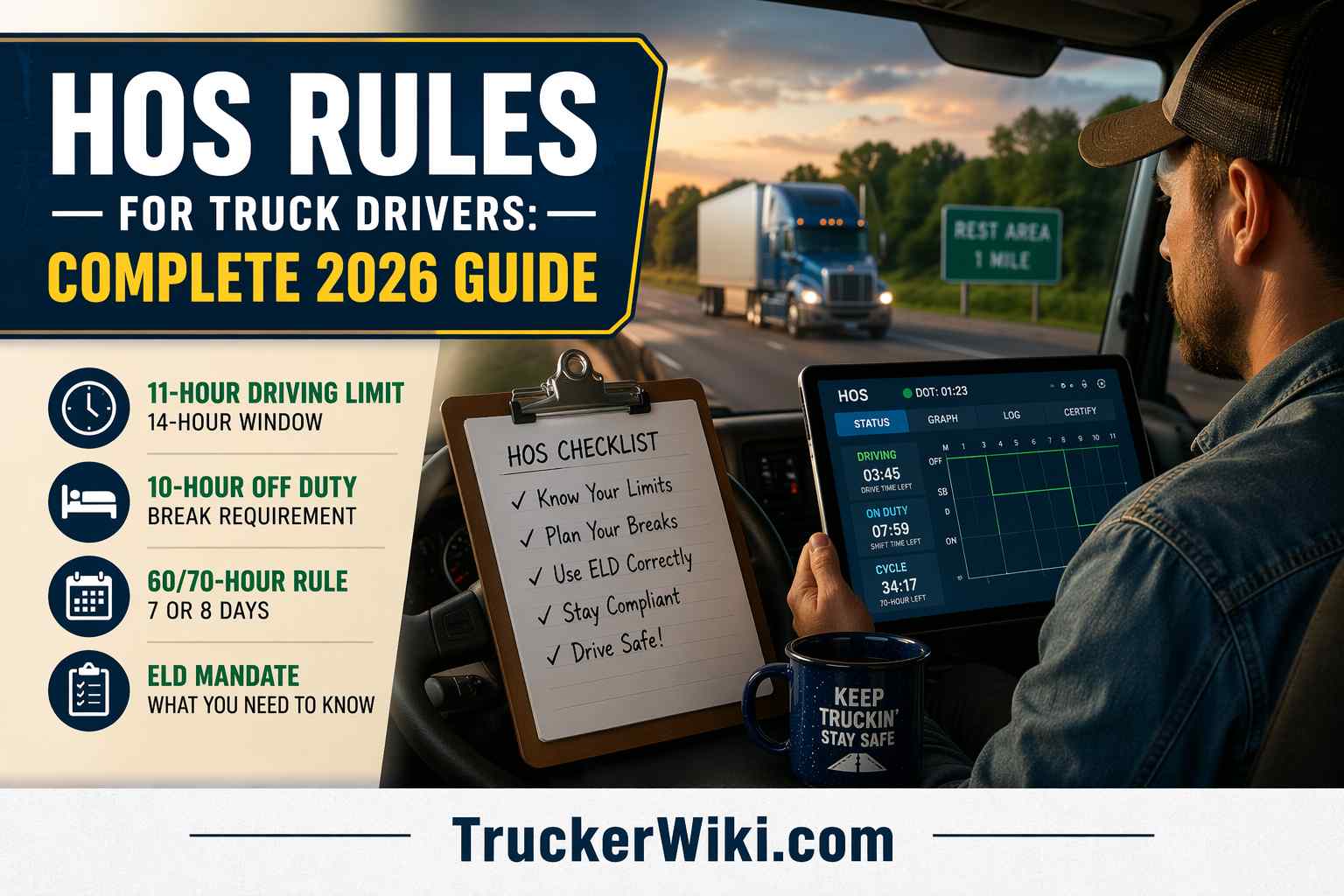
HOS Rules for Truck Drivers: Complete 2026 Guide
In the 2024 International Roadcheck, enforcement officers conducted nearly 49,000 inspections across North America and found that hours-of-service violations were the single biggest reason drivers were placed out of service, accounting for roughly 32 percent of all driver out-of-service violations recorded that week.
That number is not a fluke or an outlier. It reflects a persistent enforcement reality that plays out at weigh stations and roadside checkpoints every single day of the year.
The stakes extend well beyond a single roadside stop. FMCSA records more than one million driver violations and over 200,000 driver out-of-service orders in a typical year, and HOS-related violations consistently rank among the most serious categories on that list.
For carriers, repeated violations feed into Compliance, Safety, Accountability scores, trigger federal audits, and in serious cases can threaten operating authority. For drivers, a documented pattern of violations can make it difficult to insure and difficult to place with reputable carriers.
This guide covers every layer of the current HOS framework for property-carrying CMV drivers.
You will find the five core daily limits, the weekly hour caps, sleeper berth split options, major exemptions, ELD requirements, the latest enforcement data, and the FMCSA pilot programs launching in 2026 that could change how the 14-hour clock works in the future.
Whether you are a driver tracking your available hours, a dispatcher building schedules, or a safety manager updating company policy, this guide gives you the complete and current picture.
Why HOS Rules Exist and Who Must Comply?
Hours-of-service regulations exist because driver fatigue kills people on American roads at a measurable and preventable rate.
FMCSA’s Large Truck Crash Causation Study found that fatigue was a contributing factor for approximately 13 percent of CMV drivers involved in serious crashes, and broader analyses of heavy truck crash data place the fatigue-involvement range between 13 and 40 percent, depending on methodology.
These numbers justify treating HOS compliance as a core safety control rather than an administrative formality. The rules are issued by FMCSA under 49 CFR Part 395 and apply to drivers operating commercial motor vehicles in interstate commerce.
A vehicle meets the federal CMV threshold for HOS purposes if it weighs 10,001 pounds or more (actual weight or gross vehicle weight rating), is designed to transport 16 or more passengers not for compensation, is designed for 9 or more passengers for compensation, or transports hazardous materials in a quantity requiring placards.
Intrastate carriers follow state-level HOS rules that closely mirror federal standards in most cases, but state-specific differences do exist,t and operators must verify requirements with their specific state.
Certain operations, including some local, agricultural, and emergency relief movements, qualify for full or partial exemptions that are covered in detail later in this guide. If you operate in interstate commerce and your vehicle meets the CMV definition above, federal HOS rules apply to you.
The Five Core HOS Limits Every Property Driver Must Know
Five interlinked limits control when you can drive, for how long, and when you must stop. Violating any one of them during a roadside inspection is enough to put you out of service on the spot.
10 Consecutive Hours Off Duty Before Driving
Before starting any driving shift, you must first complete 10 consecutive hours off duty. That period can be taken at home, in a hotel, in your sleeper berth, or in any combination of those settings as long as the full 10 hours are uninterrupted. Until that block is complete, you cannot legally place a CMV in motion.
The 14-Hour Driving Window
The moment you come on duty after 10 consecutive hours off, a 14-hour clock begins running. You may not drive a CMV after the 14th consecutive hour from that point, regardless of how many actual driving hours you have used.
Meal stops, fuel breaks, and shipper wait times do not pause or extend this window under the current permanent rules. For a precise walkthrough of how the window works in practice, review 14-Hour Rule Explained for Truck Drivers.
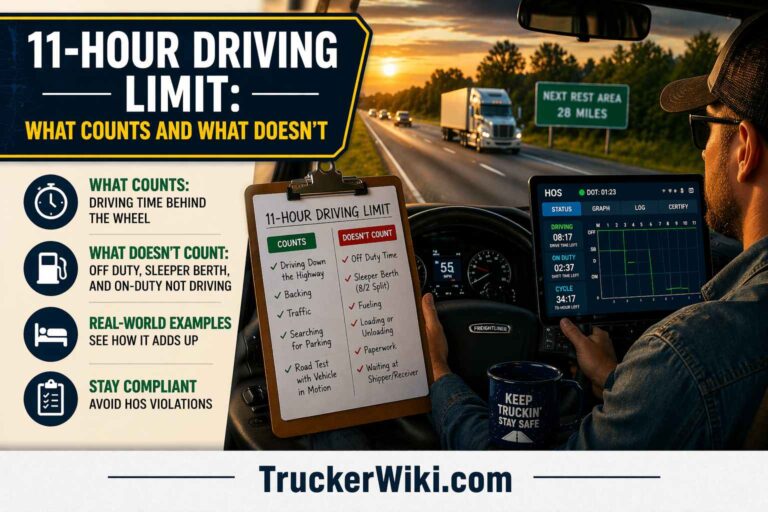
The 11-Hour Driving Limit
Within your 14-hour window, you may drive a maximum of 11 hours. Once you accumulate 11 hours of actual driving time since your last qualifying rest period, you must stop driving even if your 14-hour window has not yet closed.
For a detailed breakdown of what counts toward the 11-hour total and what does not, see 11-Hour Driving Limit: What Counts and What Doesn’t.
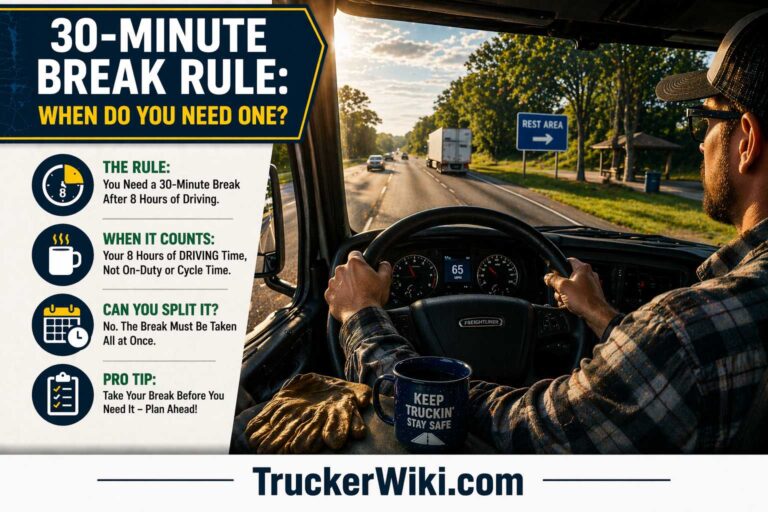
The 30-Minute Break After 8 Hours of Driving
After 8 cumulative hours of driving time, you must take a break of at least 30 consecutive minutes before driving again. The 2020 HOS final rule changed how this break is measured so that the 8-hour trigger is based on driving time rather than total on-duty time, which gives drivers more scheduling flexibility.
The break can be satisfied with off-duty time, sleeper berth time, on-duty not-driving time, or any consecutive combination of those statuses. For the full rules on when this break applies and when you are exempt, see 30-Minute Break Rule: When Do You Need One?
Core HOS Limits for Property-Carrying Drivers
| HOS Rule | Limit | How It Resets | Important Note |
|---|---|---|---|
| Off duty before driving | 10 consecutive hours minimum | Required before every new driving shift | Can include sleeper berth time |
| 14-hour driving window | No driving after hour 14 on duty | New 10-hour off-duty period required | Breaks during the day do not stop this clock |
| 11-hour driving limit | Maximum 11 hours of actual driving | New 10-hour off-duty period required | Measures driving time only, not on-duty time |
| 30-minute break | Required after 8 hours of driving | 30 consecutive minutes off driving | Short-haul exempt drivers are excluded |
| 60/70-hour weekly cap | 60 hrs in 7 days or 70 hrs in 8 days | 34-hour consecutive off-duty restart | Carrier selects the applicable cycle |
The 60/70-Hour Weekly Limit and the 34-Hour Restart
Beyond the daily limits, HOS rules impose a rolling weekly cap on total on-duty hours. Carriers that do not operate CMVs every day of the week apply a 60-hour limit over any 7 consecutive days.
Carriers that operate CMVs every day of the week apply a 70-hour limit over any 8 consecutive days. Once you reach your carrier’s applicable cap, you cannot drive until your rolling total drops below the limit, or you complete a valid 34-hour restart.
The 34-hour restart allows you to reset your entire 7-day or 8-day on-duty total to zero by taking 34 or more consecutive hours off duty. An important change from earlier versions of the rule: there is no longer any requirement that those 34 hours include two separate periods between 1 a.m. and 5 a.m.
Any continuous 34-hour off-duty period now qualifies without restriction. For a complete walkthrough of how to calculate your running total and plan restarts around a typical weekly schedule, see 70-Hour Rule: How the 8-Day Reset Works.
Practical scenario: You are on a 70-hour/8-day cycl,e and you finish Friday evening with 68 hours accumulated over the past 8 days. You have only 2 hours of on-duty time remaining before hitting the cap, which is not enough to accept the Saturday morning load your dispatcher is offering.
You take the full weekend off, accumulate your 34 consecutive hours by Sunday morning, and start Monday with your counter reset to zero. That restart lets you run a full, productive week without restriction and without any pressure to push the rules.
Sleeper Berth Splits: How the 7/3 and 8/2 Options Work
Drivers with sleeper berths do not always need to take a single uninterrupted 10-hour block. The 2020 HOS final rule updated the split sleeper berth provision to give long-haul and team drivers more flexibility in how they structure rest. Under current rules, you can satisfy the 10-hour off-duty requirement by combining two separate rest periods that meet specific minimums.
The first period must be at least 7 consecutive hours in the sleeper berth. The second period must be at least 2 consecutive hours and can be spent off duty, in the sleeper berth, or in any combination of those two statuses.
Together, the two periods must total at least 10 hours. The most common configurations are a 7/3 split or an 8/2 split, though any arrangement meeting the 7-plus-2 minimums is valid.
The critical advantage of a properly structured split is that neither qualifying period counts against your 14-hour driving window. This means a driver waiting several hours at a shipper or consignee can take a sleeper berth break, preserve the remaining portion of their 14-hour window, and continue the trip legally without losing usable driving time to the clock.
Misapplying this provision is one of the most common logging errors that enforcement officers identify at the roadside. For a full breakdown of how to log each split configuration correctly, see Sleeper Berth Rule: 7/3 and 8/2 Split Explained.
HOS Exemptions That Add Real Flexibility

CDL Short-Haul Exception
The 2020 HOS rule significantly expanded the CDL short-haul exception, making it available to a broader range of local and regional drivers than at any point in the rule’s history.
Under 49 CFR 395.1(e)(1), a property-carrying driver qualifies if they operate within a 150 air-mile radius of their normal work reporting location, start and end each shift at that same location, and do not exceed a 14-hour duty period.
Before the 2020 rule took effect, the radius was limited to 100 air miles, and the maximum duty period was capped at 12 hours.
Drivers who qualify under the short-haul exception are exempt from keeping a Record of Duty Status and from the 30-minute break requirement. Carriers must still maintain time records showing start time, end time, and total hours worked for each qualifying day.
The exception cannot be used on days when a driver starts or ends at a different location, exceeds the radius, or works beyond 14 hours.
Adverse Driving Conditions Exception
When drivers encounter conditions that were not known and could not reasonably have been known at the time of dispatch, the adverse conditions exception permits an extension of up to 2 additional hours of driving time and up to 2 additional hours on the 14-hour window.
For property drivers, this pushes the maximum driving limit to 13 hours and the on-duty window accordingly. Valid scenarios include sudden road closures, unforecast severe weather, and major unexpected traffic incidents. Routine rush-hour delays and poor load planning do not qualify.
Agricultural Exemption
Drivers transporting agricultural commodities or farm supplies during state-defined planting and harvesting seasons are fully exempt from Part 395 while operating within a 150 air-mile radius of the commodity’s source.
Within that radius, there are no HOS limits and no ELD or RODS requirement, though all other FMCSA safety rules remain in effect. The moment a driver crosses beyond the 150 air-mile boundary, standard HOS limits apply immediately for the remainder of that trip.
Emergency Relief Exemption
Under 49 CFR 390.23, drivers providing direct assistance during a federally declared emergency can be temporarily exempt from some or all HOS regulations for the duration of the active declaration.
FMCSA issues and updates these declarations in response to specific events, and the scope of each exemption varies. Carriers must verify that a specific movement is covered under a current, active declaration before treating HOS rules as suspended.
Personal Conveyance: What It Covers and What It Does Not
Personal conveyance is an FMCSA guidance concept, not a codified regulation, that allows a driver to operate a CMV in off-duty status for personal use when completely relieved of all work responsibility.
FMCSA’s 2018 guidance confirmed that personal conveyance is permitted even with a laden trailer, as long as the movement provides no commercial benefit to the carrier. Common legitimate uses include driving between a truck stop and a restaurant, traveling between a driver’s home and their normal work reporting location, and moving a CMV to the nearest safe parking after exhausting available hours at a customer location.
The boundary between appropriate and inappropriate personal conveyance is where many drivers and carriers make costly mistakes. Moving a loaded trailer closer to the next morning’s delivery point to preserve a time advantage for the carrier is not personal conveyance.
Driving to a maintenance facility, repositioning equipment at the carrier’s request, or traveling to the next day’s pickup location all fall outside the permissible use. FMCSA has made clear that drivers who run out of hours at a shipper or receiver may drive to the nearest safe parking, but no further under personal conveyance.
On an ELD, carriers can enable or disable a dedicated personal conveyance driving status. When enabled, location recording shifts to a 10-mile precision radius rather than 1-mile, while off-duty time continues to accumulate normally.
Misuse of the personal conveyance status is treated by enforcement officers as log falsification, which carries serious penalties, including potential out-of-service orders and negative CSA score impacts.
Carriers should establish a written policy defining exactly when personal conveyance is and is not permitted, and should train dispatchers not to instruct drivers to use it as a workaround for running overtime.
ELD and Logging Requirements in 2026
FMCSA’s Electronic Logging Device mandate requires most CMV drivers who must keep Records of Duty Status to use a certified ELD rather than paper logs.
The mandate applies to most interstate CMV drivers operating property-carrying and passenger-carrying vehicles, and it extends to Canada-domiciled and Mexico-domiciled drivers operating within the United States.
ELDs automatically record driving time, engine hours, vehicle miles, date, time, and location, synchronizing that data with driver logs in real time.
Several categories of drivers are exempt from the ELD requirement. Drivers who use paper RODS for 8 days or fewer in any rolling 30-day period do not need an ELD. Drivers operating CMVs manufactured before model year 2000 are exempt.
Drivers qualifying for the CDL short-haul exception within 150 air miles and 14 hours are also exempt because they do not have to keep RODS at all. Drive-away and tow-away operations that meet specific FMCSA criteria qualify for exemption as well.
Carriers must retain RODS and all supporting documents, including fuel receipts, bills of lading, toll records, and payroll data, for a minimum of six months, and those records must be available during FMCSA audits.
Beyond basic compliance, carriers that review ELD data proactively can identify patterns of chronic near-violations, recurring detention delays, and drivers who consistently approach maximum hours.
Addressing those patterns through route adjustments, shipper negotiations, and targeted coaching reduces both violations and fatigue risk at the same time.
What the 2024 Enforcement Data Reveals About HOS Risk?
The 2024 International Roadcheck made the enforcement picture unmistakably clear. Inspectors conducted nearly 49,000 inspections across North America during that three-day enforcement campaign.
Approximately 9,345 vehicle combinations were placed out of service, producing a vehicle out-of-service rate of about 23 percent. Approximately 2,290 drivers were placed out of service, producing a driver out-of-service rate of approximately 4.8 percent.
Hours-of-service violations were the top driver out-of-service category, representing roughly 32 percent of all driver OOS violations recorded that week. This is not an anomaly specific to one enforcement event.
Separate FMCSA annual data show more than one million driver violations and over 200,000 driver out-of-service orders in a typical year, with HOS-related offenses consistently among the most serious categories on record.
The Commercial Vehicle Safety Alliance updates its North American Standard Out-of-Service Criteria annually, and the 2025 edition, effective April 1, 2025, continues to list specific HOS violations as automatic out-of-service triggers, including driving beyond maximum permitted hours and log falsification.
Practical scenario: A driver finishes 11 hours of driving and then accepts a short additional run from the dispatcher, reasoning that a few extra miles poses minimal risk. An officer conducts a Level 1 inspection at a weigh station 40 miles down the road, pulls up the ELD data, and immediately places the driver out of service for exceeding the driving limit.
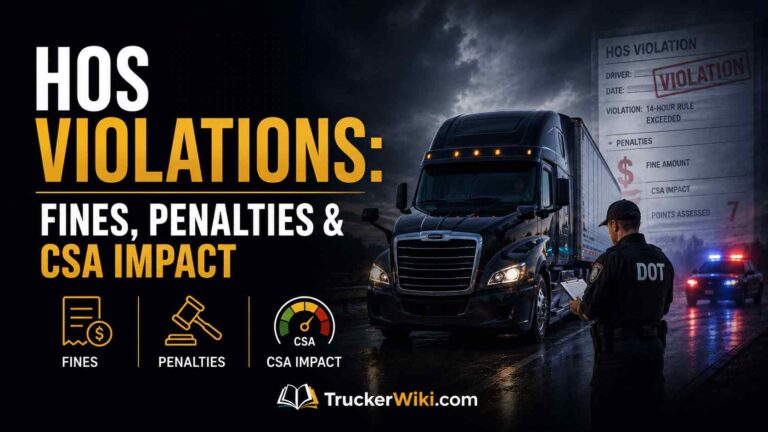
The carrier receives a violation on its CSA record, the driver loses the remainder of that day’s income, and the load sits on the dock. To understand exactly how violations like this compound into CSA score damage and trigger financial penalties, review HOS Violations: Fines, Penalties, and CSA Impact.
FMCSA audits increasingly use ELD data alongside supporting documents to identify systematic patterns of noncompliance. Carriers that show a history of log falsification or that have documented instances of pressuring drivers to violate HOS rules face not just civil penalties but the possibility of a downgraded safety rating.
An “acute” or “critical” violation finding in a compliance review can trigger mandatory corrective action plans and, in extreme cases, orders to cease operations entirely.
FMCSA’s 2026 Pilot Programs: What Could Change

FMCSA is recruiting a limited number of drivers for two structured pilot programs in 2026 designed to evaluate whether additional HOS flexibility can maintain or improve safety outcomes.
The two concepts under active study are the Flexible Sleeper Berth and the Split Duty Period. These are research programs operating under controlled conditions,s and they do not change the current rules for any driver not formally enrolled in a pilot.
Pausing the 14-Hour Clock
The most significant concept being tested is whether drivers should be allowed to pause their 14-hour driving window with an off-duty or sleeper berth break of up to 3 hours. Under current permanent rules, the 14-hour clock runs continuously from the moment a driver comes on duty and cannot be stopped by any break, meal stop, or customer wait time.
The pilot would allow an enrolled driver to take an extra rest period, for example, please 2 to 3 hours off duty at a receiver, and then resume the remaining portion of their 14-hour window rather than losing that time permanently to the running clock.
If pilot data supports this change, it could meaningfully reduce pressure on drivers to rush through pickups and deliveries to preserve their remaining hours.
Long detention times at shippers and receivers are among the most consistently cited triggers for HOS violations in practice, and the clock pause concept addresses that problem directly.
No timeline for potential rulemaking has been announced. Until a final rule is published, the pause option carries no legal standing for drivers outside the pilot program.
Alternative Sleeper Berth Splits
The 2026 pilot also tests sleeper berth configurations beyond the current 7/3 and 8/2 options, including 6/4 and 5/5 splits.
Some researchers and drivers believe these configurations may align better with natural sleep patterns and allow more flexible trip planning on certain route types.
As with the clock pause concept, these splits exist strictly in a research context in 2026 and carry no legal standing under the permanent HOS regulations currently in force.
Carriers should monitor FMCSA announcements regarding pilot results and any proposed rulemakings that follow. Eligible carriers should consider applying to participate so the industry’s operating experience shapes the eventual rule.
For non-participating drivers, the existing rules described throughout this guide are the only rules that apply, and training materials should not suggest otherwise.
How to Stay Compliant Starting Today?
The single most effective action a driver can take right now is to verify that every duty status entry in their ELD accurately reflects actual activity, every day.
Log falsification is not just a regulatory violation. It is one of the fastest paths to a CSA record that disqualifies you from loads, makes you difficult to insure, and ends careers.
If your carrier is pressuring you to misrepresent hours, that pressure itself is a regulatory issue that FMCSA auditors specifically look for during compliance reviews.
Safety managers and dispatchers should audit a representative sample of driver logs every week, cross-referencing ELD records against fuel receipts, toll records, and delivery confirmation timestamps.
Discrepancies caught internally can be addressed and corrected before they become formal violations. Discrepancies found by a federal auditor during a compliance review become part of the carrier’s permanent safety record.
For trip planning, every load should be built with realistic buffers for loading, unloading, traffic, and parking time before a driver is ever dispatched. The most common cause of HOS violations is not driver carelessness but dispatch schedules that are structurally impossible to complete within legal hours.
If a run cannot be done within available hours without breaking the rules, the answer is to split it across two days, not to hope for favorable enforcement conditions along the route.
- Confirm your ELD appears on the current FMCSA-certified ELD list and has not been decertified.
- Know your carrier’s cycle choice (60/7 or 70/8) and check your rolling on-duty total every morning before dispatch.
- Review the short-haul exemption criteria on days when you start and end at the same location within 150 air miles.
- Understand exactly which sleeper berth split configuration you are logging before you begin the first rest period. od
- Read your carrier’s personal conveyance policy in writing and confirm with your safety manager before using that status
- Record detention time accurately and consistently so your carrier has documented data to use in shipper negotiations
- If you are operating in or near a declared emergency area, confirm the specific exemption language with your safety manager before assuming HOS rules are suspended.
The rules described in this guide represent the full legal framework in force as of 2026. The pilot programs may eventually reshape parts of that framework, but they do not affect your compliance obligations today.
Carriers and drivers that invest in accurate logging, realistic scheduling, and consistent training will be better positioned to adapt when new rules take effect and better protected in any enforcement action in the meantime.